
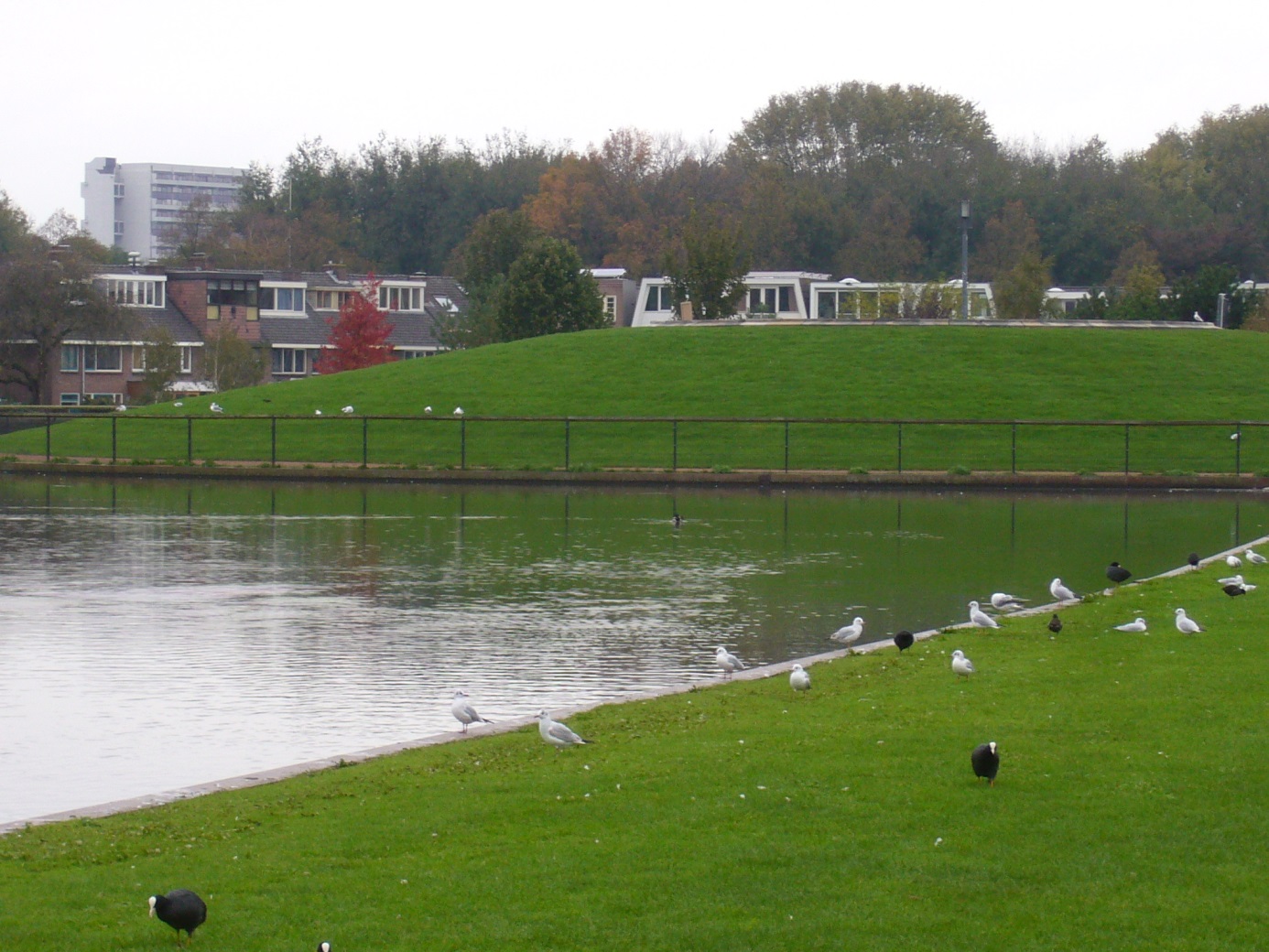
On the eastside of Utrecht, there is a large area with a lake, a playground, trees, statues, an animal farm. It’s a very enjoyable place for all kinds of people and activities. Yet, only 60 years ago, it was the largest dangerous waste dump in The Netherlands. The story illustrates nicely the interaction over time of profitable business, environmental pollution, city council deliberations, local action groups and innovative restoration.
It all started around 1855 when an entrepreneur asked permission from the municipality to start a factory that would convert coal (?) to town gas and some other products. By 1900, a factory… With the advent of electricity and cheap oil, gas-from-coal had no future anymore. The factory closed down in 1960. Various development plans were proposed, but in 1978 the plan of the local citizen groups was adopted: affordable housing, sports accommodation and gardens for ‘wild’ plants and flowers. Soon after the start, the dream of a buurtpark was cruelly disturbed by the discovery serious soil contamination. In 1983 a cleaning operation started: 65.000 ton of contaminated soil were to be transported to a nearby treatment plant, at an estimated cost of 13 million guilders. In 1990, measurements of the Chemiewinkel of Utrecht University indicated much more serious contamination than previously thought, with tar, phenols, pac’s, cyanides and other pollutants. The laying-out of gardens was immediately stopped and years of measurements, digging and experimenting started. The Griftpark, as it was called, became an experimental garden for Dutch soil sanitation policy, with consultants coming and going. In the summer of 1980, it became clear that the pollution with carcinogenic substances in dangerously high concentrations, until 35 m deep in the soil and 50 m in the groundwater, demanded immediate closure of the 14.000 m2 large park.
Because of the depth of the pollutants, the first cost estimates were in the order of 1000 million guilders. This was, in view of the discovery in the 1970s and 1980s of hundreds of seriously polluted sites, considered too expensive. Government and municipality opted for isolating the polluted soil within a the core area and clean the soil outside this area, at an estimated 300 million guilders. This operation took 18 years, from 1980 to 1998, and costed 250 million guilders. Much was learned about the technical and the socio-psychological aspects of such a venture and the Griftpark became the kernel for Dutch soil restoration policy.
Isolating the pollutants has done with 60 m deep sheets of a clay-like, concrete-reinforced material (bentonite), over a total length of 1200 m. A gravel layer of 20 cm and another layer of on average 1,5 m soil have been put on top, in order to prevent contact between people and pollutants and water movements. Such a cover is also put on the small mountain in the middle of the park, called the Accuberg because it contains battery waste and other rubbish. The inside of the resulting huge dam-wall has to be drained permanently. At 60 m depth, a natural layer of clay impedes inflow of groundwater. This is done with three pumps creating a permanent under pressure that prevent polluted water from flowing out – but it also causes groundwater to trickle in despite the containment and get contaminated. The pumping, at a rate of 12 to 15 m3 per hour, has to continue forever and the pumps have to be replaced every four years – the cost are an estimated 70 million guilders in total. The pumped-up groundwater is piped to a water treatment plant where the toxic carbohydrates and cyanides are sufficiently broken down by bacteria to be discharged.
The story of this old gas factory shows how the fulfillment of basic needs, such as for lighting and cooking, entrepreneurial aspirations, technical progress in combination with unanticipated and undesirable side-effects, notably chemical pollution, and community involvement make up a complex history. What once looked as industrial prosperity changed into a pollution nightmare, which in turn became one of the most visited parks in Utrecht. The old river Biltsche Grift, with a new bed and waterproof borders, is now part of the ecochain of the Utrecht canals and the river Vecht: from toxic waste dump to ecosystem service. Advanced methods to locate pollution suggest that a more refined cleaning process using bacteria may make it possible to remove pollutants in a very focused way: from eternal pumping to biological restoration.
Main source: Alleen schoon is mooi – De geschiedenis van het Griftpark. Buiter, Jansonius, Van Santen en Volkers. Stokerkade 2009.
Leave A Comment