
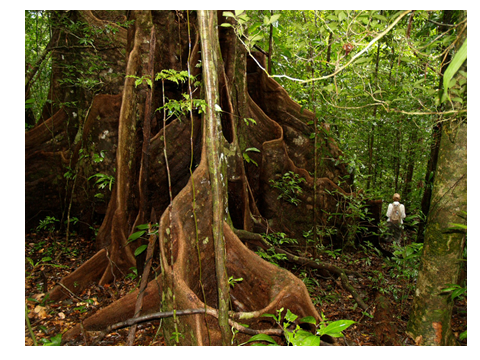
The Trésor Foundation was founded in 1995 by enthusiastic and committed individuals at the University of Utrecht, the Dutch, French and U.S. branches of the World Wildlife Fund (WWF) and the Dutch business community. The Foundation’s mission is: to conserve biodiversity and develop sustainable land use in a way that is equally beneficial to all the parties directly and indirectly involved, by means of cooperation, consultation and local participation. The Foundation bought 2,600 hectare (ha) of rainforest from the French-Guianese diocese in the northeast of French-Guiana and later expanded with another 1,400 ha. The university made an assessment of the area’s carbon storage capacity, which motivated companies to participate with an investment to compensate part of their carbon emissions and as a way of branding.
A ‘commercial’ nature reserve was born with three objectives. The first one is protection of the biological diversity and the existing ecosystems in and nearby the park. The second one is stimulation and support of scientific research in tropical systems. The third one is providing botanic and environmental education by starting or contributing to educational programmes for schools and visitors of the Trésor Reserve. The park management is done by a voluntary local board (Association Trésor) with three full-time employees at their service. Because the park is being granted an official national park status (Réserve Naturelle Regionale) as a token of social appreciation, their salaries are now paid for by the regional government.
Some original fundraising methods were created to finance the park and the activities. A rainforest adoption system was created that makes it possible for private contributors to adopt square meters of the reserve for a certain amount of money and a certificate in return. In this way, donating money becomes a more personal affair, even though the certificate gives no further rights to its owner, and the management of the reserve can remain simple. Compensating for greenhouse gas emissions is another way of fundraising. Several university departments compensate their CO2-emissions from flight trips with donations to the Trésor Foundation. For the future, management seeks to facilitate corporate research for bioprospecting, as relevant knowledge of the area can significantly reduce a company’s investment costs prior to the research. In return, an agreement will be made to finance further development of the area.
The project has large positive effects for the people in the area and as a result receives much local support. The area gains much (inter)national interest and a local ecotourism industry is developing. Investments create revenues and employment for the local population. One example is the production of durable wooden signposts for alongside the walking trails: The company that was asked to make them now also provides them to other reserves across the continent. It illustrates the positive link between local economic growth and nature preservation when park management involves the local population. The neighbouring, and twenty-five times larger, Kaw-Roura Reserve now also obtained official protected status, as a result of the example set by Trésor.
The project illustrates what can be achieved by a number of committed and knowledgeable individuals and by collaboration between local communities, environmentalists, governments, science and business. The central message is that in order to accomplish your objectives, intensive, innovative and adaptable management is a must. Poverty alleviation and education play a central role and respect for the local situation is key because no two forests and no two cultures of the people that inhabit them are alike. For the Foundation itself, after fifteen years the future perspectives are upscaling the reserve and disseminating knowledge to serve the general cause of nature conservation.
See www.stichtingtresor.org for more information.
Leave A Comment