

The aspiration of Sustainable Development (SD) is associated with well-being for life on Earth and in the long term (de Vries 2023). It is often narrowed down to human happiness, in which the long term is only involved inasfar as people’s well-being is influenced by expectations and emotions about the longer term prospects for themselves, their kin and the larger world. This, the quest for SD overlaps with the investigations of the circumstances and cause of human happiness.
Many attempts are made to catch happiness in terms of ‘objective’ indicators such as income, health and others, both at the individual and the collective level (de Vries 2023). Alongside is the experiential, subjective approach to happiness, in which people are asked directly whether they are happy and content with their life or not – the Subjective Well-Being (SWB) approach (Veenhoven 2012). Happiness is then described as ‘the subjective enjoyment of one’s life as-a-whole’. This and other research shows for the USA and the UK that the fraction of happy people did hardly change over the last half century despite a 3-fold increase in income. Hence, income does contribute to happiness, but at a declining rate for every Euro added. The scientific literature does suggest at least seven factors that really matter for an individual’s experience of ‘being happy’: family ties, financial situation, work, social environment, health, personal freedom and philosophy of life, in order of importance (Layard 2005). Income plays herein a partial and indirect role. It should be added that this finding may be valid for people in European and American society only and even there it may change due to for instance a growing number of immigrants.
Recently I participated in an webinar on Insights from psychological science for Zen philosophy, by Dr. Mattheis van Leeuwen of the Netherlands Institute for Personal Development (www.nipo.org). This has given interesting additional insights, as it adds semi-empirical findings from psychology and introspection (associated with a B2-worldview) to the common modern-materialist approaches (associated with A1-A2 worldview). See also https://www.sustainabilityscience.eu/what-are-needs/ .
A first question. What does (neuro)science say about the first of the four Noble Truths in Buddhism: life is suffering (or dukkha: not being at ease, a sense of friction, standing unstable)? It raisese the question: what is human well-being and what drives us to realize it? A widespread concept of human well-being is Maslow’s hierarchy of needs (Figure 1a). It is idealistic, with physiological needs at the bottom and self-actualization at the top – and it is subjective and not empirically rooted. One of the critical comments is that self-realization is not a fundamental drive; instead, self-actualization is a feeling that is the result of a satisfactory and meaningful life. Indeed, in 2010 Kendrick et al. gave a reinterpretation of the Maslow pyramid, in which not self-actualization but Mate Acquisition, Mate Retention and at the top Parenting are at the top (Figure 1b). It seems more grounded in (biological-empirical) reality – without reproduction no survival.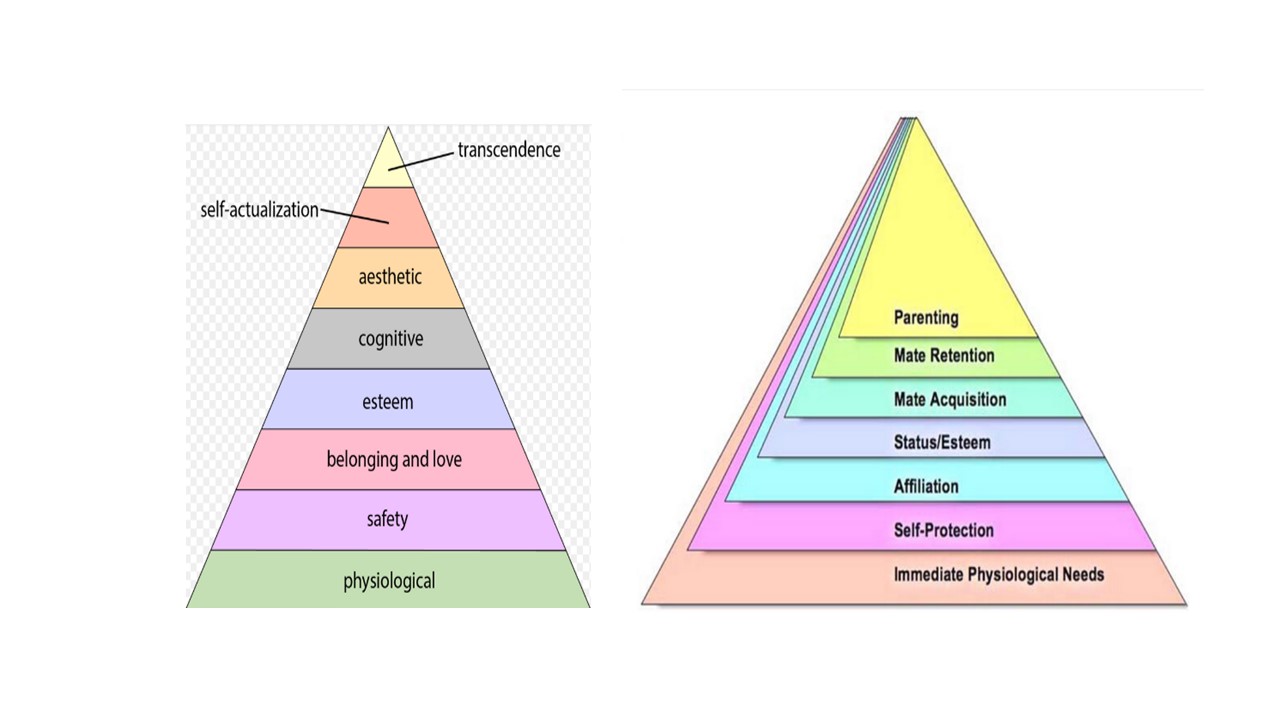
From a neuroscientific perspective, there are two basic drives: approach and avoidance. At the basic level: fight or flight. In a more elaborate, human setting, they are the tendency to leap forward and see the positive, assertive, good and opportunity and the tendency to the negative, defensive, evil or risk, respectively. Ambivalence is built into it. People tend to lean towards the negative-defensive out of the urge to survive, but there is a balance in the brain with the vital-progressive. It might be argued that sustainable development incorporates both: development is forward progress-oriented vitalism, sustainability is the alertness for risk and danger.
The two basic drives of approach and avoidance compete for attention. The second one, avoidance of prevention, is evolutionarily the more powerful one, which results in a bias towards negativity – and suffering. Maslow made in this respect an observation which is also relevant for the sustainability transformation humanity is in right now: ‘One can choose to go back toward safety or forward toward growth. Fear must be overcome again and again; growth must be chosen again and again.’
The second of the four noble truths is: all suffering springs from ignorance. It raises fundamental questions: what is ignorance in relation to which (conception of) reality? Insights from the neurosciences are remarkably close to Buddhist conceptions of reality and ignorance. Our brains are not simply ‘observing’ a reality out there; instead the brain continuously constructs a reality by continuous sequence of predictions, signalling mismatches and respond with adjustments. It projects and adjusts. In concreto: we see what we expect to see (which saves brain energy) and we have no view of our blind spots. Thus, the belief in an ‘objective reality’ is erroneous. It is what in Buddhism is described as ignorance (avidya): not seeing the world as it actually is. Reality is an unknown and unknowable emptiness (sunyata) – a statement which cannot be empirically verified and remains part of the philosophical discourse. The other two noble truths are about the end of suffering and the path that leads to the end of suffering.
In our era of virtual reality and artificial intelligence (AI), the idea that we construct our world gets a new and, in a sense overwhelming, meaning. It resonates even more deeply with Eastern philosophy as expressed in statements like the one on what is associated with the end of suffering: nirvana (or heaven or paradise) by Chandrakirti: “The essence of Nirvana consists simply in the suppression of all the constructions of our fertile imagination”.
The end of suffering and the path towards it, the third and fourth noble truth, is summarized in the Eightfold Path, the fundamental part of which are Right Views as opposed to Ignorance. “The object of the Path is… to reach what Buddhists call ‘the other bank’, where another aspect of things is perceived, and where our vain reasonings and speculations, having become objectless, fall away from us.” (David-Néel 1977:58).
What does science, more specifically psychology, tell us about the way out of suffering, in a time that in Western society an ongoing flood of books on self-improvement and self-advancement is published, often in American-style pragmatism with titles like Authentic Happiness, Self-care, Simple Living, Super Better and Hyper Focus. These books have the underlying assumption that there is an authentic self: that which you really are, independent of what other people think of it, and that this ‘self’ can be (re)constructed and improved.
Recent insights from science emphasizes that the ‘I’ is an illusion, as already discussed. In particular, the notion of an ‘authentic self’ which can be dis- or uncovered is false. Research, albeit with all the assumptions and noise of psychological experiments and surveys, indicates that authenticity is a context-dependent feeling in relation to others. People tend to feel most authentic when others see them as they wish to be seen, and when they can show socially desirable and/or positive behaviour. It is not an ‘I’-thing which can located somewhere. Importantly, a sense of authenticity strongly correlates with well-being or ‘happiness’. An important question then: how much control (in the sense of intentional activity) do we have over our ‘happiness’? It turns out that most people overestimate this significantly – genetic and environmental factors might exceed 80%. Another finding is that you should not read about this, because it makes you unhappy… (the happiness paradox). It is interesting to reflect here on the role of the dominant ethics of meritocracy in modern society: if you are successful, you deserve it, if you are not, you failed (de Vries 2023).
Also science, then, hints at a solution which is found in the Buddhist teachings, as stated in the title of the book by Niebauer (2019): No Self, No Problem – How Neuropsychology is catching Up to Buddhism (Niebauer 2019). In Buddhism, acquiring Right Views by scrutinizing your own motives and their effects makes it possible to regulate one’s conduct in a better manner for oneself and others. How sees science the road from overcoming ignorance to ethics?
People do not really know what makes them happy. Many roads are taken and a constant stream of advertisements provides the necessary illusory messages. Van Leeuwen argues that part of happiness is malleable and the key to it are values. There are many definitions of values, in essence a value is a desirable goal which is a guiding principle in one’s life in a variety of settings. To live with and to work on one’s values makes one happy. It is inherently positive. There is scientific evidence that, across peoples and cultures, there exists a set of universal values, (Schwartz and Bardi 2001; de Vries 2023).
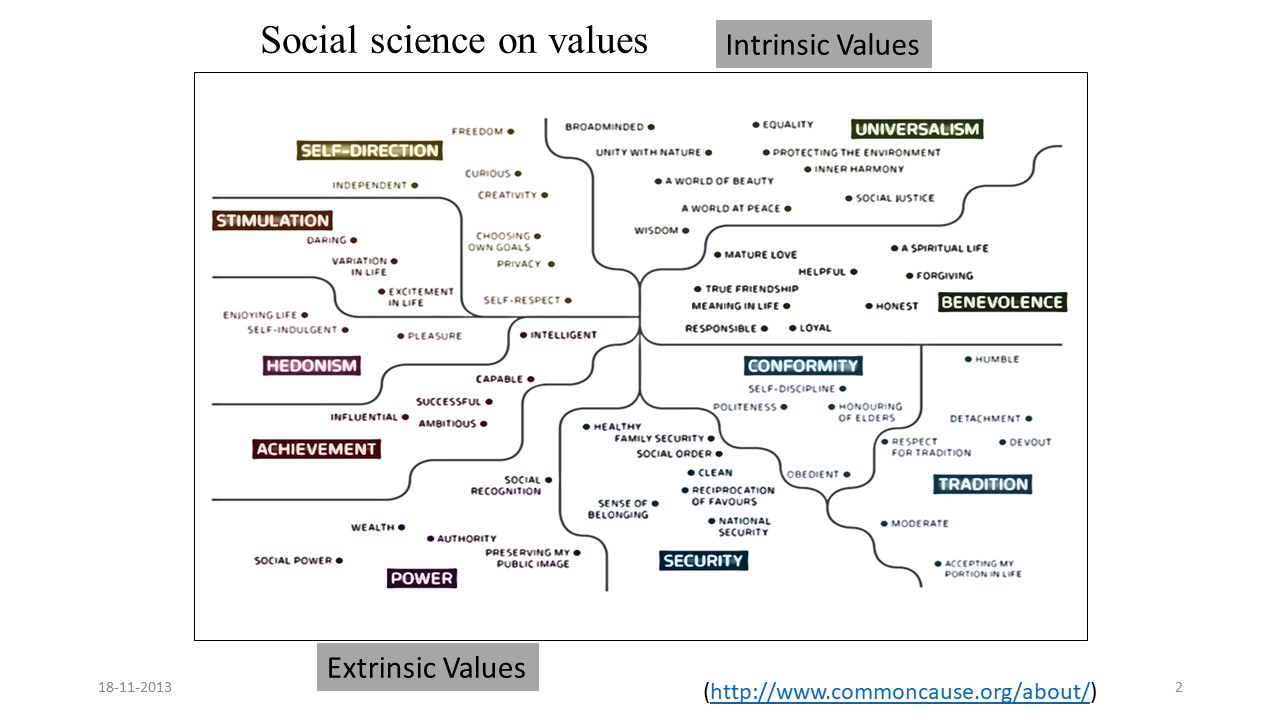
One of its representations stems from the Common Cause foundation (https://commoncausefoundation.org/) (Figure 2a). The scheme makes it possible to explore one’s values and explore positive and negative connections between them. None of these values is wrong in itself, but some values seem to make people a bit more happy than others. In this webinar, it was asked which value you aspire will make you the most happy? A two-third majority chose goodness., with universalism as a second. Pursuing goodness and being other-oriented makes you happy… Self-management and self-development are also often chosen, apparently in the belief that there is such a thing as ‘self’…
Another representation is derived from the World Value Survey (https://www.worldvaluessurvey.org/wvs.jsp) (Figure 2b). It organizes the outcomes of questionnaires about values at country level along two dimensions of change. One is from traditional to secular values; the other is from survival to self-expression values. Temporal and cross-country changes may be explained by a variety of changes such as rising income, spreading of Modernity values, ageing and changing roles of women and minority groups. However, the relationship between such socio-cultural features on the one and individual-psychological on the other hand is a complex one. Clearly, within each of the socio-political and socio-cultural settings (e.g. Catholic, Protestant and Orthodox Europe, or African-Islamic and Latin America) the quest for individual happiness and well-being will take different forms. The Buddhist-Zen approach to individual happiness discussed here will be confronted with different challenges and obstacles in these different settings.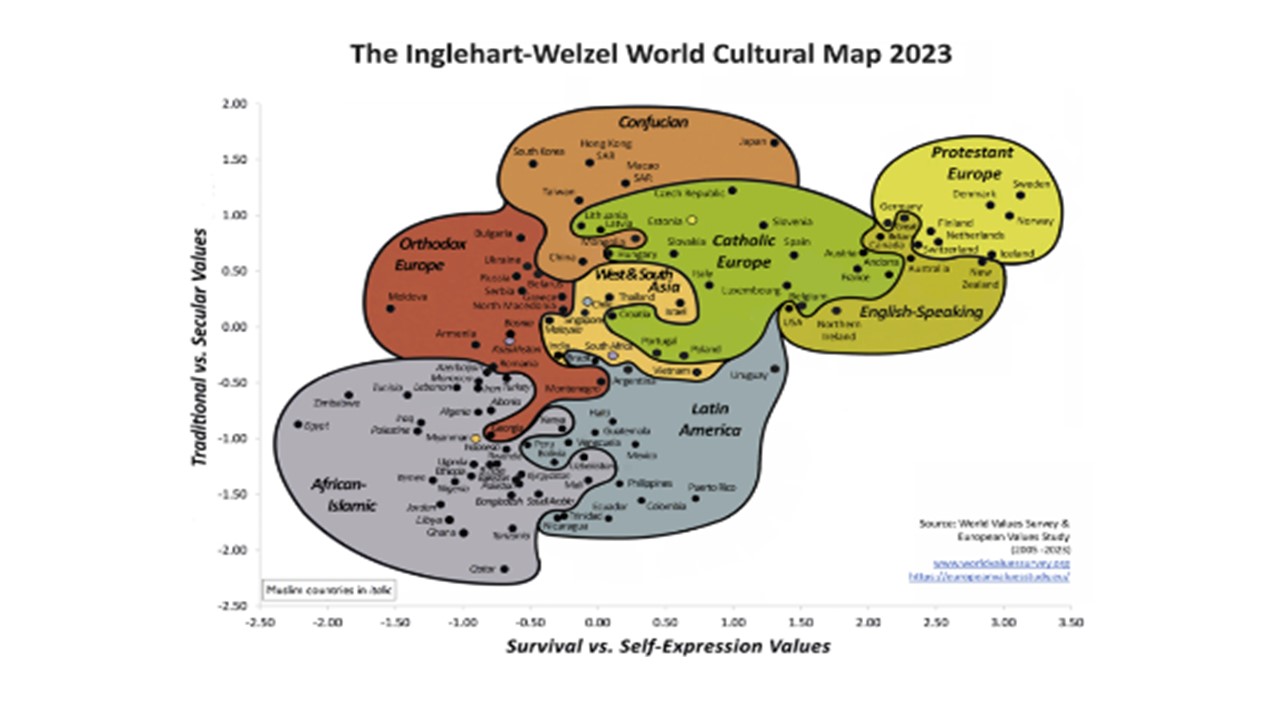
In my book Sustainability Science (de Vries 2023), I discuss values in the context of a worldview framework. A worldview is then associated with a particular set of values, beliefs and interests (see the website https://www.sustainabilityscience.eu which also contains an interactive monitor to explore one’s worldview). To me, the Zen webinar was interesting because it points at the importance of what I call the B2-perspective Subjective Idealism on a sustainable future (De Vries 2023):
The world of Subjective Idealism (B2) has an inherent diversity in its expression. Mind and spirit, will and imagination are at the core. In a quest for personal development, the individual discovers that truth is only found within and that the real needs for creativity and spirituality are satisfied by mastery of the sensate. The focus in everyday life is on transcendent personal needs and development and on the ‘management of greed’. The divine is experienced as subjective and Nature as divine mystery. Suffering is associated with the frustration of non-attainment of ideals and the endless misery and ignorance of worldly life and its delusions (samsara).
Within the own community, there is belief in and effort towards self-reliance and conflict resolution at the community level. A common manifestation are the eco-spiritual communities and ecovillages, but also the many independent Christian and other worship movements throughout the world. Adherence to this worldview also takes the form of criticizing – by artists, revolutionaries, mystics and gurus – the injustices of the status quo and of embracing local traditions and conformity. It manifests in the activities of Civil Society Organizations (CSOs) on charity, refugee help and so on (A2-B2). The contemplations and teachings of the world’s great philosophers and enlightened masters are a perennial source of inspiration. The Buddha’s Four Noble Truths, the monastic rules of medieval mystics and the Gandhian concept of swaraj fit in this worldview.
In a more secular vein, the Athenian agora, the Indian panchayat and sociocracy are preferred governing practices and there is a preference for appropriate human-scale technology. Indeed, not only about technology but also on other issues such as human needs, the diagonal opposition between the worldviews of Subjective Idealism (B2) and Objective Materialism (A1) or Modernity were and are a source of much and often creative conflict between the bureaucracy and the pioneer, the king and the philosopher-jester. In their extreme manifestation, they become a sect with an authoritarian guru-leader who starts to turns the proclaimed virtues into vices. Another extreme is the entirely isolated lunatic and other sufferers of mental illness, who are sometimes rediscovered as geniuses.
This worldview contains the kernel of mystic and esoteric religious teachings and ethics. Talking about Buddhism, David-Néel (1939/1977:189) writes: ‘He who does good deeds is not paid for them by a reward which satisfies his more or less sensual desires: riches, celebrity, power, health, physical beauty, etc. The fruit of his pure, generous and unselfish actions is his own improvement.’ Christian mystics phrased a similar message: ‘To be full of things is to be empty of God. To be empty of things is to be full of God.’ (Eckhart). The variety of religious sects, with hundreds of thousands of followers, are also expressions of this worldview – before they eventually become absorbed in organized religion or commercialized. Numerous manifestations in politics, art and literature could be added.
There are many other manifestations of this worldview. ‘I have no doubt that it is possible to give a new direction to technological development… that shall lead it back to the real needs of man, and that also means: to the actual size of man. Man is small, and, therefore, small is beautiful.’ (Schumacher 1973). A similar sentiment is heard in the words of the native population of North America: ‘The earth has received the embrace of the sun and we shall see the results of that love’ and is poetically expressed in romantic poems. It is also found in the African philosophy of ubuntu ‘I am because we are’ and of Buen Vivir in South America and other indigenous, non-Western philosophies (Norren 2017).
ZEN WEBINAR 16-1-2025 www.zen.nl with Mattheis van Leeuwen NIPO mattheis@gedragsverandering.nl
Literature
David-Néel , A. (1977). Buddhism – its doctrines & its methods. Avon Books
De Vries, B. (2023). Sustainability Science (2md ed.). Cambridge University Press, Cambridge
Kenrick, D. T., Griskevicius, V., Neuberg, S. L., & Schaller, M. (2010). Renovating the Pyramid of Needs: Contemporary Extensions Built Upon Ancient Foundations. Perspectives on psychological science : a journal of the Association for Psychological Science, 5(3), 292–314. doi: 10.1177/1745691610369469
Niebauer, C. (2019). No Self, No Problem: How Neuropsychology is catching Up to Buddhism. Hierophant Publishing
Schwartz, S, and A. Bardi (2001). Value hierarchies across cultures. Journal of Cross-Cultural Psychology 32(3)268-290
Veenhoven, R. (2012). HAPPINESS: Also known as ‘life-satisfaction’ and ‘subjective well-being’. In: Kenneth C. Land, Alex C. Michalos, and M. Joseph Sirgy (Eds.) Handbook of Social Indicators and Quality of Life Research. 2012 Dordrecht, Netherlands: Springer Publishers. page 63-77
Leave A Comment