Chapter 14

Fishing strategies: an agent-based simulation

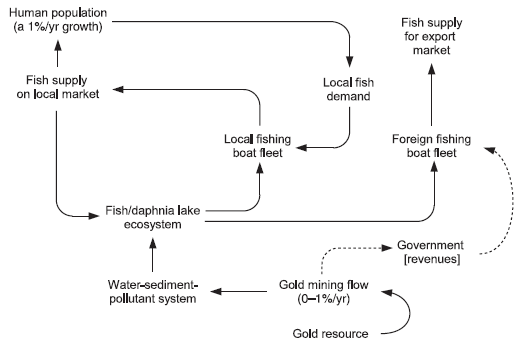
Already for decades, ecologists are aware that proper modelling and management of fisheries has to incorporate the behaviour of fishermen. An early example was a model of two different fishing strategies (Allen and McGlade 1987). A more recent analysis investigates different harvesting strategies in an anegnt-based simulation model (ABM) (Brede and de Vries 2009). Let [...]
By |2024-04-17T13:35:20+00:00June 15th, 2023|Chapter 14, Chapter 9|0 Comments

Fisheries: a history of technology and oil

The force of technology is illustrated with some numbers. Fishing power, defined as the product of number of ships and potential catch per ship, has globally increased sixfold between 1970 and 2005. There was a massive increase in ship size, with supertrawlers as floating fish factories operating for months on sea. In 2016 the global [...]

By |2023-12-22T16:46:54+00:00June 14th, 2023|Chapter 14|0 Comments

Local fisheries: layers of (over)exploitation

Island are offering examples of how societies did or can evolve – think of the historical reconstructions of Easter Island (see blog on this website). One feature is their openness for external influences – sometimes beneficial, sometimes catastrophic, and often a mix of both. In the novel Island, Aldous Huxley describes an ideal society on [...]

By |2023-12-09T17:14:24+00:00March 24th, 2020|Chapter 14|0 Comments

The Canadian Fish Drama

Northeastern Canadian fisheries – cod, haddock and other species – are in serious crisis since the 1990s. It is “the classic case of the failure of conventional science-based fisheries management: the collapse of the northern cod of Newfoundland and Labrador” (Finlayson and McCay 1998:311). For centuries the extraordinary abundance of cod has been exploited by [...]

By |2023-12-09T18:03:13+00:00June 4th, 2015|Chapter 14, Narratives|0 Comments
Go to Top