
Already for decades, ecologists are aware that proper modelling and management of fisheries has to incorporate the behaviour of fishermen. An early example was a model of two different fishing strategies (Allen and McGlade 1987). A more recent analysis investigates different harvesting strategies in an anegnt-based simulation model (ABM) (Brede and de Vries 2009).
Let there be a distributed resource consisting of j = 1..P fishing zones, each modelled as a standard logistic growth resource model. Each agent chooses where to fish in the next season. The choice is determined by a probability table that gives the chance that agent i fishes in zone j in the next season. The table mirrors the agent’s view of the resource base in terms of catch and profit performance. After each fishing season it is updated, using the information about his and possibly also other agents’ last and previous performances. How an agent builds this probability table is determined by the strategy it pursues. Therefore, we define four strategies:
- the agent bases resource selection only on individual profit (Minority Game (MG));
- the agent’s choice is motivated by the performance of a team it belongs to and shares its catch with (Team Game (TG));
- agents use the impact of their catch on the performance of the whole community (COllective INtelligence (COIN)); and
- the agent selects the resource to be exploited randomly (RANDom (RAND)) similar to a stochast
MG is a very selfish, individualist strategy. The COIN strategy is more ‘cooperative’ because agents base decisions not on their own profit but on the impact of their effort for the community outcome. If played by many agents in the group, TG is a very cooperative strategy.
A series of model simulations has been performed to see under which conditions strategies survive in an evolutionary competition (Figure 1-2). The exploitation regime is characterized by a harvesting pressure, defined as the ratio between N * cmax (N number of ships, cmax maximum catch per ship) and the recovery time of the resource Dtrec. If the harvesting pressure increases, the average catch per vessel declines and the number of vessels following a particular strategy changes. Figure 2 The average number of vessels that follow one of the strategies, as a function of the harvesting pressure. The coordinated long-term (COINL) strategy is the most attractive one as long as the resource is not overexploited (Brede and de Vries 2009) What would happen if the agents would, instead of having a short time horizon (S), make a long-term (L) projection on the basis of their knowledge of the resource? As it turns out, such long-term strategies perform consistently better than the equivalent short-term strategies. The COINL-strategy is now superior as long as the resource is not overexploited, but beyond a certain harvesting pressure, some of the distributed resources are occasionally overharvested and the minority game (MGL) strategy rises to dominance. The model simulations suggest that very abundant resources allow for uncoordinated harvesting, but increasing harvesting pressure favours more and more the long-term planning cooperative strategy. However, upon getting closer to the tipping point, first the long-term planning selfish behaviour and later the short-term profit oriented selfish behaviour are favoured. For extreme overharvesting (with very low yields) a team strategy with a large team comprising almost all the agents are best. This narrative seems to resonate a common observation about resource exploitation. First, the resource is considered abundant and is exploited without regulation. When usage rates increase, more efficient harvesting becomes necessary and logical and, as a consequence, innovation and planning emerge. It is also a stage, in which the competition for resources intensifies, which has been a recurrent cause of conflict in human history (Frankopan 2023). If, however, the situation further deteriorates, parties become more selfish in their behaviour. Upon further decline, the short-term starts to take over from long-term planning, until finally sort of ‘communist’ regimes evolves in which all share and cooperate in the scarcity and misery. Literature Allen, P., and J. McGlade (1987). Modelling complex human systems: A fisheries example. European journal of Operations Research 30(1987)147-167 Brede, M., and B. de Vries (2009b). Harvesting Heterogeneous Renewable Resources: Uncoordinated, Selfish, Team-, and Community-Oriented Strategies. Ecological Modelling 25 (2010) 117–128 Frankopan, P. (2023). The earth transformed: An untold history. Bloomsbury Publishing, London [1] Harvesting pressure is calculated as the maximum possible catch for the given number of vessels divided by the recovery period. It increases for shorter recovery periods. It is an equivalent of resource scarcity or abundance.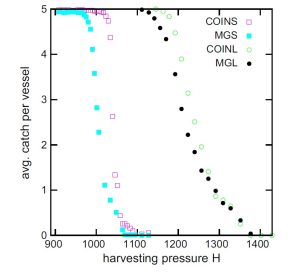 Figure 1 The average catch per vessel declines with increasing harvesting pressure. Long-term (L) strategies perform better than short-term (S) strategies (Brede and de Vries 2009).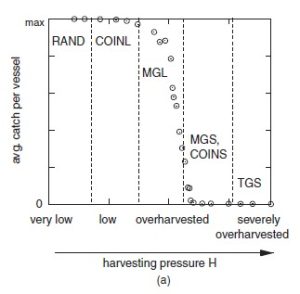
Leave A Comment