
Needs is a broad category. It overlaps with wants and desires. It covers a broad array of items, from basic needs for food and shelter to spiritual aspirations. How needs are perceived and actualized is a key aspect of the quest for sustainable development.
The goal of sustainable development is a quest for developing and sustaining qualities of life. But what is quality of life? It is often equated with the word happiness, which is loving and living without want for which each language has its particular word and experience. If sustainable development is understood as the quest for quality of (human) life and ‘the good life’ for the individual and the collective, it effectively is about the needs, wants and desires of people and the alternatives for future action to satisfy them [1]. How are they defined and investigated, what are proper indicators, and how are they socially constructed?
Needs: objective and subjective
In the social sciences, quality of life is often associated with the needs hierarchy (Maslow 1954). People behave and use their resources in such a way that their physiological needs (food, shelter etc.) are met first. When these ‘basic needs’ are sufficiently satisfied, people will orient themselves towards higher needs: safety, belonging and being loved, inclusiveness. Even higher in the hierarchy are esteem and self-actualization [2]. It is a holistic approach which offers the prospect of unlimited opportunities for personal growth, provided that basic needs can be fulfilled. Table 6.1 summarizes categories which have been proposed in order to come to grips with the notion of needs in relation to quality of life. They have different origins, but all contain the idea of ‘lower’ and ‘higher’ needs.
The different ways in which the notion of needs is approached, reflect this hierarchy. In Bertold Brecht’s famous phrase: ‚Erst kommt das Fressen, dann kommt die Moral ..‘ . (‘First comes food, then comes morality’). So-called basic needs are thought to be rather universal and can within certain parameters be determined scientifically. The Food and Agriculture Organization (FAO) almost exclusively defines them in terms of nutritional requirements. Food deprivation, or in common language: hunger, is quantified in great detail and in relation to the location, gender, age and so on of the individuals concerned. Similarly, the World Health Organization (WHO) focuses on the prevalence of various diseases and with ‘objective’ indicators such as the number of HIV/AIDS patients, access to medical services and safe water, and expenditures on health and education. All this data suggests the possibility to define and measure quality of life as (conditions for) the fulfilment of basic needs for food, shelter, safety and bodily health.
Even these ‘lower’ physiological needs, however, have less tangible and measurable aspects. Food requirements reflecting genetic and climatic circumstances and too little or too much food can affect quality of life negatively but not uniformly. The prospect of starvation or disease may diminish quality of life as much as an actual food shortage or illness. Even for the ‘lower’ needs, then, objective definitions and indicators are difficult. For the ‘higher’ needs, in a complex society where needs are constructed in interaction with social exchange and technology, it is much harder.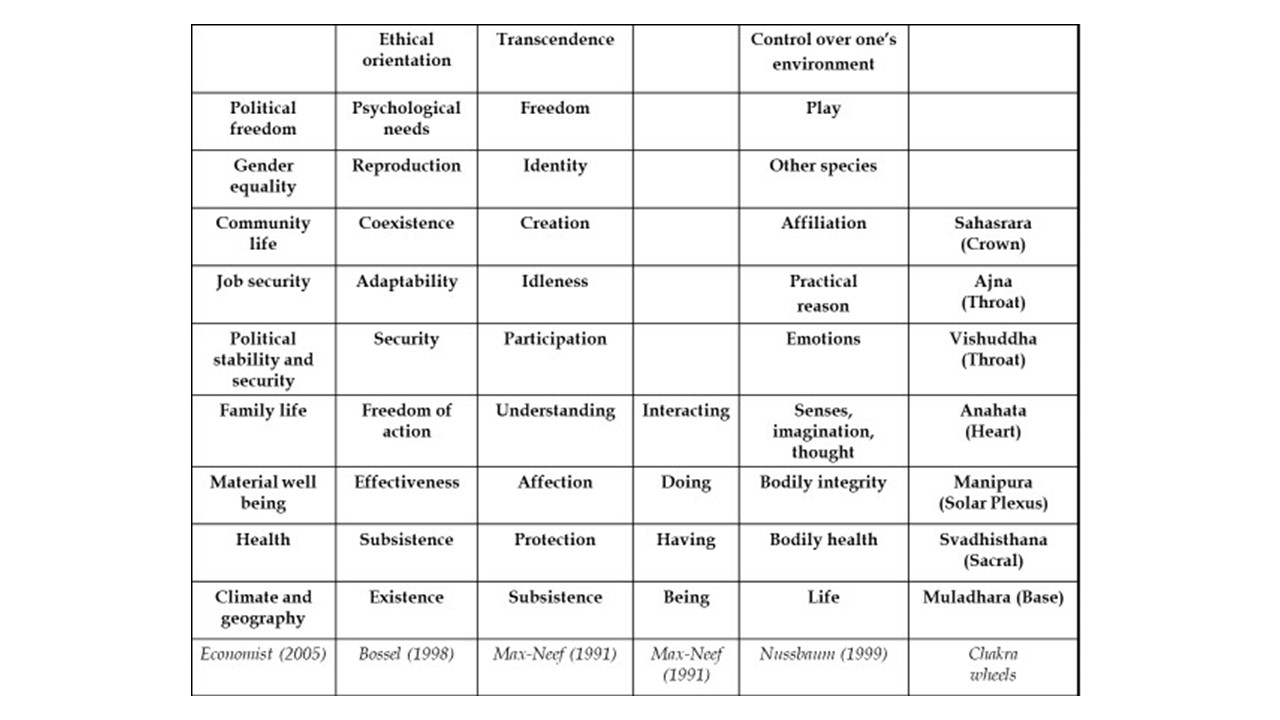 Table 1 Possible hierarchies of needs and quality of life indicators. The rows indicate keywords associated with the various aspects of quality of life, in ascending order from objective-material to subjective-immaterial. The lowest row indicates the source.
In mainstream economic theory, the evaluation of quality of life is derived from the preference-based decisions made by an individual person in a situation of limited resources and opportunities. These preferences are presumed to be known, stable and coherent and to reflect a considered judgment of what people value (Banerjee and Dufo 2019). The ‘revealed preferences’ as expressed in people’s purchases are considered more trustworthy than ‘stated preferences’ in answer to questionnaires [3]. The rational choice is to satisfy those needs that maximize utility/benefit or minimize regret/cost for a given income (§5.4). No normative statements are made about either ends or outcomes. Individual income or expenditures expressed in monetary units is still the most widely used indicator of quality of life, also because it is the most widely available and easily accessible. An example is the notion of a poverty line – the 1,25 $/day per person of the World Bank – which is established from the expenditures needed to buy a basket of commodities for survival. Adding indicators of work and living conditions from, for instance, the World Development Indicators (WDI) is then already an improvement.
There are at least two objections to this view of quality of life. First, people’s quality of life depends on more than the goods and services one can buy with money (Sandel 2013). Secondly, people’s behaviour often does not follow the presumed economic rationality but involves habits, risk and probability assessments, contextual judgments and social imitation and comparison. Both objections have variously been addressed in welfare economics and have been met with complementary approaches as is discussed in the next paragraph.
Needs, wants and desires are in economic science proclaimed to be individual, utility-oriented and hedonic. Their provision is done personally and informally and/or anonymously by the market, although with huge and increasingly personalized marketing efforts. Economists use the notion of reference drift for the phenomenon that the needs of an individual influences and is influenced by the needs of others (van Praag and Frijters 1999, van Praag and Ferrer-i-Carbonell 2004, Layard 2005). It is echoed in Girard’s notion of mimetic desire: imitation plays a large role in the formation of needs and desires.
The wealthy were and are often leading in the construction and purchase of extravagant consumer items – whether a luxury palace in 1900 BCE, a mechanical clock or bath-shower device in 1900 CE, a household robot in 2020 CE or a space trip in 2030 CE. Veblen called it (the need for) conspicuous consumption. Also, needs and their satisfaction change over time as a consequence of habituation, new experiences and knowledge and novel goods and services. This phenomenon, called preference drift or hedonic treadmill, means that a person needs or desires at least (the prospect or expectation of) an increase in income in order to remain satisfied because he is in retrospect less happier with the income gain than he had expected. It is a growth-promoting feedback loop and, in combination with advertisements, one of the drivers of growth in consumption (Jackson 2009).
The social construction of needs is also highlighted in the concept of positional goods in relation to social scarcity (Hirsch 1977) [4]. When a majority of people rise above merely life-sustaining consumption, an increasing part of consumption depends on the individual tastes and the actions of others. One category stems from comparing and imitating what others are doing: ‘needs’ arise from wishing to keep up with or differ from others, as in fashion and the latest smartphone. A second category are goods and services that are inherently scarce, such as good teachers or medical doctors: the satisfaction of these ‘needs’ depends on one’s position in the competitive hierarchy [5]. Both have become important features of post-modern lifestyles (Reckwitz 2018). A third category are the ‘needs’ for a good or service that can only be provided as a public good, such as clean air or non-congested traffic. Purchasing such goods and services is confronted with social scarcity and their provision and distribution require coordination by the collective, as is most evident in the (mis)management of global commons such as fisheries, biodiversity and the atmosphere (§13.5).
Coping with the ‘needs’ for positional goods and services can be done by internal psychological reassignment. However, the satisfaction of these needs are (also) dependent on external aspects of social scarcity and collective organization. Their fulfilment is elusive because the more people enjoy them, the less satisfaction they give and the more severe the competitive struggle to ‘get ahead of the crowd’ becomes. Other consequences are rising expectations and subsequent disillusion when it turns out that ‘the winner takes all’, with disproportionate rewards for those on the top of the ladder (corporate CEOs, celebrities, sports idols). It fits in with a meritocratic ethic (§5.4). Because most of the SDGs depend on the provision of public goods and services with a positional character – health and education services, clean air and water, policing, justice – it is highly relevant in the present context. If the state fails to deliver such goods and services, private business may grasp the opportunity to make profits. In the situation that traditional values fade away and a well-organized public order is not (yet) in existence, this easily leads to or reinforces existing clientelism, nepotism, corruption and crime.
Needs as socially embedded constructs
Social scientists, whose focus is naturally on ‘higher’ needs, emphasize that quality of life is more a ‘subjective’ socio-cultural construct than an ‘objective’ individual state. “Human needs and wants are generated, articulated, and satisfied in an institutionalized feedback system. They do not appear from thin air but are created by the social interactions that comprise the civic community.” (Douglas et al. 1998:259). The influence of community standards and rules are highlighted in the research on collective action (Ostrom 1990, 2009; Banerjee and Duflo 2019).
A clear choice in favour of such an experiential, subjective approach to quality of life is made in the expanding field of happiness and well-being research. People’s behaviour is then analyzed in depth on the basis of surveys and experiments [6]. For instance, in the Subjective Well-Being (SWB) approach, they are asked directly whether they are happy and content with their life or not (Veenhoven 2012). Happiness is then described as ‘the subjective enjoyment of one’s life as-a-whole’ and correlated with quality of life. Surveys in the USA and the UK suggest that the fraction of happy people did hardly change over the last half century despite a threefold increase in income. The explanation is that other factors matter as much or more for an individual’s experience of ‘being happy’: family ties, financial situation, work, social environment, health, personal freedom and philosophy of life, in order of importance (Layard 2005). Income plays only a partial and indirect role, although this seems to be less clear at (very) low income. The previously mentioned World Values Survey and the European Values Study use a similar but broader approach (Box 5.1) [7].
Happiness and well-being research has its critics: there is still no consensus on how to measure happiness and the approach can be used as an ideological device to deny or hide underlying structural causes of misery. It also misses out on spiritual and paradoxical aspects of quality of life, like ‘adversity can make you stronger and happier’. This shortcoming is partly addressed with the notion of Eudaimonic Well-Being (EWB), introduced by psychologists as an extension of SWB and bringing in doing well besides feeling well (Martela and Sheldon 2019). Unfortunately, the dozens of elements proposed for the EWB are not easily measured either. In a broader approach, the search for self-transcendence is part of quality of life too (Koltko-Rivera 2004). Equating happiness to healthy functioning in the physiological, sexual, social, psychological and spiritual domains of life is also a way of broadening the notion of quality of life (Jackson 2021) [8].
Two approaches deserve attention for their emphasis on the embeddedness of needs in a socio-cultural context. The first one concerns the concepts of Capabilities. Not only realized but also non-realized options contribute to the experience of ‘the good life’. Knowing that there is medical help in case of an accident, police in case of robbery and a nearby forest in case of stress contributes already to well-being. This is captured in the Capability Approach (Nussbaum and Sen 1993). Capabilities are what a person might wish and is capable to achieve. They represent her opportunities and the set of options from which she can choose. They reflect the potential to fulfil human needs and the freedom to choose which ones to fulfil. A person’s set of capabilities depends on his means (land and house, income etc.) but also on personal characteristics (education, creativity etc.) and on social and environmental arrangements (family and community network, access rights etc.). When a person actually manages to do something or be someone in leading a life, one speaks of realized options or functionings. The capabilities of a person thus reflect the alternative combinations of functionings that she can realize. Poverty is in this view seen more as capability-deprivation than means-deprivation.
The capability approach connects the subjective experience of a good quality of life: freedom to choose ends, with the objective resource-oriented aspects: means to realize ends. An unstable climate, polluted drinking water or a corrupt banking system confine a person’s capabilities and limit his freedom of choice, and therefore the quality of life he can realize. It has an intuitive plausibility in concrete situations. For instance, the existence of a public transport system is a capability: every citizen may decide to use it or not. Capabilities are thus connected to alternative options that can be provided in different ways and in relation to their public or private character (government, markets…). As such, it is directly linked to the ways in which provision of goods and services is organized (§8.4; Claassen 2008). Operationalization of capabilities is difficult, however. An attempt at concrete implementation is the formulation of basic needs and the use of the available statistics to explore the extent of satisfaction (Nussbaum 2000; Table 6.1).
Another interesting concept is the term satisfier, introduced as part of Human Scale Development theory (Max-Neef 1991). it has been formulated in the 1980s in Latin America in response to the failure of postwar ’developmentalism‘ and monetarist neo-liberalism. Needs are understood as a system of interrelated and interactive needs without a hierarchy. Existential needs can be categorized in the four classes of being, having, doing and interacting; they correspond with axiological or evaluative needs (Table 6.1). Human needs are met in a dynamic process (of social construction) of needs on the one hand and physical means on the other hand. The means are called ‘satisfiers’: anything that contributes to the actualization and fulfilment of human needs. They include space, social norms and practices, organizational and political structures and historical and cultural settings [9]. Economic goods are their material manifestation.
Several classes of satisfiers can be distinguished and not all of them are actualizing needs. There is much delusion and manipulation going on around them. Pseudo-satisfiers are items or behaviours that give a false sense of satisfying an axiological need, usually via propaganda, advertisements and other forms of persuasion. Examples are certain medical treatments (‘placebo’) for subsistence and protection; status symbols and chauvinistic nationalism for identity; and formal democracy for participation. Inhibiting satisfiers fulfil a given need excessively and at the expense of other present and future needs satisfaction. They usually originate in customs, habits and rituals. Examples are economic competitiveness in the name of freedom which often inhibits the needs for subsistence, protection and affection, or religious fundamentalism providing identity at the expense of understanding and freedom. Some actions destroy the possibility to satisfy needs in the name of another need. For instance, the arms race, national security doctrines and censorship and bureaucracy claim to satisfy the need for protection, but often destroy the need for subsistence, affection, participation, identity and freedom. Conversely, increasing regulation due to crowding and congestion is often experienced by the individual as a reduction in capabilities and hence in quality of life.
Needs as technological construct
Although needs, wants and desires are embedded in socio-cultural contexts, science and its application in technology have always been an important force too, shaping – often inadvertently – needs and the means to satisfy them within these contexts [10]. With the accumulation, commercialization and dissemination of scientific knowledge, this process has become intense and obvious in both the individual and the collective arena.
The first drivers of engineering for needs satisfaction have been (the representatives of) states. Weaponry has been developed since ancient times to realize the ambitions of warlords and kings for power and territorial expansion – and satisfy the need for security (Pacey 1992; §3.3). Military technology keeps redefining the ‘need’ for security and is still setting many of the priorities in applied science in what Eisenhower called in the 1950s the military-industrial complex. The building of castles and cathedrals, universities, jails and hospices, roads and bridges has satisfied needs for recognition, power and status. In Modernity, state involvement has expanded into the construction of sewage systems, health and transport infrastructure and other public services organized by government departments and executed by engineers from private and public enterprises (§5.2) [11]. These aspirations and the corresponding scientific and technical innovations created their own ‘needs’ for water, hospitals, roads and so on. Not surprisingly, the authority, rules and revenues of the state increased with rising collective needs: what gets priority, who is to decide on costs and benefits and who will execute the works? (§4.2). Societal needs are then legitimated by an objective techno-economic perspective (known as functionalism) in which goods and services come from a mixture of public and professional provision. Socialism, communism and fascism manifested extreme variants of such functionalism, with disastrous results when professionalism got mixed up with personal power and mythical beliefs.
The first genuine originators, it can be argued, were the consumers. The interactive feedbacks of technical practice and scientific experiments which conceived and satisfied the needs for (better) food, housing, clothing, transport and so on in the form of higher yields in agriculture and novel machinery, materials and power (wind, water) in manufacturing have ancient roots. The prime organizational principle was the market. From ancient times onwards, there have been dynamic and at times fierce battles to strike a balance between state-led provision of collective needs and market provision of individual consumer needs (Bavel 2018). Needs and wants are often thought to emerge autonomously as part of ‘human nature’, but in 20th and 21st century consumer capitalism they are as much or more the outcome of state and corporate decisions on what is scientifically promising, technologically feasible and profitable, and societally marketable and (un)desirable [12].
The concept of needs has been explicitized in the Sustainability Science book in several cahpters, for instance in the pyramid on water needs (Figure 16.1) and in the energy ladder in development pathways (paragraph 17.3.2).
Footnotes
[1] The distinction between needs, wants and desires is ambiguous and somewhat arbitrary. A wealthy person may consider access to opera an essential need; a poor businesswoman needs a smartphone and a sick person needs medical support and medicine for their very economic and physical survival. They are indeed close in daily language. Needs refer to more universal aspects of life. Wants and desires are personal and dynamic parts of individual life-histories. Wants are usually seen as rather personal; desire is associated with personal impulses and longing. All three can range from instinctive greed to spiritual yearning.
[2] The needs hierarchy was also a response to narrow behaviourism. How strictly people actually adhere to such a hierarchical sequence is a matter of dispute (Max-Neef 1991). Immaterial needs as expressed in religion, art, culture and trade are existential too (James 1902).
[3] An example is a construction model of health indices across countries, in which functional limitations, self-reports of health, and a physical measure are interrelated to construct health indices (Meijer et al. 2011). The authors find that “health indices correlate much more strongly with income and net worth than self-reported health measures.”.
[4] Hirsch published his book Social Limits to Growth (1977) partly in response to the Limits to Growth book by Meadows et al. (1971) which dealt with physical limits.
[5] Another example is (access to) information, as generals and diplomats know already for a long time. It was and is also crucial in industrial innovation in corporations and states and protective moves such as patenting.
[6] Much research is done in emerging fields like behavioural and experimental economics, where game theory, laboratory experiments and simulation models are combined (Gintis 2005).
[7] The results are usually presented at the country level, which may be misleading because subgroups within countries – for instance, young people or people living in large cities – may differ more from other subgroups than from similar subgroups in other countries.
[8] A deep reflection is given by Arendt: ‘There is no lasting happiness outside the prescribed cycle of painful exhaustion and pleasurable regeneration’ (quoted by Jackson 2021:60) and the only chance for contentment is deep inward materiality, an insight which is expressed ever more frequently in the context of sustainability (e.g. Latour 2021).
[9] There are also dissatisfiers: those rules, structures etc. that prevent the fulfillment of needs. They may come from oppressive power structures, but they may also stem from increasing regulation due to crowding and congestion. Experienced by the individual as a reduction in capabilities and hence in quality of life, they are, if well designed and implemented, the least harmful for the total of individuals. It explains the perennial attempts at escape from such dissatisfiers.
[10] Although its specific path was always embedded in a socio-cultural context. See for instance Schemmel (2020) on the different contexts in which science and technology developed in Europe and China.
[11] Although it is hardly mentioned explicitly in the SDG-formulation, most of the goods and services needed for the realization of the SDGs require great and effective involvement of the state (Vries 2019).
[12] A new and evolutionary (counter)force is the activist prosumer-user with access to internet and social media.
Leave A Comment