
The consumption of meat is increasingly becoming controversial as a spectrum of activists point at the negative side-effects for animal welfare, human health, local pollution and climate change inducing greenhousegas emissions. The meat industry and its suppliers see their profits and expansion opportunities under threat, arguing that there are already many regulations in place and competition on the global market is endangered. The divergent perspectives on meat consumption derive from different values of what matters in life, on different observations and presumed relationships (‘the facts’) and on differences in interests and power. In some places the debate has become extremely polarized, suggesting that no common ground exists.
The worldview approach is a way of framing the divergent perspectives on sustainability issues, such as the meat controversy. It explores the values and mental maps of stakeholders in the issue at hand, categorizing them along the axes material-immaterial and individual-collective (see Chapter 6). In this way, the worldviews according to which various stakeholders perceive the problem and its solution(s) are made (more) explicit. This, in turn, may open the space for mutual respect and genuine dialogue, in which common grounds can be explored and robust solutions – in the sense of gaining widespread support – can be worked out. It also enables students to engage with a sustainability issue and become critical in the analysis of ‘the facts’ presented on internet and other sources.
In the course Perspectives on Sustainable Development at the Copernicus Institute of Sustainable Development at Utrecht University, the students write in groups of three or four students an assignment in which the worldview approach is applied to a sustainability issue of their choice. In the years 2014 and 2015, a total of 64 assignments have been written classified in 5 clusters (Population, Food and Land, Energy and Climate, Water and Resources and Pollution). As an example, I present here one of the assignments, namely on the topic introduced above: Meat in Europe, by the students Ruffino, Chadid, Bareman and Van Gessel. It is not meant as a template – students have much freedom in setting up this piece of exploratory research.
A first lesson is the recognition that sincere study of stakeholders’ worldviews discards any simplistic problem or solution. Usually, the issues are complex indeed, as is society. It is also true for the aspiration to make European meat production and consumption more sustainable. Secondly, the analysis indicates that common ground does exist between these four world views. A collective action plan should involve three elements. The first one are subsidies that support environmental goals rather than trade goals. Subsidies and stricter environmental policies could encourage extensification of livestock production, which reduces environmental effects, improves animal welfare but compensate farmers for their financial losses and will not raise meat prices. Strict policies regarding use of preventive antibiotics would probably also be acceptable for all stakeholders. A second element is investment in technologies that create meat alternatives or reduce environmental damage. For instance, investment in technologies such as in-vitro meat and manure composting will be supported by all actors and should play a key role in future action. A third element is investment in communication strategies to raise awareness about meat production, notably about health and environmental aspects and farming techniques. Indeed, awareness raising stands out as common ground amongst all actors. For instance, labelling is seen as a way to increase the power of consumers to influence the production process, but is also accepted as a way to increase value added.
In a paper titled Implications of Complexity (2021), Mario Giampetro writes about the importance of narratives in sustainability science (https://ojs.unito.it/index.php/visions/article/view/5995/5270). He applies it with an example from a Food Conference, which aligns with the above analysis (Figure 1). More such applications are appearing, showing the growing awareness and need that narratives are chosen to frame a particular sustainability issue before a more quantitative/modelling approach is brought in. Pluralism and offering more than one perspective on sustainability issues is becoming mainstream – but it also produces disgust with the resulting post-modern anything goes relativism. It cal also easily be abused by obscuring scientific facts and personal beliefs and interests.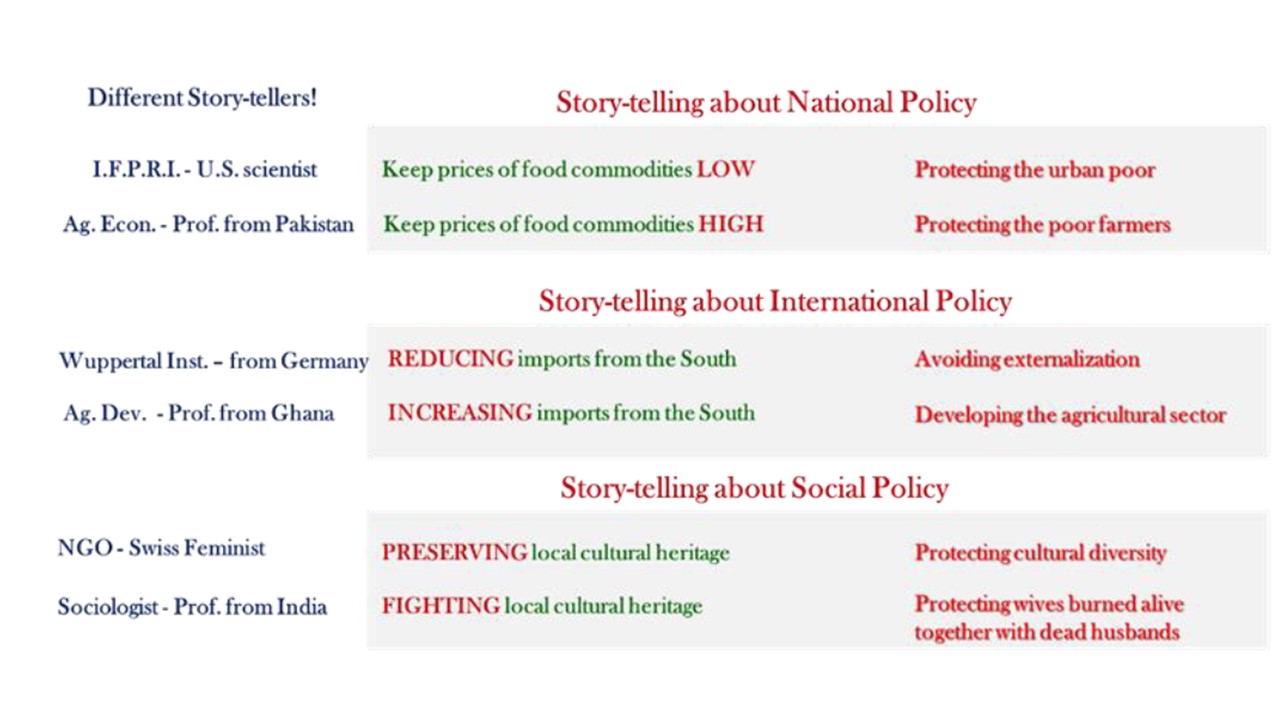 Figure 1 Contrasting scientific advice of different experts/story-tellers at the SAGUF World Food Conference, Zurich, 9-10 October 1996
The meat is not the problem, neither the animal, but the real problem is the animal and meat industry itself. Why do we produce animals in a factory ? The so called feed-lots in the Unites-States, the pig- and poultry-farms in Europe and all over the world that are completely disconnected from the soil, they all function according to industrial principles with fodder as an input and ready-for-meat animals as an output. As has been pointed out as early as in the seventies of the last century by a NGO-action called “Soja, so-nee!” (in The Netherlands), soya imports from over the ocean means a cost in terms of transport and a loss of forest area over there, but it also discourage farmers in Europe to integrate leguminous crops in their field rotations, as they have done for centuries before. The development of an industrial way to produce meat (called “bio-industrie” in some countries) has been a policy of short-term thinking, that started as a supplement of income to the many small farms that existed in Europe after that mechanisation had been generalised. Before, animal production (especially “red meat” from cows and horses) was just a by-product from farms that had shortly given up animals for traction and ploughing the fields. Animal husbandry has been, and still is of great importance in areas where arable cropping is difficult or even absent, like in wet areas or in very dry regions. In many landscapes horses, cows, sheep and goats are an essential factor in order to convert otherwise useless pasture land into useful products, like meat, milk and cheese. In order to maintain landscapes and areas of natural interest, farm animals have an important role to play. On the other hand, fowl and pigs also have always been a part of the farming system, but rather on a small scale. These animals are useful by eating the waste and remains of the harvest of crops, or by utilising other sources of proteins like the acorns in the woods.
The least harmful way of keeping animals would be by having them integrated in the farming system, what means that the fodder and the straw and the hay they need are produced on the farm itself or in the surroundings. In an agricultural system including soil, plants and animals (and human beings!), meat is just a secondary product of the farm. There where conditions are optimal, like in the Dutch “polders”, arable cropping could be preferred above animal husbandry, although the advantage of leguminous crops in the rotation remains, which means the need of a presence of animals anyhow. In regions of Europe where agricultural conditions are less favourable, keeping animals will give a necessary extension to the farm income. Thus, from an agronomic point of view animals have their role in many agro-ecosystems, and meat will be a useful but rather scarce product.
In developing countries of the South, the situation is more complex. On the one hand, rural populations will support themselves with locally produced meat within their traditional farming systems. On the other hand, cities are often supplied with meat produced in an industrial way, or the meat is imported, sometimes as a leftover from overproduction in Europe or another meat-exporting country.
When one considers that more than half of the world population is living in towns, how can this population be supplied with cheap meat. If one would count into the price of meat the environmental costs of industrial animal husbandry (“bio-industrie”) this meat would certainly be not as cheap as it is now. Also, farmers obtain the lowest revenues from these activities and diseases like avian influenza are frequently ravaging entire regions. Subsidising farmers to produce a meat that is either labelled (produced with certain restrictions) or biological (in-bedded in a soil-related farming system) would need a change in European common agricultural subsidy policy (CAP). Therefore a new idea is raising under the slogan: “Public money for public goods”. Which means that public money will be given to farmers not as a kind of interest on their land, which is the case under the current CAP regulation, but as an incentive to produce smarter and for a healthier environment.