
Island are offering examples of how societies did or can evolve – think of the historical reconstructions of Easter Island (see blog on this website). One feature is their openness for external influences – sometimes beneficial, sometimes catastrophic, and often a mix of both. In the novel Island, Aldous Huxley describes an ideal society on the imaginary island Pala, where people live with a heightened consciousness and opportunity for a humane and happy life for all. But it is powerless against the invading, imperialist forces of the Evil Outside. More realistically, Helena Norberg-Hodge gives an account of the gradual decline of traditional life in Ladakh, a mountainous region in the Himalayas, in her book Ancient Futures: Lessons from Ladakh for a Gobalizing World. It is a testimony to the vulnerability of the few traditional cultures in the world which are left, either literally on an island or in an isolated forest or steppe, desert or arctic enclave. Which place is still sacred to the homo sapiens? Below, I recount a imaginary story of an island and illustrate the dynamics of decline with a system dynamics model.
Local fisheries in the world are under threat in the last decades, as large-scale industrial exploitation continues to grow at the expense of more sustainable small-scale fisheries (Zeller and Pauly 2019). There are many historical accounts of how such overexploitation affects, in combination with other phenomena such as pollution and mining, local livelihoods of people. Here, I present an (extremely) simplified model-based illustration of some of the underlying dynamics as it might have unfolded in the imaginary country Lakeland. This is the narrative. Lakeland is an island with a small human population and a lake with abundant fish. The human population is in equilibrium with the ecosystem – a sustainable state as long as population growth remained small. However, one day, gold is discovered on the island and ‘development’ occurred in the form of a gold mine. The mining causes water pollution. Then another ‘development’ event takes place: foreign fishing companies get permission to catch and export fish. Gradually, water quality in the lake deteriorates and more effort is needed to satisfy local fish demand. Fish on the local market gets more expensive and the gold resources is nearing depletion.
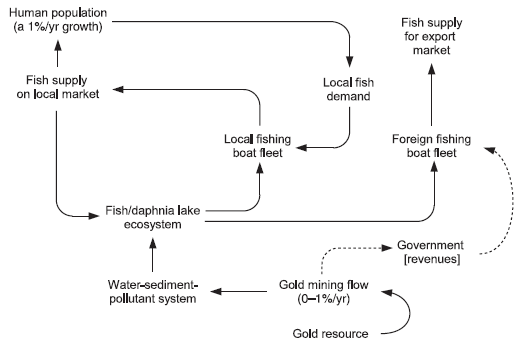
The country consists of two subsystems: a lake or coastal area with fish and their food – say, daphnia, a kind of water flea – and the economy of people, fishing boats and a reserve of mineral ore with high gold content (Figure 1). The Lakelanders get their food from fishing in the local lake and make their boats and nets from local materials. There are only two capital stocks: boats and nets, and mining equipment. They change because of investment and depreciation, with the latter assumed to be inversely proportional to the economic lifetime. The demand for fish is growing over time because of population growth. This means more boats and nets. Therefore, you can make three reasonable assumptions about the fishermen behaviour and the ecosystem:
- fishermen invest in new boats and nets in order to satisfy expected growing demand;
- there is an upper bound to the annual fish catch; and
- gold mining causes pollution, which negatively affects the
Each season the fishermen go out harvesting fish, which is sold on the local market at the end of the season. Assuming a population growth of 1 percent per year (%/yr), the Lakeland fishing grounds are sustainably exploited over the chosen simulation period of about twenty years (1,100 weeks; Figure 2a). As long as the population and fish demand hardly change, the fleet size remains about constant. Such a sustainable state has existed in many places and for long periods, with different institutional arrangements. Note that the model is meant to be an illustration and has not been implemented for a real-world situation.
Figure 1. The Lakeland model world: a human population that sustains itself by fishing and exploiting a gold mine, and an ecosystem with a prey-predator dynamic and pollution of water and sediment.
The islanders can ‘develop’ and enter into the large ‘world’ economy by opening up the gold mine for exploitation and by allowing foreign fishing vessels to enter the lake. Often, the population does not really have a choice and is simply exposed to such developments by foreigners, either as military or commercial force. Aldous Huxley gives a compelling description in his book Island (1962) how such a process can unfold.
Exploiting the gold deposit can become the first and most important, export-oriented sector in the economy. It not only provides revenues to the Lakeland community or government, but it also generates mining waste that flows into the lake and pollutes the water. The pollutant concentration influences the reproduction rate of the daphnia, which in turn affects the fish population that predates on the daphnia. The mining waste slowly accumulates in the lake sediment, building up a stock of pollutant. As a consequence, even if pollution stops the concentration in the water declines only slowly because the pollutant in the sediment dissolves again.
Figure 2a. Path of the fish population, the fleet and the weekly catch during the fishing season (note: time axis is in weeks). The catch changes the fish-daphnia system only temporarily and insignificantly (Δt = 1, Euler).
Figure 2b. As in (a), and with pollution from gold mining at 1%/yr, affecting the daphnia population and, subsequently, the fish population and fish catch (Δt = 1, Euler).
A possible outcome is shown in Figure 2b. The growing pollutant concentration in the lake reduces the fishing productivity, defined as catch per unit effort. Fishermen respond by building and sending out more boats. But the mining waste flow continues to harm the ecosystem, and after about ten years, the fish population collapses (Figure 2b). The Lakelanders have to import fish – for which they can use the revenues from gold mining, provided these are not spent on luxury items or transferred to a foreign bank. The lake is no longer a food resource and the sediment has become loaded with pollutant (Figure 3a). The phase diagram plot in Figure 3b shows how fish population (x-axis) and daphnia population (y-axis) move in time. The gold resource gets depleted and the ecosystem degrades to a much lower ecosystem biomass. The system has shifted to a new equilibrium with a significantly lower quality of life for a human population.
Figure 2c. As in (a), and with permission for a maximum of 500 foreign boats to fish for export (Δt = 1, Euler).
The other option for development in Lakeland is to let a foreign fishing fleet enter the fishing grounds. The foreign boats fish for export to the world market where prices are assumed to be constant. Whether and how many foreign fishing boats will come fishing depends on the profit ratio. They will go elsewhere if the net income, equal to fish sales minus operational cost, is less than the capital cost of the vessels. The foreign fleet is in fact a top predator, with the financial sector with its return on capital criteria as the ultimate top predator. The typical pattern is that the foreign fleet rapidly enters the area, increases in size towards the maximum catch permitted and declines in response to declining fishing productivity from overfishing.
Figure 3a. The pollution level in water and sediment for the 1%/yr gold mining (Δt = 1, Euler).
Figure 3b. Phase space diagram for the simulation with gold exploitation (black curve; Figure 2b) and for the simulation with gold exploitation and foreign fishing boats as discussed in the text (grey curve) (Δt = 1, Euler).
Assuming that the government issues permits from the third season onwards for a total of 500 ships, a possible outcome is shown in Figure 2c. The story is that foreign boats capture the opportunity of high returns on capital investment, but start leaving the area once the high return on capital can no longer be sustained. The total fleet (local plus foreign) then reaches a sustainable exploitation level. The damage is not irreversible, but government revenues from fishing permits and local fish availability both decline. The situation may get worse if the government gives in to the temptation to ignore pollution and overfishing and, instead, decides to ward off local opposition and subsidise local fishermen for as long as it has revenues to do so. Such a policy actually accelerates the collapse and is one consequence of the resource curse (Ross 2001). The combination of gold mining and foreign fleet fishing spells disaster (Figure 3b).
More sustainable pathways are possible. The government can, for instance, enforce environmental regulation on the mining waste flow or spend part of the revenues on pollution abatement. It can also be more stringent with permits for foreign fishing companies and tax them more heavily, particularly if mining is also permitted. From a policy point of view, the trade-off for the Lakeland community is between a variety of assets, each with its own indicators: ecosystem health, gold resource, local food supply and supply security and, last but not least, government income from taxing gold mining and fishing activities.
Leave A Comment