
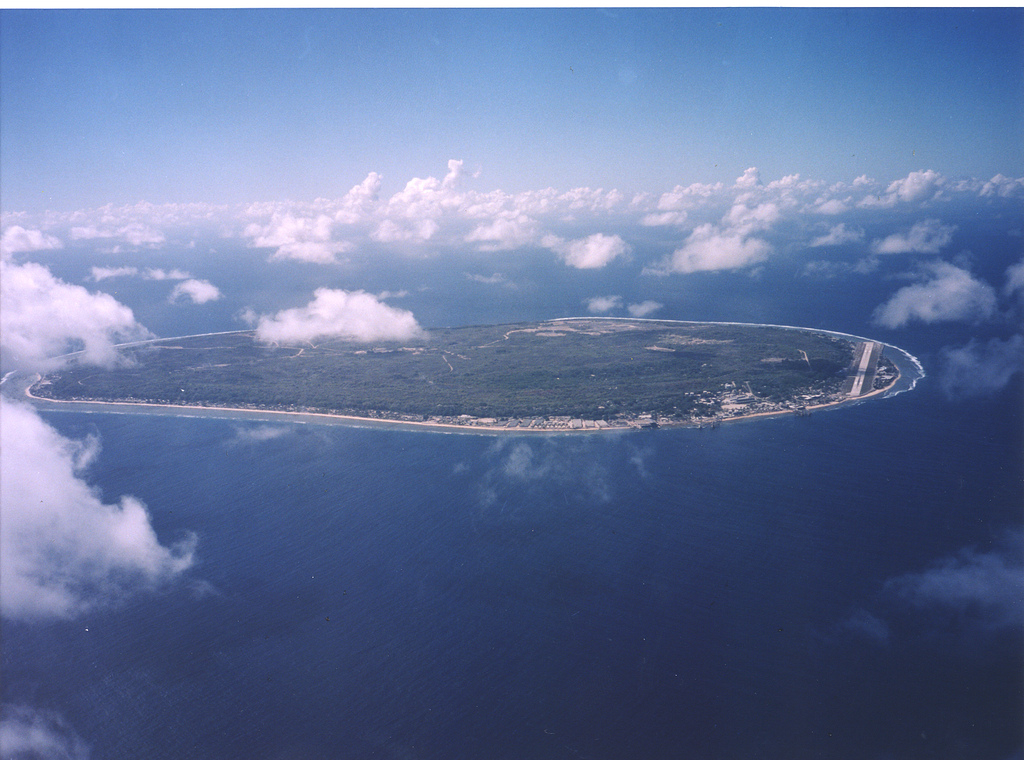
Some 1500 km east of Papua New Guinea, in the Pacific, is the small island of Nauru. It is the smallest independent republic, with nowadays some 12.000 inhabitants on an area of less than 25 km2. The story of Nauru’s ‘discovery’ in 1798 by a British captain who gave it the name Pleasant Island and its subsequent exploitation by colonial powers and then a native government is a cautionary tale of modern development.
Early 19th century there were living a few thousands of people on Nauru, but tribal warfare in the 1870s reduced it by 40%, largely thanks to firearms introduced by passing whalers. The diseases brought by colonizing Germans further reduced the indigenous population. Colonial rule by Germans and later Australians, followed by three disastrous years of Japanese occupation resulted in fewer than 600 Nauruans left on the island by the end of WWII. However, the clue to its history is called phosphate.
Unlike other small and remote Pacific islands, Nauru possesses a valuable commodity: phosphate, a fertilizer ingredient. Its exploitation started in 1900. “It is not easy to get at. It lies between conical pillars of fossilised coral up to five metres high, and cannot be mined without leaving an uneven, unfarmable, impassable forest of white stone pinnacles.“ It has become an ecological disaster. Strip-mining has cleared the once-dense tropical vegetation and turned Nauru into a barren wasteland. The exposed rock reflects the heat of the equatorial sun and drives away rain. Nauru nowadays resembles a mound of barren rock surrounded by a narrow green brim of vegetation (photo).
Initially, the colonial powers used their monopoly and paid almost nothing to Nauruan landowners. In 1968, the Nauruans refused an offer of resettlement on an island near Queensland (the government of Australia had declared Nauru uninhabitable) and chose for independence. The Nauruans had to borrow money to buy out foreigners in the phosphate company and two-thirds of the phosphate was already gone, with all the environmental destruction. Nevertheless, in the 1970s Nauruans were among the richest people on earth. But was this wealth used sustainably? Unfortunately not.
The future looked bright. The government planned to set aside revenues from mining to rehabilitate the land, introduce public services, stimulate economic development and invest for future generations. Additional investments were made in the phosphate mining and processing and selling to new buyers pushed up revenues to an astonishing amount of $17,500 for each islander.
In reality, an unsustainable welfare state and lifestyle emerged. Until recently there were no taxes, schooling and medical care are free, and electricity, telephones and housing are subsidized. Nauruans saw no need to work for a living and 95% of those who worked were employed by government. Foreigners, one third of the population, run the hospitals, schools and restaurants. Nauruans have developed a lifestyle which gave them the reputation of the most obese population in the world with the largest incidence of diabetes. Male life expectancy has fallen to 55 years. On top of this, greed, mismanagement and fraudulent advisers have eroded the available funds – at some point Nauru had a fleet of five Boeing 737s…
Phosphate production peaked in the 1980s and has since fallen by two-thirds, as did prices. In 2007, phosphate mining ceased and the only hope is to exploit deeper layers. Licensing the tuna fishing grounds to foreign fishing vessels brings in some revenues. But the resource limits are obvious. Since the 1990s, the government had to cut expenditures and find additional sources of revenues. Suing colonial governments for past destruction, sacking civil servants and attracting big loans (in 2000 the deficit reached 18% of GDP) brought temporary relief.
Other more controversial sources were attempted too: offshore banking and taking up refugees. Any can with a small amount of money set up a bank in Nauru, with next to no regulation. Some $70 billion of Russian money is said to have vanished into Nauruan accounts in 1998 and a task-force of the G7 identified Nauru in 2000 as one of 15 countries deemed uncooperative in its fight against money-laundering. The island’s days as a banking haven are numbered because big western banks no longer do business. The deal with Australia to accommodate asylum seekers – the ‘Pacific Solution’ – caused serious opposition and is faced with competition from other poor Pacific nations.
By now, Nauruans have among the lowest income in the world and are almost completely dependent on imports. They voted away their government ten times, to no avail. The idea of simply buying another island and starting afresh is once again under discussion. At least for Nauruans, that is still an option – unlike for most populations elsewhere…
Photo credits: casjsa on Flickr
Leave A Comment