
The seven-plus billion human beings on the planet are increasingly connected through material and informational exchanges. Their everyday behaviour and their desires, emotions, aspirations and expectations are still very different and diverse, yet there seems to be a shared universal idea(l) about ‘the good life’. At least, that is the implication of the Sustainable Development Goals (SDGs) as formulated between 2012 and 2015 and accepted as part of Resolution 70/1 in 2015 by the 193 member states of the United Nations (UN). The Goals and the associated 2030 Agenda aim to “achieve a better and more sustainable future for all” and to “promote prosperity while protecting the planet”. ‘The good life’ is about “equal rights to economic resources, access to basic services, ownership and control over land and other forms of property, inheritance, natural resources, appropriate new technology and financial services” (#1.4), equal access to justice for all (#16.3) and much in-between. It is also about reducing or eliminating bads in life: physical, emotional and social suffering (hunger #2; illness #3; violence #5.2, #16.2) and corruption and bribery #16.5).
The SDGs are ambitious to the extent that many consider them unrealistic and impossible promises. Of course, that has been said of previous ideals – such as slavery. Others are convinced, genuinely or as a strategy, that the SDGs are feasible and they are designing action programs and monitoring systems at various scale levels.
The SDGs are also modern, in the sense of reflecting the ideal of the [European] liberal democracy and welfare state. The underlying core values are a belief in science- and technology-based material progress, an economic system of competition on open markets, and human rights for the individual. In practice, the goals are a mixture of political and economic liberalism and utilitarian pragmatism, promising emancipation from drudgery and oppression and the comforts of modern life to the poor and offering ongoing growth, adventures and opportunities for the rich. To realize them, the impact upon the natural environment should be managed and contained: we are living on one, finite planet.
Although Modernity is in many parts of the world the uncontroversial ideal, there are important forces at work in different directions. The claim to universal knowledge of science and the strict distinction between fact and value have in many places be replaced by a postmodern relativism, with emphasis on the particular and local and contingent. The Enlightenment ideal of emancipation is crumbling too, it seems. On the one hand, the individual has in modern society no longer an incentive to practice civic duty and altruism or cooperate for the collective, as social virtues disappear and the managers in state and corporate bureaucracies banish morality from public and social to individual life. It coincides with what De Tocqueville foresaw in the 19th century for democracies: the erosion of republican institutions from the inside and the rise of a ruthless law-and-order elite, once material welfare becomes the dominant aspiration of the middle-class citizens. On the other hand, large groups of people reject Modernity’s secularism and reach out to church and religion for a moral anchor and for consolation, meaning or community. This does occur not only among the desperate and poor but also among rich populations. Thirdly, Modernity’s colonialism and capitalism with a history of exploitation of people and nature did and does feed resentment in many parts of the world, despite its consumerist appeal. These centrifugal forces, always operating in history, give a sense of unbalance and uncertainty. Perhaps, founding the SDGs in Modernity is one of its vulnerabilities. Is there a way out?
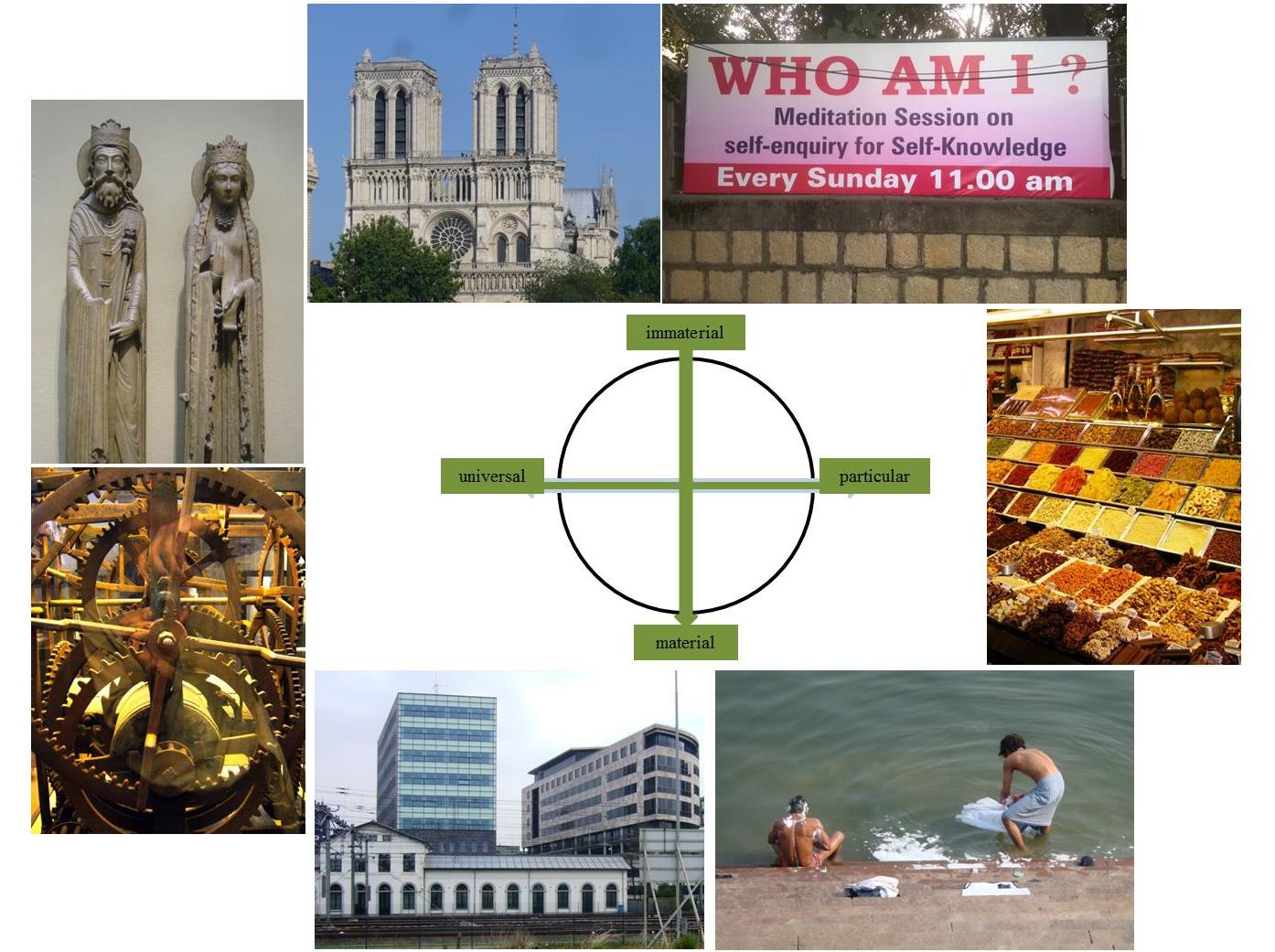
In the past decades, I have with colleagues developed a heuristic framework under the name of Worldview Approach, as part of the Sustainability Science course at Utrecht University. In essence, it proposes to explore sustainability issues cq. the SDGs within a two-dimensional framework (see figure). The dimensions or axes represent polarities and, as such, creative tensions in (human) lives, rather than sharp dichotomies or rigid distinctions. The first, horizontal axis represents ontologically (the tension between) individual and group or collective and, epistemologically, (the tension between) particular and universal. The second, vertical axis represents (the tension between) material and immaterial and body and mind (or spirit or soul). It occurs as a gradual unfolding of human beings into interiority and is at the root of religious awareness and philosophical inquiry. The two dimensions make up a fourfold worldview space, with each corner representing one characteristic set of values and beliefs about how the world is experienced and interpreted.
A starting point is that each human being should get the opportunity to unfold his potential as conceived within the broader (world) community. In the beginning, the child will learn the habits and values, the language and rituals of the family and community in which it grows up. Upon maturing, the individual can develop her skills and roles in the material world as economic actor and in society as citizen, and also in the immaterial realms of life such as religion and the arts. From an SDG-perspective, the actual behaviour – or agency – is what matters – the lower right corner. In the context of ‘the good life’, however, all four corners matter, with different emphasis throughout one’s lifetime.
Modernity represents a narrative in the middle-left part of this space, in which the individual is assumed to identify primarily with the (rather abstract) values of rationality and human rights. However, for most SDGs this is too narrow a frame – think of inequity and property, health and education, gender relations and functioning of institutions. People experience in their lives the local traditions and beliefs of their community, the bureaucracies of business and government, the moral commandments of their priests and the exigencies of their personal emotional and spiritual yearnings. These are the broader settings in which people can engage with the SDGs. The hypothesis is that genuine sustainability, with (human) dignity and justice as core values, reside in the (dynamic) middle ground of worldview space, whereas polarization towards extreme positions is an impediment. It is not a rejection of Modernity, but a plea to broaden the cultural and ethical foundations of the SDGs.
In other words, let us liberate the SDGs from the ‘prison of Modernity’ by broadening the perspective. To this purpose, I explore the developments in ethics and moral philosophy and position them in the worldview framework. A preliminary conclusion is that virtue ethics, originating in Aristoteles’ idea of telos and elaborated by MacIntyre in After Virtue, and the capability approach, as worked out by Sen in Development as freedom, are the positions nearest to the middle ground.
Literature
Soest, H. van, D. van Vuuren, J. Hilaire et al. (2019). Analysing interactions among Sustainable Development Goals with Integrated Assessment Models. Global Transitions 1(2019)210-225
Vries, B. de (2019). Engaging with the Sustainable Development Goals by going beyond Modernity: An ethical evaluation within a worldview framework. Global Sustainability 27 september 2019, e16
Leave A Comment