
The force of technology is illustrated with some numbers. Fishing power, defined as the product of number of ships and potential catch per ship, has globally increased sixfold between 1970 and 2005. There was a massive increase in ship size, with supertrawlers as floating fish factories operating for months on sea. In 2016 the global fleet exceeded 4 million vessels, of which 61% was engine-powered but less than 2% were large (>100 gross tonnage) vessels. Investment in – ever larger – fishing vessels is a major driver behind overexploitation. It led to a relentless search for new fishing grounds and new markets, spurred by the rapid development and application of IC-technology to spot the fish on open sea and to connect producer and consumer (communities) on fish markets.
Long-term historical trends give essential insights from a sustainability perspective, as an analysis of the landings of bottom-living fish species into the UK and the total fishing effort shows (Thurstan et al. 2010). After a rapid increase in landings between 1890 and 1915 and a further increase until 1950, there was an accelerating decline to levels around the year 2000 landings of half the 1890 level. Taking into account the innovation waves from sail ships to steam trawlers and then to motor trawlers and after factoring out innovations such as better gear and nets, a long-term indexed productivity of fishing activity (catch per unit of effort) was constructed ( in Appendix 14.A2). It turns out that between 1890 and 1920 productivity in ton per unit of fishing power dropped dramatically, but the increased landings masked the steep decline in fish stocks. Productivity doubled again between 1920 and 1960, as fishing vessels exploited new grounds in the Arctic and West Africa. After 1960, a precipitous decline in productivity set in and reached unprecedentedly low levels by 1980 – a thirtyfold decline since 1889 (Figure 1)..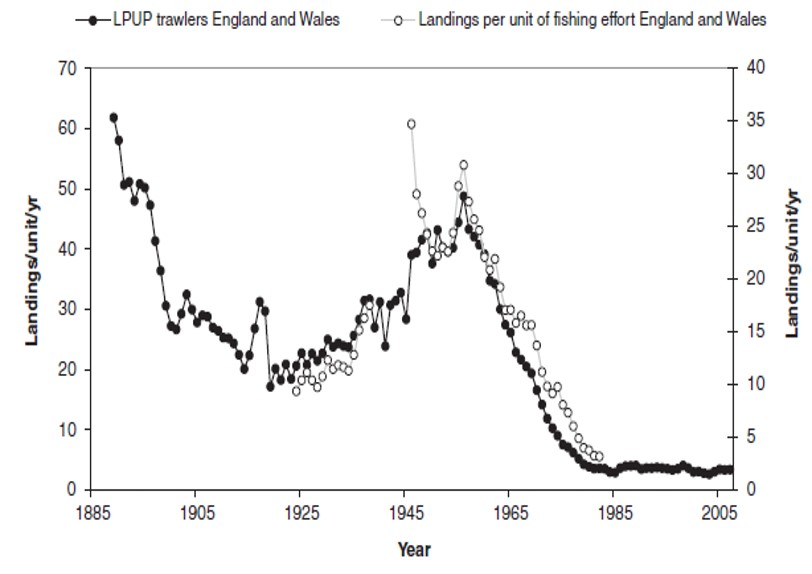
Figure 1. Productivity in UK fisheries 1889–2007. Landings of bottom-living fish per unit of fishing power of large British trawlers. Closed circles show landings per unit of fishing power (LPUP) into England and Wales, open circles show landings per unit of fishing effort of large British trawlers (corrected for changes in fishing power) into England and Wales (Thurstan et al. 2010).
Long-term empirical analyses such as this confirm theoretical analyses that predatory fish biomass is currently at most 10% of pre-industrial levels, and that productivity has gone down so much that “for every unit of fishing power expended today, bottom trawlers land little more than one-seventeenth of the catches in the late 19th century.“ (Thurstan et al. 2010). It is a classical tragedy of the commons story and urgent action is needed to eliminate overexploitation of European fisheries and rebuild fish stocks.
Leave A Comment