
The market has discovered scarcity as something to be desired. The Stock Fund Utilities department of the dutch bank ING announced in 2007:”…prospects remain good. In the states of California and New York energy shortages threaten and it drives the price up.” Similar advertisement are seen for water. Drinking water used to be a service ‘freely’ offered by nature. With growing populations and hygiene standards, it is in combination with growing agricultural water demand rapidly becoming a scarce commodity in many places – or at least, that is a widespread perception. A process of ‘commodification’ has started. Every scarcity offers an opportunity for value added: profit and employment – and its exploitation tends therefore to be supported by business people and politicians.
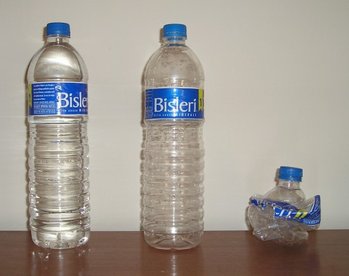
In the first decade of the 21st century, an estimated 200 billion water bottles are annually consumed and bottled water has become worldwide a 60-billion dollar industry. Total bottled water consumption amounted to some 35 billion liters, largely in high-income regions. In 2007 a USA citizen drank on average 125 liter of bottled water per year, up from 7 liter per year in 1976. Massive marketing efforts have led to this change. Selling one liter of water at a price many times the production cost (and many times the price of the equivalent from the public water system) is undoubtedly a marketing success. The bottled water market is expanding at the expense of the sodadrinks, as these are increasingly seen as a cause of obesity. “drinking water instead of three sugary drinks per week for a year will spare you seven pounds of fat.” says one of the Nestlé ads. In essence, it is a costly way of going ‘back to the 1950s’.
The industry worries that increased activism on the alleged environmental impact of bottled water can affect sales negatively. The billions of mostly plastic bottles, also from soft drinks, are now causing waste problems from local to global scale. This is pushed aside by the International Bottled Water Association (IBWA): “…there’s little if any measurable evidence that activists have had an impact upon bottled water sales. Bottled water is well-established and popular with consumers who rely on its convenience, healthfulness and refreshing taste…
But not everyone is getting in line. In Bungadoo, a 2000-inhabitant town 120 km south of Sydney, the community council decided to put a ban on plastic bottled water. The decision was taken in response to a project of a large company to pump water in Bungadoo and then bottle and sell it. Permission for the project has been refused, but the decision is reconsidered in the Land and Environment Court. “We are a small community in favour of environmental sustainability” says a local shopkeeper. ‘Bundy on tap’ has become the slogan, now that the community council has decided to install tapwater systems. Australians pay more than 2 A$/liter for bottled water, whereas tapwater is almost free. The industry fights the idea with the arguments of unemployment and obesity…
Leave A Comment