
There are quite some book on system dynamics which make a connection with sustainable development problems and solutions. Based on personal contacts, I choose two for a brief intrduction. The first one is the book Managing Complexity in Social Systems – Leverage Points for Policy and Strategy (2nd ed. 2023) by Christoph Mandl. The seond one is Small System Dynamics Models for Big Issues: Triple Jump towards Real-World Complexity (2013) by Erik Pruyt.
Managing Complexity in Social Systems – Leverage Points for Policy and Strategy by Christoph Mandl
This book explores how to manage complexity in a highly interconnected world. From organizational addiction to market failure, from limits to growth to the rebound effect, from tragedy of the commons to path dependence, answers can only be found by combining insights from complexity science, system dynamics, system theory and systems thinking. As such, the book aims to bridge the gap between rigorous science and real-life experience in order to explore the potential and limitations of systems archetypes and their leverage points in implementing effective policies and strategies. It is grounded in the system dynamics language of stock and flow diagrams to address issues of circular causality and causal loops in social systems (cf. Chapter 9 in Sustainability Science). Among the topics addressed in the second edition are global climate change and rapid spread of epidemics.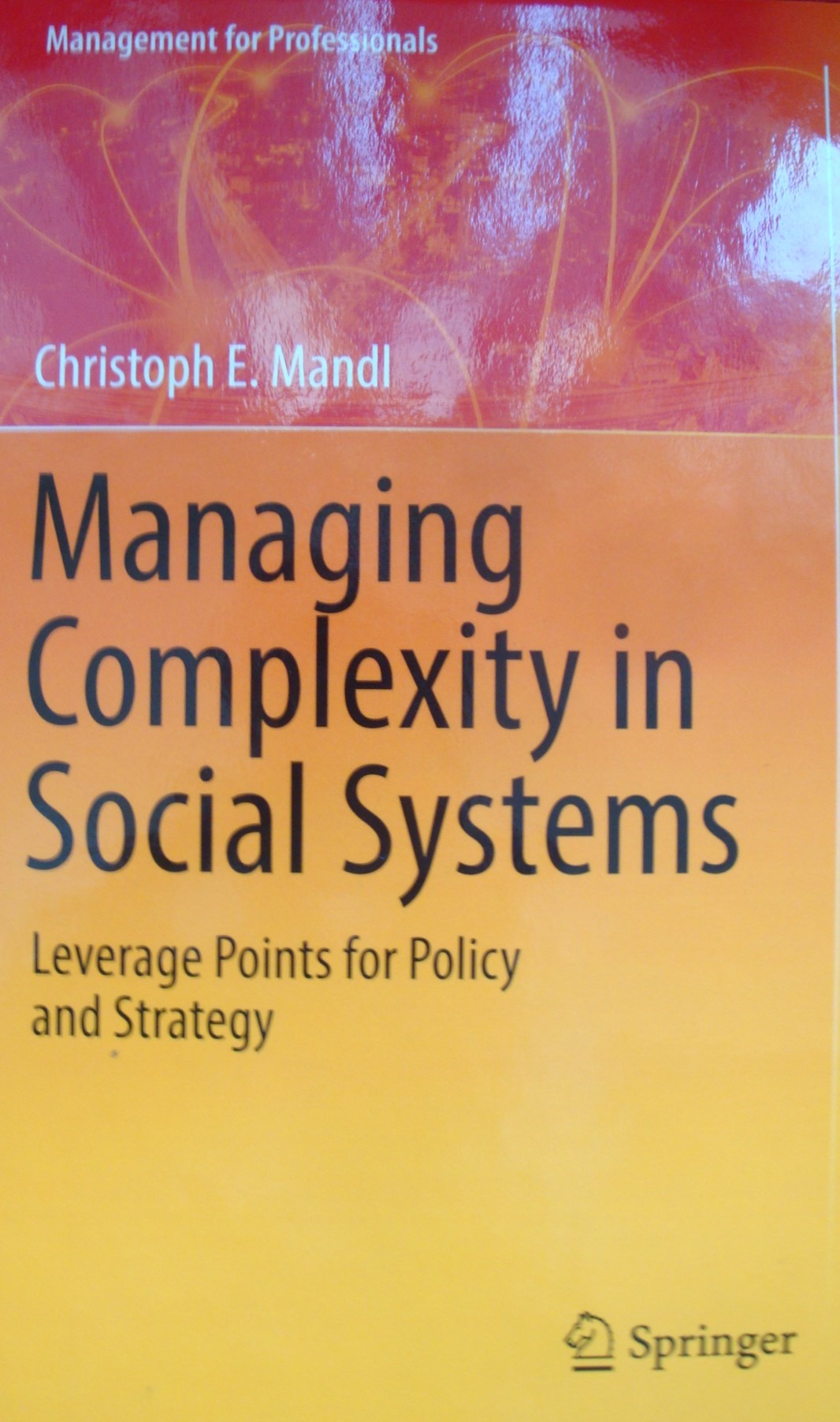
After an introductory chapter, some basics is introduced in the chapter From Logic to Circular Causality: perceiving events, patterns, structure; equilibrium, resilience, and emergence; and prediction, butterfly effect, and decision-making. The third chapter is on describing and understanding the dynamics of social systems, with a stock-flow discussion on climate change and on leverage points. Chapter 4 deals explicitly with ‘tame’ systems archetypes, such as shifting the burden and escalation. The last chapter is on more ‘wicked’ systems archetypes: growth and underinvestment, and policy resistance.
Small System Dynamics Models for Big Issues: Triple Jump towards Real-World Complexity by Erik Pruyt (Delft Technical University http://simulation.tbm.tudelft.nl.)
This book on system dynamics, titled is set up as an interactive and flexible learning tool. The System Dynamics (SD) methodology is introduced with qualitative exercises in which short descriptive texts are, with help of questions, translated into Causal Loop Diagrams (CLDs). Next, the elementary modelling aspects (building, simulation, testing, analysis) are introduced, followed by simple quantitative SD exercises. Subsequent chapters introduce more advanced simulation tools, functions and techniques, introducing and using Vensim software (see www.vensim.com for a free download) and an extensive set of questions and answers to test the student’s understanding. In-between are useful Recap and Lessons to be Learned sections. This book is highly recommended for anyone who wants to get a more in-depth understanding of system dynamics as a tool to translate verbal accounts of complex issues into a formal dynamic model. The latest version of the e-book can be downloaded from: http://simulation.tbm.tudelft.nl .
Other literature
Meadows, D. H. (2008). Thinking in Systems. Chelsea Green Publishing, Vermont
Randers, J. (Ed.) (1980). Elements of the system dynamics method. Productivity Press, Cambridge Mass
Roberts, N., D. Andersen, R. Deal, M. Garet and W. Shaffer (1983). Introduction to computer simulation – A system dynamics approach. New York, Addison-Wesley Publishing Company
Sterman, J. (2000). Business Dynamics – Systems Thinking and Modeling for a Complex World. Boston: McGraw Hill
Stroh, D. (2015). Systems Thinking For Social Change A Practical Guide to Solving Complex Problems, Avoiding Unintended Consequences, and Achieving Lasting Results. Chelsea Green Publishing Co.
Leave A Comment