
A fragmented, disciplinary approach does not work in sustainability science. A broader perspective transcending disciplinary boundaries is needed. One framework to investigate global change phenomena in such a broader, problem-oriented setting is the syndrome approach, originally proposed by the German Advisory Council on Global Change (WBGU 1994) and later conceptualised and developed at the Potsdam Institute of Climate Impact Research (PIK) (Schellnhuber et al. 1997; Petschel-Held et al. 1999). The word syndrome comes from ‘running together’, in particular, the simultaneous occurrence of signs of disease. Here, it refers to a typical co-occurrence of different complex natural and social dynamic phenomena or symptoms. The symptoms are causally connected and constitute the elements of a syndrome. The basic assumption of the syndrome approach is the existence of clusters of interrelated symptoms.
Examples of social symptoms are positive trends in individualisation and informatisation, in mobility of people and transport of goods and information, and in rural-urban migration and urban sprawl. Natural symptoms can be source-based, such as trends in use and depletion of energy and other resources and in resource use productivity. Sink-oriented natural symptoms are changes in biodiversity and in accumulation of waste and pollutants in soils, water and air.
A region may be vulnerable to a syndrome when it is exposed to a particular, causally connected set of symptoms. Its disposition signifies the probability that the syndrome occurs. It depends on the region’s exposure and sensitivity whether and how the syndrome affects the region. Exposure depends on exposition factors. These are rather short-term events that may activate a syndrome if the disposition is high. Events such as natural catastrophes and extreme political or economic shocks can arise from within the system (endogenous) or from the outside (exogenous) or from both. The sensitivity of a region for the event and the subsequent intensity of the syndrome is a complex pattern of agroecological, economic and socio-cultural factors. The final impact depends also on the capacity of people in the region to respond. Such a coping capacity or capability can prevent or mitigate the consequences of a syndrome. Obviously, there are overlaps with resilience theory. The Table below shows a list of situations that qualify as syndromes. Based on the dominant aspect of the human-nature interaction under consideration, a distinction can be made between utilisation syndromes, development syndromes and sink syndromes. Syndromes are often occurring in interaction, for instance, when an operating syndrome triggers or reinforces another syndrome.
| Table Overview of the global change syndromes (Lüdeke et al. 2004) | ||
| Syndrome name | Short description of the mechanism | |
| Utilisation syndromes | ||
| Sahel Syndrome | Overcultivation of marginal land | |
| Overexploitation Syndrome | Overexploitation of natural ecosystems | |
| Rural Exodus Syndrome | Environmental degradation through abandonment of traditional agricultural practices | |
| Dust Bowl Syndrome | Non-sustainable agro-industrial use of soils and water | |
| Katanga Syndrome | Environmental degradation through depletion of non-renewable resources | |
| Mass Tourism Syndrome | Development and destruction of nature for recreational ends | |
| Scorched Earth Syndrome | Environmental destruction through war and military action | |
| Development syndromes | ||
| Aral Sea Syndrome | Environmental damage of natural landscapes as a result of large-scale projects | |
| Green Revolution Syndrome | Environmental degradation through the adoption of inappropriate farming methods | |
| Asian Tiger Syndrome | Disregard for environmental standards in the context of rapid economic growth | |
| Favela Syndrome | Environmental degradation through uncontrolled urban growth | |
| Urban Sprawl Syndrome | Destruction of landscapes through planned expansion of urban infrastructures | |
| Disaster Syndrome | Singular anthropogenic environmental disasters with long-term impacts | |
| Sink syndromes | ||
| High Stack Syndrome | Environmental degradation through large-scale dispersion of emissions | |
| Waste Dumping Syndrome | Environmental degradation through controlled and uncontrolled waste disposal | |
| Contaminated Land Syndrome | Local contamination of environmental assets at industrial locations | |
Building upon the syndrome approach, a similar framework has been developed under the heading of archetypical patterns of vulnerability. It was developed as part of the 4th Global Environmental Outlook (GEO) in response to a request from governments to show how the environment provides challenges and opportunities for development (UNEP 2007). While GEO is a global assessment, its strong regional focus bridges the gap between a coarse global overview, on the one hand, and insights from local case studies of sufficient relevance for countries and regions, on the other.
The concepts of vulnerability and risk play a key role. Similar to syndromes, vulnerability is considered a combination of exposures, sensitivities and adaptive capacities in a social-ecological system. Examination of local and regional situations and trends shows that there are certain mechanisms in human-environment systems that create specific, representative patterns of the interactions between environmental change and human well-being (Kok and Jäger 2007). These patterns of vulnerability tend to have characteristic space- and time-scales at which human development takes place and is confronted with constraints. They can be regarded as archetypical or generic, because they describe the common element in case studies from widely different regions of the world. The details may be quite different, but their essence is the same: a typical scientific attempt at universally valid knowledge.
An archetypical pattern of vulnerability has two components. One is the vulnerability creating mechanisms, and the other is the spatial distribution of typical combinations of the mechanisms. Their investigation in GEO-4 is guided by five questions (Kok et al. 2011):
- What are the main exposures, and the key vulnerable groups and their sensitivities that together define the pattern of vulnerability?
- What are the basic vulnerability creating mechanisms that constitute this pattern of vulnerability?
- In what form and where does this pattern manifest itself?
- How can future changes within the human-environment system affect well-being of vulnerable (groups of) people?
- What are the opportunities – individual responses or policy responses – to cope with and adapt to future changes?
The first two questions address a description and formalisation of a specific pattern under investigation. For instance income, population pressure, access to markets, soil quality and water availability are identified as determinants of food security – determinants meaning rather complex elements or subsystems. To answer the third question, a quantification and statistical analysis of the information from the answers to the previous two questions generates a set of proxy indicators for the most important determinants of vulnerability creating mechanisms. For instance, population density is a proxy for population pressure and soil quality serves as an index for sensitivity to water erosion. The proxy indicators are then investigated to find more or less correlated clusters which yields one functional and one spatial characterisation of a pattern of vulnerability. The functional one consists of a specific constellation of indicators that are labelled vulnerability profiles, while the spatial one contains the spatial distribution of the profiles. The profiles and their differences and similarities give insight into the factors that create the vulnerability in a specific cluster. The resulting vulnerability patterns provide an entry point for identifying opportunities to reduce vulnerability and directions for policymaking (and answer the fourth and fifth question).
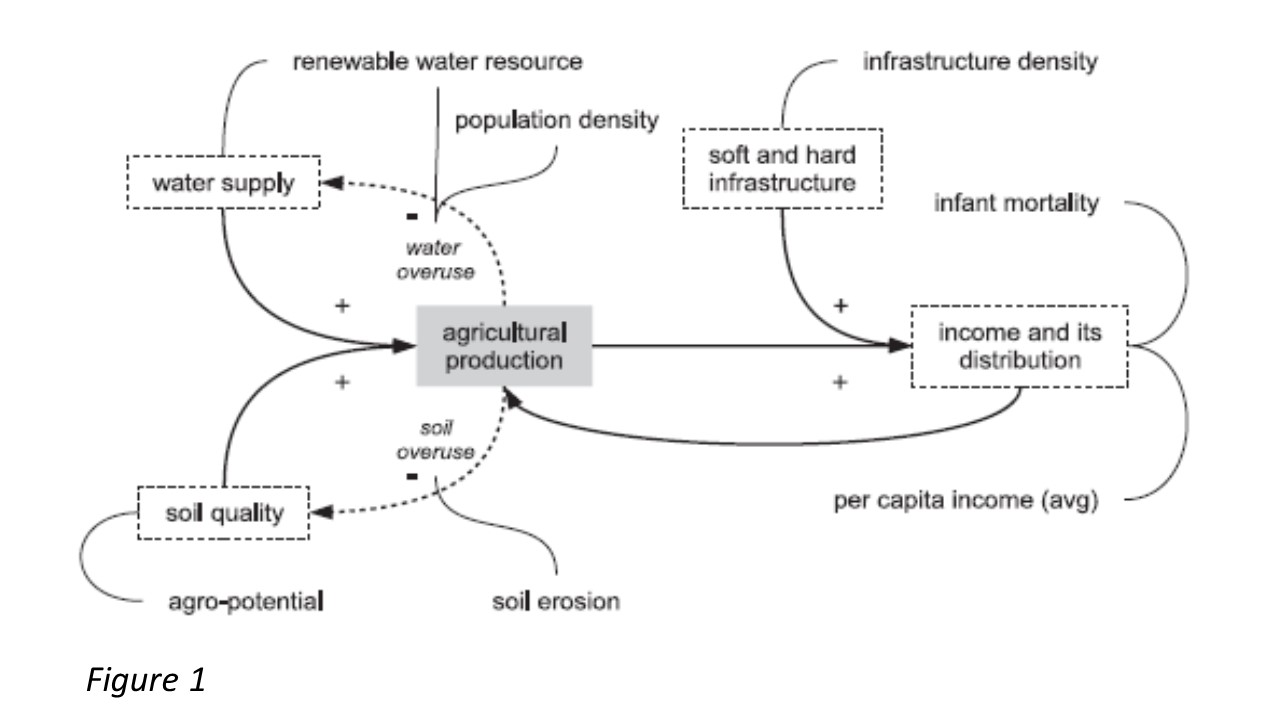
Figure 1 is an illustration for small-holder farmers in dryland ecosystems, where humans have to sustain food production in an environment of erratic rainfall. It shows a condensed influence diagram of the pattern of vulnerability, with a focus on food production, soil and water resources, and income. The boxes indicate important vulnerability determinants and the arrows show hypothesised relationships and their direction of influence. The thin lines represent the indicators that are used as proxy quantification of the determinants.
Figure 1
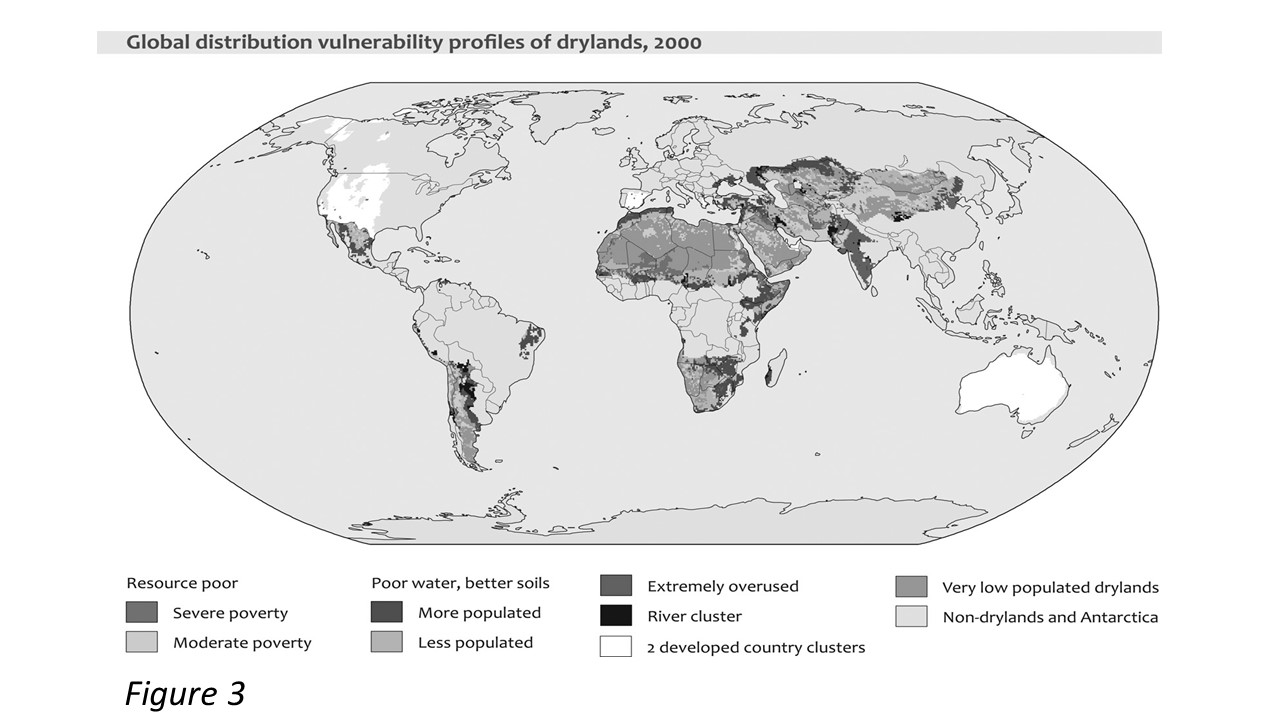
For a number of variables (water availability, soil degradation and fertility, infrastructure and population density, infant mortality and income), quantitative indicators have been collected at the grid-cell level and investigated for correlations. This leads to vulnerability profiles in the form of min-max normalized indicator values (y-axis) for each of the variables (x-axis) (Figure 2). In this way, six typical vulnerability profiles in drylands worldwide can be identified with catchwords: one river cluster, one with extreme overuse, two with resource poverty, and two with poor water but good soils. Each profile is associated with grid-cells in space and shown for each of the six, plus two additional, profiles (Figure 3). It is seen from this exercise that the resource poor regions with people in severe poverty – and characterised by high infant mortality – are largely located in a small band south of the Sahara Desert. A subsequent, more rigorous categorisation of vulnerability patterns in drylands indicates that it is indeed possible but not simple to identify generic patterns of potentially unsustainable developments in fragile regions (Sietz et al. 2011).
Figure 2
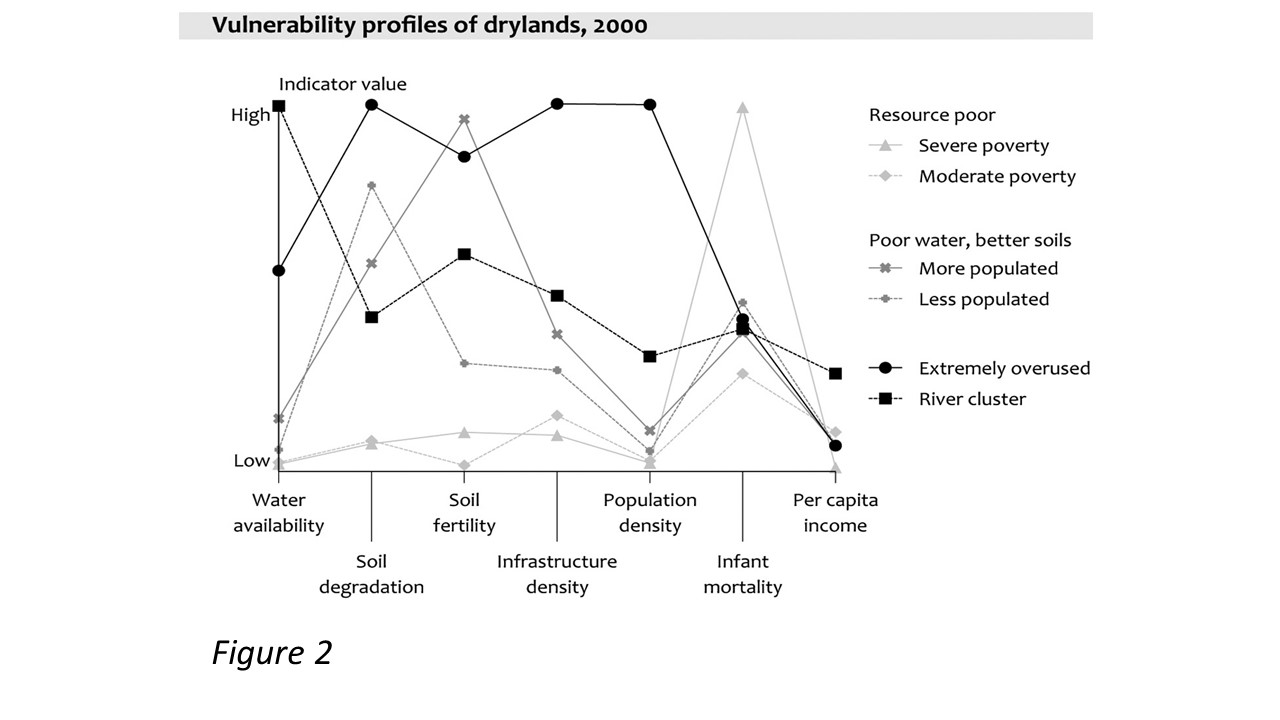 Figure 3
Why is it useful to identify and study such syndromes and archetypical patterns? In many places on Earth, people feel powerless in the face of forces that threaten their quality of life and appear to be inevitable. Many assessments are done to understand the causes of deteriorating quality of life and unsustainable development trends, but the insights gained and lessons learned often remain local or regional in their impact due to the specifics of the situation. If archetypical patterns can be identified, such local and regional assessments can provide an analogue and a remedy for other places in the world. People in one situation may then learn how to respond, adapt and heal from insights about what happened elsewhere. It provides generic insights in the dynamics that create vulnerable situations for people and can be used as a basis for further analysis of opportunities and responses to reduce vulnerability.
References
Kok, M., and J. Jäger (Eds) (2007). Vulnerability of People and the Environment – Challenges and Opportunities. PBL/UNEP Background Studies, 2007. Available at www.pbl.nl/en.
Kok, M., M. Lüdeke, T. Sterzel, P. Lucas, C. Walter, P. Janssen, and I. de Soysa (2011). Quantitative Analysis of Patterns of Vulnerability to Global Environmental Change. PBL/PIK/NTNU Background Studies, 2011. Available at www.pbl.nl/en.
Lüdeke, M., G. Petschel-Held, and H. Schellnhuber (2004). Syndromes of global change: The first panoramic view, GAIA 13(2004).
Petschel-Held, G., A. Block, M. Cassel-Gintz, J. Kropp, M. Lüdeke, O. Moldenhauer, et al. (1999). Syndromes of global change: A qualitative modelling approach to assist global environmental management, Environmental Modelling and Assessment 4(1999)295–314.
Schnellnhuber, G., A. Block, M. Cassel-Gintz, J. Kropp, G. Lammel, W. Lass, et al. (1997) Syndromes of global change, GAIA 6(1997)19–34.
Sietz, D., M. Lüdeke, and C. Walther (2011). Categorisation of typical vulnerability patterns in global drylands, Global Environmental Change 21(2011)431–440.
Sterzel, T. (2019). Analyzing global typologies of socio-ecological vulnerability. PhD Thesis, University of Potsdam
Leave A Comment