
Reading the Sustainable Development Goals (SDGs) that were agreed upon by the United Nations in 2015 in the document Transforming our world: the 2030 Agenda for Sustainable Development (sustainabledevelopment.un.org), I am struck by the high level of aspiration not to say idealism. The Goals do indeed demand a transformation and, besides focused technological innovations, crucial ingredients for its success are immaterial ‘items’ such as more equal distribution of income and wealth, community and solidarity, and social trust. These largely implicit elements of the transformation are the more difficult because of the inherent pluralism and locality and the interaction with heterogeneous geographical and resource situations. Are there universal recipes to promote these elements?
Bo Rothstein, of the Quality of Government (QoG) Institute of the University of Gothenburg has written a nice summary of some decades social science work in the field around the question: how to improve human well-being by decreasing political, social and economic inequality.
Rothstein’s rejects cultural determinism or interest based theories as an explanation of the prevailing and growing inequality in the world. Instead, and in accordance with his background as political scientist, he argues that the answer to the above question has to be found in the design of political institutions. Secondly, Rothstein proposes reciprocity as the basic human orientation in life: people are motivated in their behavior to a large extent by what they think other people are going to do. Even without personal benefit, people will therefore engage in solidaristic cooperation if three conditions are met:
- The proposed policy and required behaviour are morally justified (´substantive justice’);
- Most other people engaged can be trusted to also cooperate (´solidaristic justice´)+ and
- People are convinced that the policy can be implemented in a fair manner (´procedural justice´).
To make solidaristic behavior also sustainable, institutions should be designed in such a way that the support for just principles is reinforced by the perception of institutional performance – a positive feedback. In the real world, one often sees unfortunately that it can also become a negative feedback, in which justice and fairness are eroded in a downward spiral of distrust and institutional misconduct.
Social science theory and fieldwork tell us that social interpersonal trust is what makes reciprocity turn in the right direction. In a sustainability context, the message is that the many forms of collaborative efforts needed for the realization of the SDGs will only take place if enough people believe that other people will also behave according to the aspired moral principles. The best way to generate social trust is the existence of high-quality government institutions operating on the basis of impartiality and universalism. It means staying away from policies oriented towards minorities and stimulating choice for the responsible individualist citizen. This is an enormous challenge, that is implicit but certainly not less important in the formulation of the SDGs.
In the context of worldviews as presented in Chapter 6, the notion of reciprocity can be positioned in the middle as it acknowledges the role of trust and thus of the immaterial and the human scale. It gives an important role to ´top-down´ government institutions in anchoring justice and fairness, while at the same time giving room to ´bottom-up´ individualism and creativity. Finding this balance in setting up and experimenting with food and energy cooperatives, river and forest management, and other forms of community and regional collaboration is an ongoing adventure in the quest for sustainable development
This text is based on Creating a Sustainable Solidaristic Society: A Manual. by Prof. Bo Rothstein, The QoG (Quality of Government) Institute Working Paper Series 2011:7 (http://www.qog.pol.gu.se/digitalAssets/1357/1357838_2011_7_rothstein.pdf). University of Gothenburg.
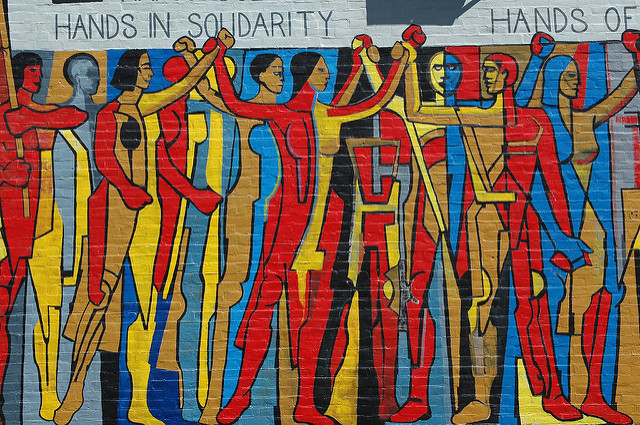
Photo credits: “Solidarity Mural”, by Terence Faircloth on Flickr. (CC BY-NC-ND 2.0)
Leave A Comment