
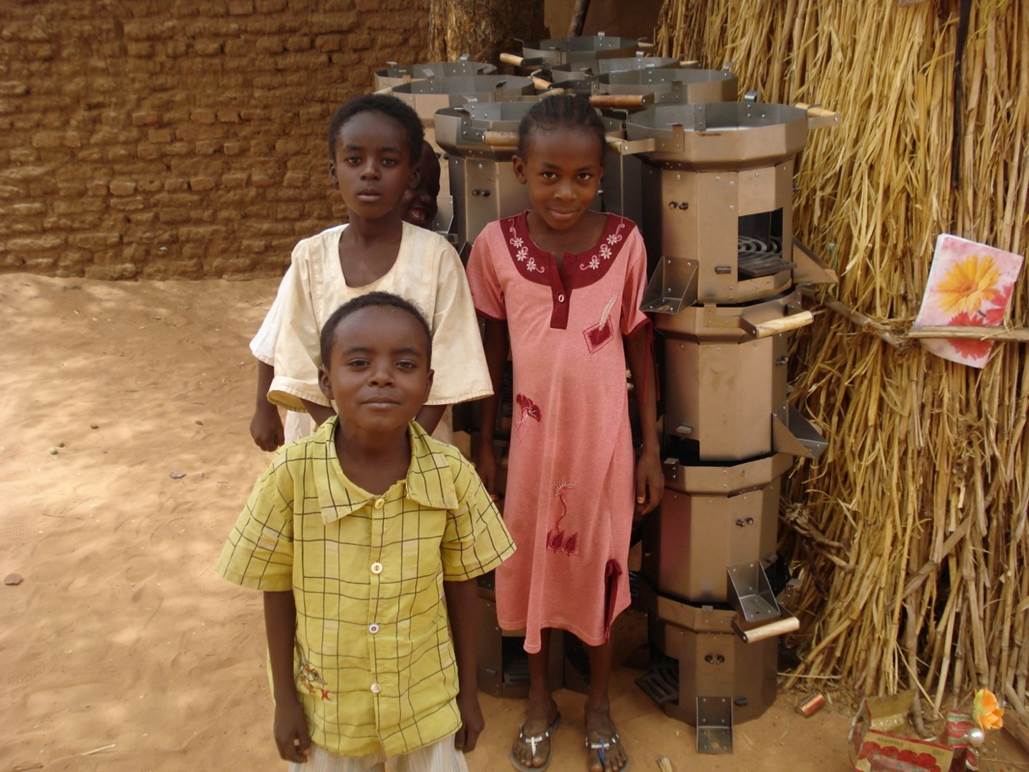
In the fall of 2005, Berkeley scientist Ashok Gadgil was asked by the U.S. Government to try to find a solution to a grave problem facing Darfuri families in displacement camps: women had to walk as long as seven hours, three to five times per week to find firewood. In response, he and his colleagues and the women of Darfur designed the Berkeley-Darfur Stove (BDS) V14. The project is a good example of sustainable livelihood improvement, as it solved several problems simultaneously. Because the BDS uses half as much firewood as traditional cooking methods, it limits harmful emissions that contribute to global warming. Users save $300 per year in fuel costs. Over the five-year life span of the stove, this savings is approximately $1,500. Reduced excursions for firewood collection translate into rest and relief for the exhausted women in the displacement camps and time that could be spent with family or on income generating activities. As to safety, the stove reduces the need for women to leave the camps in search of firewood and it thereby reduces their exposure to sexual assault and violence. It also contributes to health because it limits toxic pollutants released that cause respiratory diseases such as pneumonia.
The BDS was developed by scientists and engineers at the Lawrence Berkeley National Lab, with evaluation and feedback from women in Darfur. They brought together the world’s best minds in engineering to develop a simple, locally appropriate technology and to provide ongoing technical support to the field partners. The BDS is well-adapted to the local situation. It is specifically tailored to the windy climate, the sandy terrain, the pot sizes and the cooking style of families living in the displacement camps in Darfur. The local participation of the women in Darfurprovided feedback at every step of the process, ensuring the stove design fits their needs. The local employment and low cost due to its manufacturing process are also beneficial. The BDS starts out as sheet metal pieces stamped out in India. These ‘flat-kits’ are shipped to Sudan where they are assembled by the Sustainable Action Group, a Sudanese NGO affiliated with the project partner Oxfam America. The total cost to fabricate, ship and assemble each stove is $20.
The Darfur Stoves Project and its partners produced over 15,000 stoves by the end of 2010. Each year they are in the field, these 15,000 stoves save Darfuri women as much as $2 million in fuel expenses and offset more than 20,000 tons of greenhouse gases, which is equivalent to taking > 4,000 average-sized cars off the road in the United States. An estimated 300,000 families are in need of a fuel-efficient stove and the goal is to distribute a BDS to each family. This project teaches at least two lessons for a project to succeed: you have to ‘walk with the people’, and there are always winners and losers and you have to identify them. (Photo courtesy Ashok Gadgil).
Leave A Comment