
Can we understand the role of human behaviour in renewable resource exploitation? To explore this question, we constructed an imaginary island called Lakeland, with a local population catching fish for its livelihood, having the possibility to exploit a goldmine and the option to permit large, foreign trawlers to fish in their waters. Based on an underlying system dynamics model (see http://www.sustainabilityscience.eu/2020/local-fisheries-layers-of-overexploitation/), an agent-based model (ABM) was built to better understand the role of heterogeneity in needs satisfaction and risk perception of the population, that is: the agents. Let us call the agent consumats and give them the following stylised characteristics:
- they are equipped with certain abilities for fishing and mining and they allocate their time to leisure, fishing and mining according to their individual preferences; and
- they spend the money earned from gold mining on fish imports and on non-fish consumption ‘luxury’ goods – the opportunities.
Most importantly, agent behaviour as producer (ability) and consumer (opportunity) depends on their level of satisfaction and level of uncertainty. Each consumat only behaves economically rational if he is not satisfied and certain. This behaviour is called deliberation (reasoned or individual) and is characteristic of the homo economicus. But agents can also behave differently: imitation (automated and socially determined) if satisfied and uncertain, social comparison (reasoned, socially determined) if unsatisfied and uncertain, and repetition (automated, individual) if satisfied and certain (Figure 1).
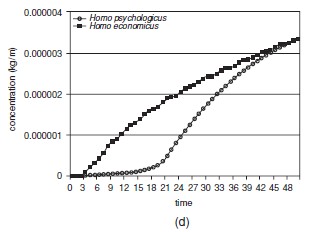
The consumats can satisfy their personal needs by exploiting two natural resources: fish and gold. Which strategy a consumat chooses depends on present and past levels of need satisfaction and uncertainty. The four options are shown in Figure 14.12. For instance, if a consumat is satisfied and highly uncertain, she will resort to automated socially determined behaviour. Each consumat updates every timestep in the simulation his memory with information on his own and other agents’ performance. Allocating time and money, it leads to certain levels of needs satisfaction and uncertainty. The needs considered are proxies for leisure, identity, subsistence and freedom What can we learn from this model about sustainable development? Development in Lakeland happens because agents switch strategy if their performance falls below the expectation they build up in their memory. They are in a social dilemma situation: each consumat is inclined to get as much income at the lowest effort possible, but in doing so they may collectively destroy the option to sustain income and quality of life for the long term. Some illustrative outcomes are shown in Figure 14.13. To keep the analysis transparant, two archetypical consumats are defined: the Homo economicus (He) and the Homo psychologicus (Hp). The former favours deliberation, because he operates with high levels of need satisfaction and uncertainty reduction. The latter is quickly satisfied and an uncertain imitator. Let us assume fishing is the only option. If initially everyone is a rational deliberator He, the fish stock is depleted before year 40 (Figure 14.13a). The Hp, On the other hand, if everyone is happy to spend their time as lazy, poor repetitors and imitators until the initial budget is spent, many of them become unsatisfied (in year 18) and switch to deliberate behaviour in order to restore income (Figure 14.13b). As a consequence, the fish stock will still be depleted but much later (Figure 14.13a,b). The two consumat-types have a very different financial budget profile and in the He-collapse period there are large income differences amongst the agents (Figure 14.13c). If uncertainty is completely removed, the He does not overharvest and the Hp spends even less time fishing. This is in agreement with the finding that uncertainty tends to cause resource overexploitation (May 1977). Figure 1a-c. Illustrative pathways in a fishing-only no-gold-mining consumat world for the Homo economicus (He) and Homo psychologicus (Hp) in the first 50 timesteps (averages for 100 simulation runs) (Jager et al. 2000). (a) The fish stock, (b) the proportion of time spent in one of the four strategies (c), the financial budget. If the consumats can engage in gold mining as an additional source of income, a transition happens from a fishing into a mining community for both He and Hp. Both do pollute the lake, with a negative impact on the fish stock (Figure 14.13d). The He are keen to grasp the new income opportunity and the fish stock is less intensely exploited. The Hp switch at a slower rate to mining, suffer more from pollution impacts and are forced into an accelerated transition to mining. Both development pathways show the same irreversible transition towards mining and a degraded environment – a story that can be told for many places on earth. Figure 2. Illustrative pathway of the pollutant concentration in the lake in a fishing and gold-mining consumat world for the Homo economicus and Homo psychologicus in the first 50 timesteps (averages for 100 simulation runs) (Jager et al. 2000). In the Modernity worldview, such catastrophes are to be averted by discovering and implementing labour-saving innovations. So what happens if an innovative deliberating consumat increases his productivity (fish caught per hour)? In a world dominated by He, the innovation makes one individual more productive than others and it rapidly spreads in this competitive and entrepreneurial world through imitation. As a consequence, the fish stock is depleted faster than without the innovation. This is precisely what happened when fishing boats became more effective. It illustrates the ambiguity of technology: innovations in resource exploitation are both cause and solution of sustainability problems. What happens when the world is dominated by Hp? Nothing, really: he is easily satisfied (is he lazy?) and does not engage in deliberation (is he stupid?). [1] These needs are supposed to play an important role and are selected out of a larger set of needs, as described by Max-Neef (1991) (§6.2). —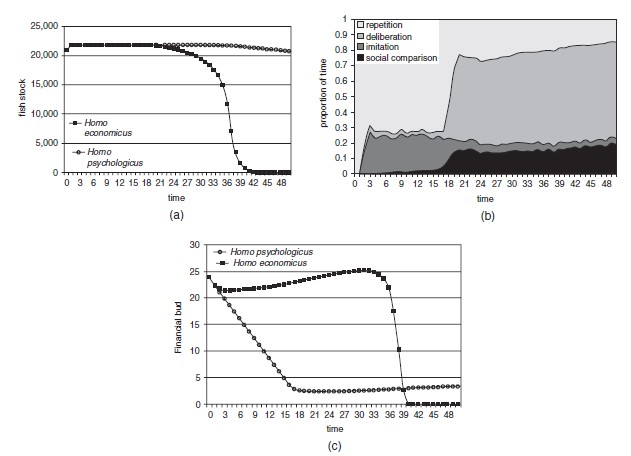
Leave A Comment