
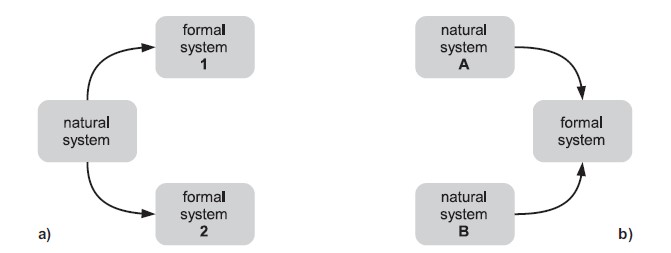
In an abstract scientific sense, modelling is a coding process and creates a relation between a ‘natural’ and a ‘formal’ system (Figure 1a; Rosen 1985). As scientists refine existing and construct new theories, there may (temporarily) be two different formal systems to describe the same natural system. An example of such complementarity is the wave and the particle description of light. Conversely, two different natural systems may apparently be so much alike that they can be described with a single model. They are analogies or, if the isomorphism is rather loose, metaphors (Figure 1b).
SEE ABOVE: Figure 1a-b. Representations of isomorphic relationships between ‘natural’ object and ‘formal’ model system: complementarity (a: left) and analogue or metaphor (b: right) (after Rosen 1985).
Such isomorphisms play an important role in the construction and communication of scientific knowledge. Their use reflects the search for universal principles governing the phenomenal world. Analogs can provide a powerful heuristic to understand complex systems in terms of (a model of) a simpler and better understood system and can help to generate shared models. Famous examples of ‘borrowing’ from physics and chemistry are Hartley’s hypothesis that the human heart works like a mechanical pump, Laplace’s comparison of the planetary system with a mechanical clock, Carnot’s use of running water to understand extraction of work from heat, Freud’s evocation of the human psyche as a steam engine and the description of economic processes as analogues of chemical and mechanical equilibria.
Metaphor is deeper: “metaphor is pervasive in everyday life, not just in language but in thought and action” (Lakoff and Johnson 1980) and broader and looser. It transfers meaning by conveying the idea that, some, but not all characteristic properties are similar in two systems. It appears that they play an important part in the brain’s cognitive mechanism by connecting disjoint domains of experience (Johansson 2022). This is particularly relevant in describing complex systems where the language of mathematics cannot be applied. Boulding (1978) used the metaphor of the Cowboy Economy as an image of unlimited economic expansion and the image of Spaceship Earth became a symbol of enlightened engineering, often contrasted with the image of Mother Earth. Using metaphors to elucidate a new and unfamiliar concept by invoking another, presumedly more familiar concept can also be confusing or misleading. One reason is that metaphors also reflect worldviews (§6.3). For instance, the metaphorical term ecosystem management carries over the idea that an ecosystem is something to be managed and hence utilized.
Literature
Many books have been written on this topic, for instance
Lakoff, G., and M. Johnson (1980-2003). Metaphor we ive by. The University of Chicago Press, Chicago
Leave A Comment