
Climatic changes have always played a role in human history. Often, it resulted from large volcanic eruptions, which caused a decline in temperature with serious impacts on food supply. Slow variations in geological evolution and planetary position played a role too, at (much) longer time scales. All climatic changes and their impacts tended to be different across different regions. Besides, impacts on human groups and societies can only be assessed within the particular context of such a society: the response of elites, the range of adaptation options etc. (Frankopan 2023).
It is therefore best to consider climate change as an additional stressor, which can range from one-time shock events and its impacts – think of volcano eruptions an subsequent bad harvests – to slow trends in climate parameters such as average temperature or precipitation. When reading alarmist or reassuring items in newspapers or on social media, remember a sentence by Frankopan in his discussion of the Little Ice Age (c. 1550 – c. 1800): “Extensive though the climatic rearrangement was, however, it is important to underline that in many cases the unsettled and unusual weather conditions serves to accentuate existing vulnerabilities rather than act as primary causes of disaster… climatic stress served to bring ongoing issues to the boil.” (Frankopan 2023:406). With this in mind, it is interesting to look at medieval Europe.
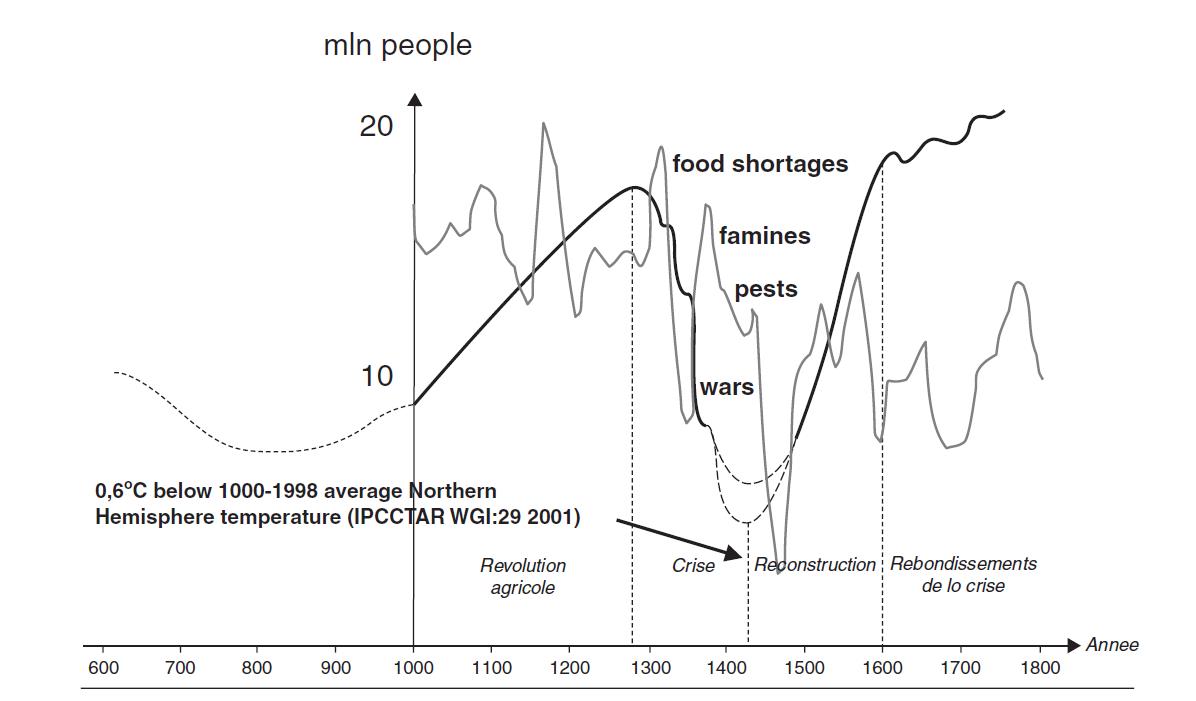
How fragile the situation was in medieval times is illustrated in the historical reconstruction of population numbers in medieval France between the year 1000 CE and 1800 CE (Figure 4.8). The graph above shows France’s population and average Northern Hemisphere temperature relative to the period 1961–1990 (Mazoyer and Roudart 1997). Detailed analyses of agricultural practices and techniques reveal an increase in potential population density since the Carolingian era. A farmer in Mediterranean Europe needed in 900 CE about 16 hectares (ha) of which two-third were pasture to feed a five-person family. This could sustain a population of 20–30 persons/km2. In Mid- and Northern Europe, these numbers were 34 ha and 8–15 persons/km2, respectively. This gradually rose to 30–80 persons/km2 around 1250 CE (Mazoyer and Roudart 1997).
In the 14th century, a series of famines, pests and wars set in, possibly related to rather sudden drops in temperature. A beautiful historical account is given in Barbara Tuchman’s book A Distant Mirror: The Calamitous 14th Century (1978). Thereafter, there was a remarkable recovery as the fall in population liberated large amounts of productive land and better fertilization strategies and tools were applied, such as the use of nitrogen-fixing clover and the horse-drawn plough. It led to further increases in yield on especially the northern soils and the population quickly recovered to a new plateau with a densities up to 160 persons/km2. This period in European history is a dramatic illustration of a cycle of expansion and decline where both natural and social forces are simultaneously at work.
Population of France between 600 CE and 1800 CE. The population data are based on Mazoyer and Roudart (1997). The dotted curve indicates the average Northern Hemisphere temperature relative to the period 1961–1990 (IPCC 2001).
Literature
Butzer, K. (2012). Collapse, environment, and society. PNAS 10(2012)3632-3639
Frankopan, P. (2023). The earth transformed: An untold history. Bloomsbury Publishing, London
Mazoyer, M., and L. and Roudart (1997). Histoire des agricutures du monde. Editions du Seuil, Paris
Leave A Comment