
The firm house lingers, though averse to square
with the new city street it has to wear A number in.
But what about the brook
that held the house as in an elbow-crook?
I ask as one who knew the brook, its strength
and impulse, having dipped a finger length
and made it leap my knuckle, having tossed
a flower to try its currents where they crossed.
The meadow grass could be cemented down
arom growing under pavements of a town;
the apple trees be sent to hearth-stone flame.
Is water wood to serve a brook the same?
How else dispose of an immortal force
no longer needed? Staunch it at its source
with cinder loads dumped down? The brook was thrown
deep in a sewer dungeon under stone
in fetid darkness still to live and run –
and all for nothing it had ever done
except forget to go in fear perhaps.
No one would know except for ancient maps
that such a brook ran water. But I wonder
if from its being kept forever under
the thoughts may not have risen that so keep
this new-built city from both work and sleep.— Robert Frost
परोपकाराय फलन्ति वृक्षाः परोपकाराय वहन्ति नद्यः|
परोपकाराय दुहन्ति गावः परोपकारार्थमिदं शरीरम् ||
Translation: It is for the benefit of others that the trees bear fruit. Rivers flow for the benefit of others. Cows yield milk for the benefit of others. Similarly, our human body is meant to serve others.— Ancient eastern wisdom
Dev means god. Nadi is river. Literally Devnadi is the river of god.
There is no mention of the Devnadi in the records of the Pune Municipal Corporation in whose jurisdiction it flows. Nor is it mentioned in the records of the Survey of India who survey, document and map the territory.
The new smart city of Baner has grown over it. In parts the Devnadi is put deep in a sewer dungeon. In parts it is bound in cemented walls that take away its 60 meter width and fit it into 2. In parts it has been replaced by 9 or 12 storey buildings built on the debris dumped to claim the Devnadi. In parts it has lost the trees to fire furnaces or make furniture. Perhaps Robert Frost travelled time an described the Devnadi in his poem on the Brook in the City. Perhaps his poem narrates the story of every brook across the world.
In any case the Devnadi was not always like this. This is the story of the Devnadi. Perhaps the story of the people who want to save every brook in every city so that it may resemble Tennyson’s Brook, not Frost’s Brook in the City.
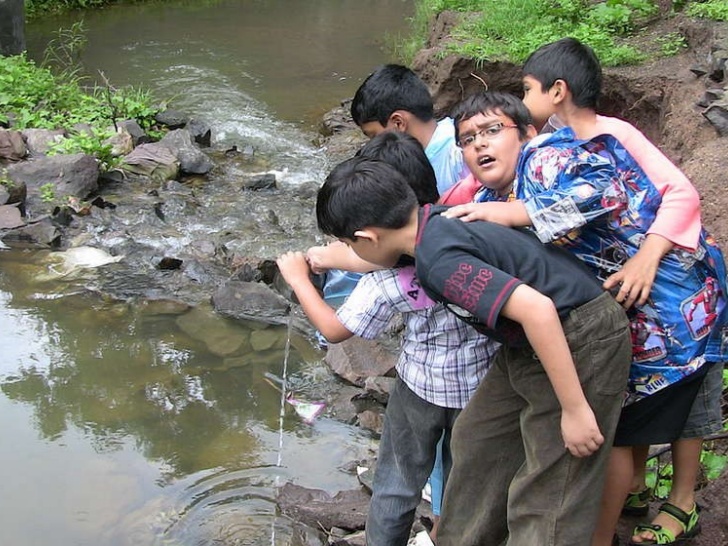
The Devnadi was perhaps the reason I moved into my apartment in Baner village on the outskirts of Pune, in 2008. My apartment’s balcony overlooked a 60 meter wide green with a brook within. The green was littered with construction debris left behind by the company that built and sold my apartment and those that built the neighbouring ones. Instead of seeing the dump, I saw it for what it could be – a small urban forest with a waterbody.
The garden superintendent of the Pune Municipal Corporation thought my dream was absurd. He said urban brooks are small – barely 2 meters wide and with mostly sewage flowing through. When he came over, at my insistence, he was amazed. He could see himself convert the brook into a Japanese garden, from its origin to the point it met the river Mula – a distance of approximately 5 kilometres. I talked with my neighbours in my my apartment and the neighbouring ones. The excitement grew. Some saw jogging tracks, others envisioned children parks. Few saw an urban forest. We found a common purpose of protecting the land of the brook. We began by clearing the debris. The children were excited to see mongoose, occasional snakes and rabbits. Dozens of species of birds. A year later we finally got the new garden superintendent of the Pune Municipal Corporation, who had replaced the one wanting to make a Japanese garden, to help us to plant 100 trees in the space behind my apartment.
Dr. Rajendrasingh, Magsaysay Award winner and India’s waterman, heard of our initiative. When we heard he was coming to see what we had done, enthusiasm doubled. Rajendrasingh pointed out that our little brook could actually flow throughout the year. He told us how we could build check dams to slow the water and allow it to percolate. He explained that the brook helps the earth to fill itself with water. Once full, the earth releases the excess water to allow the brook to flow.
After 2 hours every Sunday for a few weeks, our first check dam was built. The monsoon brought water and the stream flowed for more than 9 months. Rajendrasingh declared that the Devnadi was reborn. The sound of the flowing brook playing with the rocks, the kingfisher announcing its dives, the coots announcing their territory, the warblers their arguments, filled the Devnadi. Our wells were full to the brim even after the Devnadi ran out of flow. Devnadi was true to its name, the river of God.
We realised the brooks recharge our groundwater. They keep the perennial flow of the rivers that they join. They are the lifeline of rivers, groundwater and of all the biodiversity in our city. We released the brooks magically bring joy, serenity and peace.
Then one day in August 2010 JCBs, the earthmoving machines of mass destruction, turned up to move the banks, change the shape and channelise the Devnadi in cement. We convened the local residents into a body of residents, the Baner Area Sabha. The engineers of the Pune Municipal Corporation explained that the brook was a storm water drain and had to be channelised under the Jawaharlal Nehru National Urban Renewal Mission, a World Bank funded project. When dialogue and discussion failed, and we saw concrete being poured over the fresh water springs at the origin of Devnadi we decided to approach the courts.
A Public Interest Litigation was filed with the prayer to prohibit concreting or altering any urban stream in the state. Neither the Constitution of India nor any of the laws framed by the State and Federal Government protect rivers, much less a brook. The court referred the matter to the Ministry of Environment. Many Expert Committees later the Ministry’s recommendations to prohibit concrete, protect the natural course and width, free from encroachments, free from sewers, and afforest 10 meters on either side were ordered by the Mumbai High Court in April 2012.
Only if the rule of law prevailed! In June we were already back to the court highlighting contempt of the court’s orders by ignoring the directions and continuing to destroy the brooks across the State. Judging by the fact that the court is yet to rule on the contempt petitions filed in 2012, the court’s ability to rule on contempt petition seems restricted.
The Constitution of India and the Laws of the Union of India or its States has little protection for rivers. It became obvious that the mechanical process of courts in following laws would yield limited protection to the brooks that bring magic into our lives.
We realised that we need a legislation to protect our brooks and rivers. We began work to create a draft legislation for the restoration and conservation of rivers. Working with river activists, environmentalists, government officials, citizen groups across India and many workshops and drafts later, in January 2014 we had the first draft of the legislation. Rajendrasingh and I handed over copies of the draft to dozens of Members of Parliament and Chief Ministers of several states. The legislation recognises the important role of the river in the water-cycle. It has three parts: The first part requires the identification, notification and protection of rivers. The second lists permitted and prohibited activities. The third part creates a governance structure that ensures those with a skin in the protection of rivers can govern.
Almost 5 years on and dozens of workshops, meetings and campaigns later we wait for the legislative process to overtake the destruction of the brooks across India. Maybe you will enact it through your legislators to lead the way. That would be truly awesome. Devnadi would have changed the way we look at our brook. In the meantime the Devnadi waits to be freed from its concrete prison, the deep dungeons with sewers and of buildings that have been encroaching its land.
That would be the day the river of God would bring magic back into our life.
Additional references:
Leave A Comment