
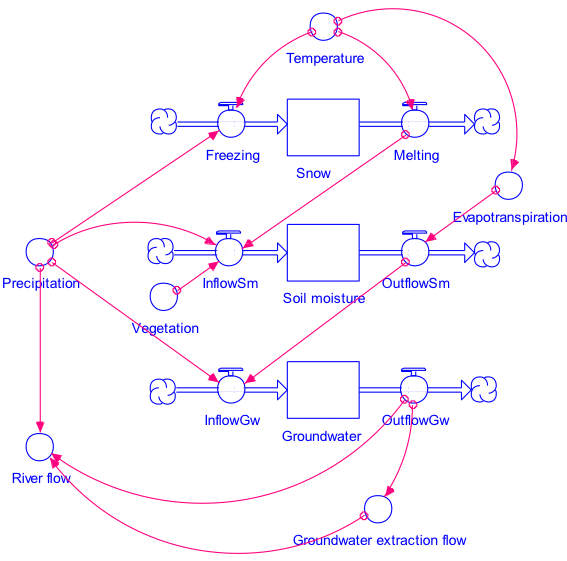
 A simplified scheme of the hydrological stocks and flows is given below. The climate variables precipitation and temperature over time are the most important input variables. Rainwater will fall upon the vegetation and partly flow out as runoff and partly evaporate, and the remainder penetrates the soil where it adds to the stock of soil moisture (‘green water’). In cold periods, part of the rainwater will freeze and the resulting snow cover will act as a temporary water stock with a buffering effect. The flows and stocks contribute to the charge and discharge of groundwater reservoirs, which also act as a buffering stock. Human water extraction occurs directly from rivers and lakes (‘blue water’) and from groundwater stocks, and indirectly from the soil. Drought can happen in one or more parts of the ‘sociohydrometeorological system’ and propagate from a precipitation deficiency via soil moisture decline to below-normal groundwater levels. Understanding the temporal and spatial patterns of the propagation of rain and temperature variations throughout the system is of great help in adequate water management in river basins. It is also important in anticipating the impacts of climate change.
One of the natural catastrophes with often severe consequences for human beings is drought: a sustained period of below-normal water availability. To understand the characteristics and mechanisms of drought, one has to investigate longitudinal data on a number of variables of the hydrological system in situ, such as precipitation, temperature, vegetation and soil, and groundwater storage and discharge. Together they make up a system in which drought signals propagate through the terrestrial part of the hydrological cycle. One scientific problem in understanding drought is the distinction between the natural causes i.e. the situation undisturbed by humans, and the man-induced changes due to water extraction for irrigation and land use/cover changes (LUCC). One way to proceed is to analyze the available data on various river catchments, separating the period with no or only minor influences by humans from the, usually later, period of noticeable and often growing human interventions. The next step is then to construct a hydrological model of the ‘natural’ situation, parametrize it for the early period, and compare for the later period the actual data with a simulated ‘natural’ state. The differences, or ‘anomalies’, provide insight in the degree to which a drought results from human water use.
The second paragraph is based on the PhD dissertation of A.F. van Loon: On the Propagation of Drought – How climate and catchment characteristics influence hydrological drought development and recovery. Wageningen University 2013. The dissertation describes the modelling and empirical testing of drought occurrence in three European river catchments and an evaluation of their use on the global scale.
Leave A Comment