
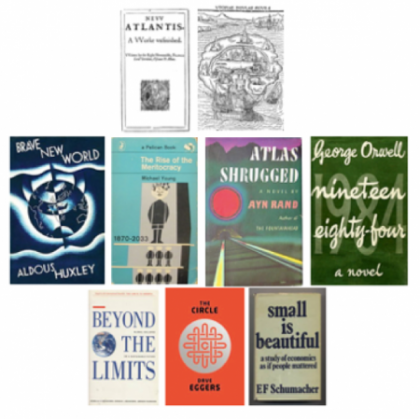
Worldviews often orient themselves to particular ideals, about human individuals and societies. Famous descriptions of an ideal society in literature are known as utopias: a place (τοπος) that is good (ευ) – or, in another interpretation, is not (ου). In his book Utopia (2006), Achterhuis proposes three criteria for a imagined future to be a utopia: feasibility, the nature of
Descriptions of an (more) desirable, ideal world have a long history. What else is Paradise in the Old Testament and The State by Plato than a utopian narrative about a lost or an ideal (or both lost and ideal) world? In western culture, two famous ones are Utopia, published in 1516 by Thomas More, and The New Atlantis, published in 1627. They have been followed by many others, some well-known – usually in English – and many less known. The Communist Manifesto (1848) promised the European proletariat a bright socialist future. Achterhuis distinguishes between a social utopia and a technical utopia. Whereas the former imagine the institutions and rules that are needed to let people live in harmony with each other, the latter see the victory over natural threats, from diseases and famine to floods and volcanoes, as the main focus. Technical utopias have become the more widespread form since the enormous advances made in science and technology in the last few centuries. They are in a less literary form, as science fiction, widespread and overlapping with government and business outlooks on and funding for research.
Interestingly, both forms of utopia can turn negative in their practical consequences – they become a dystopia. Perhaps most famous is the satirical failed social utopia 1984 by George Orwell, written in 1949. Everywhere there are signs BIG BROTHER IS WATCHING YOU: the dreaded Thought Police, and the three remaining superpowers are perpetually at war with the other. Although set in the era of Stalinist Russia and the Cold War, the 21st century information technology gives this dystopia a new meaning. Equally famous is Huxley’s novel Brave new world, which can be considered a technical utopia turned upon itself. As in 1984, the state is the main agency but now as the controller of a perfect world. Science permits the complete conditioning of people in the name of maximum happiness for everyone, implying the elimination of personal misery and initiative. Recent developments in genetic engineering and pharmacology bring this dystopia closer than many had imagined only a few decades ago. Both dystopian futures re-emerge in the book Atlas shrugged (1957) by Ayn Rand, which depicts a USA collapsing under the creativity and initiative destroying forces of government interventions and workers’ socialism. The author advocates a survival-of-the-fittest capitalism and individualism and a rational selfishness, that made her the hero of the American libertarian movement.
In the context of sustainability, a new brand of mixed social-technical utopia is worth mentioning and is often given the generic name Ecotopia: the ideal world of the ‘mixed bag’ of followers who manifested themselves, for instance, around the millennium as ‘alterglobalistes’. It emanated from the concerns about large-scale environmental destruction as described in the report to the Club of Rome Limits to Growth (1971) and A Blueprint for Survival (1972). These utopias had predecessors in the romantic and spiritual writings of authors such as Thoreau in the USA, Hesse in Germany and Van Eeden in The Netherlands, and the associated experimental communes. As described by Campbell in The Easternization of the West (2007), they merged with protests against “the Western worldview […] that accorded priority to rationality, logic, and analysis” in the form of beatniks, humanistic psychology and an increasing flow of influences from Eastern cultures. Some saw and see in these reports the invitation for a new social utopia, a new Green Manifesto; but others feared and fear the implications such as birth control, communes and ‘Buddhist economics’ – the original title of Schumacher’s book Small is beautiful (1971) – as a road to ecofascism. When ecofascism approaches a dystopian mixture of a B2-B1-world, Atlas shrugged comes close to a dystopian mixture of an A1-A2-world – and the adherents of these two worldviews are, expectedly, antagonistic to each other. A similar dialectic took place with Young’s book The Rise of the Meritocracy (1958). The author describes the rise and subsequent devolution of a system in which political power comes in the hands of individuals on the basis of their personal talents, merits and achievements. Meritocracy creates a new powerholding elite and a large underclass whose leaders have been estranged from them, an explosive mixture that ends with revolution. This interpretation is quite different from the way in which the word is used by present-day neoliberals.
Perhaps the most recent novel in this genre is The Circle by Dave Eggers. It pictures a world in which the sole survivor in what has been called ‘surveillance capitalism’ is the company The Circle. The main character in the book ponders: “Outside the walls of the Circle, all was noise and struggle, failure and filth. But here, all had been perfected. The best people had made the best systems and the best systems had reaped funds, unlimited funds, that made possible this, the best place to work.” The company develops its wave of internet-innovations only for the benefit of mankind. It aspires to create a world in which SECRETS ARE LIES, SHARING IS CARING and PRIVACY IS THEFT, with the argument that transparency induces everyone to become a good person and eliminates all crime. Yet, what comes out of it is a digitech-dystopia. A Circle-cult emerges with features that outperform Orwell’s Big Brother but ostensibly with a different motivation. The novel is a timely warning in an era in which a few giant ICT-companies and the associated commercialism rapidly dominate the trends with respect to important values and institutions such as privacy, democracy and money.
Utopias and dystopias often overlap with science fiction books and films. Until the mid-20th century, most were either technotopias with marvellous new inventions or dystopias with natural disasters or alien invasions. More recently, human-made catastrophes have become part of dystopian narratives, notably about impeding climate change. A recent example is the booklet by Oreskes and Conway: The Collapse of Western Civilization – A view from the future (2014). The authors are both historians of science and describe the 21st century from the perspective of a historian living in the year 2100. By that year, so the story goes, the world has experienced a 5+ oC change in average surface temperature…
Other readings:
- Ayn Rand, Atlas Shrugged. Random House, New York 1957
- Michael Young, The Rise of the Meritocracy. A Pelican Book, London 1958
- Aldous Huxley, Island. Harper and Brothers, New York 1962
- Herman Kahn and Anthony Wiener, The Year 2000. MacMillan, New York 1967
- Alexander King and Bertrand Schneider, The first global revolution. Pantheon Books 1991
- Robert Heilbroner, Visions of the Future. Oxford University Press, Oxford 1995
- Paul Raskin et al. Great Transition: The Promise and Lure of the Times Ahead. SEI, Boston 2002
- German Dream – Träumen für Deutschland. DTV, München 2007
- Dave Eggers, The Circle. Vintage Books, New York 2013
- Naomi Oreskes and Erik Conway, The collapse of western civilization. Columbia University Press 2014
Leave A Comment