
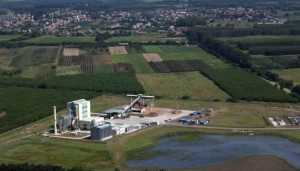
The South Nyírség region in the North-Eastern part of Hungary was traditionally an agricultural area, renowned for its tobacco and apple production. Since the transition in 1990, local agriculture has gradually lost its importance. Apple export to the Soviet market has stopped, tobacco production has dropped and other agricultural activities are hindered by the relatively low quality of soil. Today most of the landowners want to plant trees. Trees grow on lower quality soil and there are subsidies for afforestation. When the South Nyírség Project in 2003 began, there was about 80.000 hectare (ha) of privately owned forest and about 70.000 ha of state-owned traditional forests in the South Nyírség region. Most of the new plantations include fast growing species such as black locust, or poplar and the produced wood is typically used for pallet production.
The Project was initiated by local governments and entrepreneurs, because of high unemployment and outmigration of skilled workers. A logical choice was biomass-based power generation. Hungary was already in the process of EU accession and it was expected that regulation would support renewable energy production. A company was founded, that established strategic cooperation. Project development took more than four years. The local government of Szakoly village offered 20 ha, that had to be requalified from agricultural to industrial land and dozens of permits had to be obtained. Connection to the network had to be negotiated with the owner of the local public network, the German company E.ON. The major challenge was finance. In 2007, the banks agreed to give a loan 85% of the €55 mln investment – so 15% equity had to be collected from elsewhere. Another company was formed to finance a complex structure with four shareholders, who each had their own interests. Given the rather unfriendly legal, regulatory and economical environment, the close relationship with the local society turned out to be crucial.
In December 2007, the first greenfield biopower plant in Hungary started commercial operation after an official ceremony and blessing by the priests of Szakoly village. The fuel is woody biomass, delivered on a contract basis with 20-30 small, local suppliers and the state-owned forestry company of the region. The latter covers 10-20% of the fuel demand of 180-200 kt/yr (wet). Thin branches, trunks, bark, vegetation from flood areas of rivers and trees from old orchards are chipped, sorted on size and used in the power plant. Research is started on how to utilize the ashes. There are also cooperative biomass plantations. Obstacles are the inefficiency of the state run subsidy program (farmers receive subsidies a year after plantation) and the fluctuations in the agricultural prices (when the price of traditional agricultural products go up, the landowners switch back to them). Also, managers of the cooperative also tend to favour making money through buying up and selling biomass than good plantation management.
Economically, the situation is still somewhat precarious. The first years of production were below expectation but suppliers and operators are on a learning curve. The financial crisis in 2008 made the banks more demanding and project revenues are too small for economic operation because of a low feed-in tariff – at € 100/MWh well below the Central-European level. The government says that a higher tariff would increase the electricity price and is therefore not possible for commercial and social reasons. External benefits of small-scale renewable projects such as lower unemployment payments, higher taxes and avoided emissions are apparently still not considered.
Economic and energetic performance will be improved with the use of waste heat in a greenhouse, which is expected to produce 2500 t/yr of vegetables that meet the European ‘bio’-standard and to employ 80-100 people. The project demonstrates the opportunity for a paradigm shift in rural development. A national plan shows that the construction of 50-70 similar plants in the 5-20 MWe capacity range can help Hungary to reach the 2020 EU-target for renewable energy production, avoid up to 3 Mt/yr of CO2-emissions and employ over 10000 people. The project shows that growing biomass for fuel supply is an interesting energy option for (parts of) Europe.
An update on the story as of May 2013:
There are two sides of the story. From sustainability point of view, it is a success story. The biopower plant runs well, employs people, buys up locally grown biomass and pays local tax. It helps Hungary meet its renewable energy targets. The business side of the story is dark. The project attracted the attention of players who saw the project as a tool to make money. They took the project away from those, who created it. It happens in business life. There is, however, a time-coincidence between the ownership change and the political take-over in Hungary.
An update on the story in April 2017:
The story of the Szakoly Project demonstrates how much renewable energy production depends on local politics. At least in countries, which do not maintain a stable economic and regulatory environment.
The Szakoly Plant, the fruit of a nice regional development and renewable energy initiative, was inaugurated under a leftist government. When a new, rightist government took power in 2010, it was politically necessary for them to destroy the Project, as a successful creature of the “communists”. Technically it was easy. The state-owned Hungarian Development Bank, as member of the financing consortium, discontinued providing working capital for the Plant. Debt was piling up, and the owner Hungarian-Japanese joint venture had to quit. The implementation of the greenhouse project also became impossible.
The financing banks let a private person come in, who made several million Euro’s damage for the suppliers of the Plant. This person is under criminal investigation today, but the Plant became insolvent under his ill-fated ownership and was facing liquidation. New owners showed up, who made efforts to consolidate the situation. They needed two years to clarify the mess, and then sold the Plant to Veolia, a multinational utility company.
At this moment the Plant is operating normally under the professional control of Veolia. However, they are not supposed to operate the Project with a fair profit. On the one hand, they have to deal with the huge debt left by the former owners. On the other hand, the feed-in-tariff period will end within a couple of years, and nobody knows what support will be available for such plants thereafter.
Unfortunately, the Hungarian government looks at renewables as a burden, and tries to avoid making sacrifices. As a member state of the EU, Hungary has to comply with the 20-20-20 obligations. Still, no wind capacity has been created since 2006, only one green field biomass power plant (the Szakoly Plant) has been built since Hungary’s EU accession. The Hungarian biogas sector is in a crisis, and so far Hungary has not excelled in solar energy either. While not much is happening in the real life, government officials claim that Hungary is a frontrunner of renewable production in Europe, and will start working on the 2030 targets from 2018. This strange statement is based on the recalculation of residential firewood statistics. In March of 2017 the government-controlled Hungarian Statistical Office retroactively recalculated the residential statistics, and found that it is 150% more than believed. With this new figure Hungary is up to its target, and the government feels authorized to stop or discontinue all RES programs. If the European Commission leaves it unnoticed, the belief that the EU is a well-governed organisation will be further undermined. See the pdf below.
Leave A Comment