

Conceptual framework
The gradual change from mining ores to mining in-use-stocks can be considered a materials transition. The ratios between metal in the lithosphere, in in-use stocks and in end-of-lifetime stocks are indicators of the degree to which human use of the metal is progressing from virgin ore only to recycled material only. It can be simulated for past use and estimated for future use (Charpentier-Poncelet et al. 2022). It shows widely different trajectories, dependent on the particular element history and country characteristics.
In-use stocks grow rapidly in the early stage of exploitation or in a country in an early industrialization stage. The flow into end-of-life stocks is usually still small which explains a low recycling rate. One can observe this for instance for titanium (Ti) in China and for most rare earth elements (REE) globally (Li et al. 2022, Wang et al. 2020), When the commodity cycle further unfolds, ‘waste’ flows accumulate and (local) governments are forced to organize collection and treatment in landfills, incinerators and other options. Usage rates tend to saturate and in-use stocks become available for recycling as buildings, infrastructure, factories and so on are demolished. As a result, a climbing fraction of material comes from recycling. In later stages, in-use stocks become large enough to make urban mining an ever more interesting option to develop technically and economically. Waste collection, separation and treatment become more advanced. Sometimes, the scrap and waste flows are again exported to low-wage countries, where it again exploits unpriced externalities. Throughout the chain, from mining to scrap trade, the transition coincides with changing patterns and positions between producer and consumer countries. Indeed, the ratio between metal in ore and metal-in-use and metal-in-waste is one measure of the progress in the transition from a once-through virgin ore dependency to a recycling steady-state situation (Gordon et al. 2006).
System dynamics formulation
(Changes in the) industrial metabolism can be conceptualized as a sequence of positive and negative feedbacks loops of scientific and engineering advances, of (geo)strategic mining, price, trade and depletion dynamics and of responses to environmental destruction and pollution [1]. They resemble loops in the globalizing food chain:
- a positive feedback process of science and engineering on the one and economic and financial drivers on the other, causing (exponential) growth in commodity chains;
- knowledge and capital accumulation cause a steady increase in the productivity of inputs (labour, energy) and towards lower cost; this is partly counteracted by (long-term) rising supply cost as depletion proceeds; (short-term) price fluctuations stem from supply-demand mismatches on (global) markets;
- more applications, stable or declining prices and ongoing income growth cause the resource intensity of the economy (mass/€) to rise, but innovations, cost-saving efficiency measures and saturation may again bring it down;
- the externalities along the chain (resource depletion, pollution impacts and waste accumulation) are initially not perceived and not priced; with a delay, they are incorporated in the resource cost and price in response to complaints of the more affluent citizens; the rising resource price stimulates a process of cost- and pollution-reducing innovations and the development of substitutes and alternatives.
Perhaps, such a process is a postindustrial transition from low income and low resource use levels towards a new equilibrium at high- and stable income and resource use levels. The affluent countries are in the later stages of the transition, whereas in the low-income countries the first stages can be identified. The opportunities for ‘leapfrogging’, the possibilities to import resources from abroad, the vulnerability of the natural environment and the worldviews and behaviour of people are among the determinants of how such a transition might unfold.
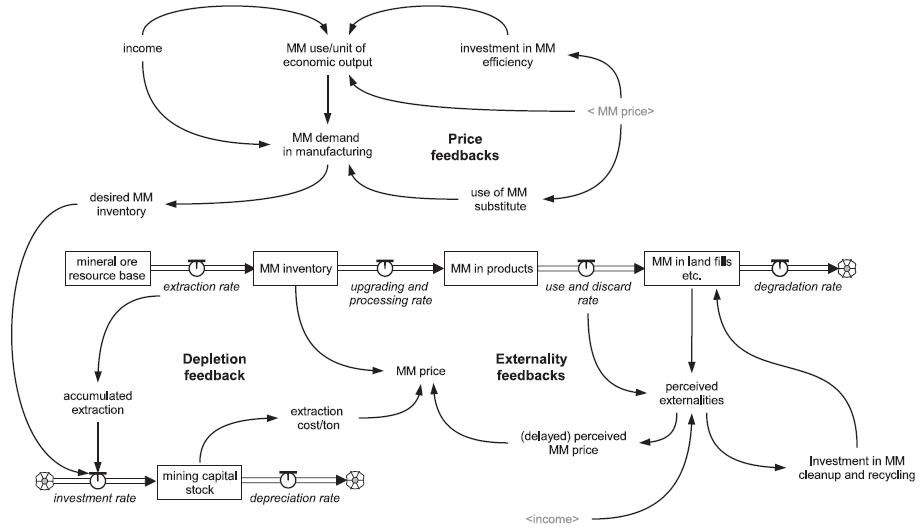
Figure 1. Causal loop diagram (CLD) of the resource chain process in an industrial economy.
An influence diagram of the archetypical transition process in an isolated economy is sketched in Figure 1. The core element is the physical resource chain, with the source and the sink sides as discussed previously. Upstream are the non-renewable resources that are extracted for industrial upgrading and processing and then an input for manufacturing and marketing. When the products are sold on the consumer market, it accumulates as resource-in-use. After the lifetime of the product, its constituents end up via various routes in one of the sinks: landfills, air, rivers, groundwater and soils. It accumulates and, for most compounds, is degraded and eliminated. The route from resource-in-use can be prolonged in a round of reuse or recycling and its extent and composition can be changed in waste treatment plants.
A possible storyline is as follows. Income growth causes an increase in mineral use, initially at an accelerating pace. The resource is still cheap, but the rapidly rising extraction rate causes a cost increase: the depletion feedback loop. The market price goes up and this induces more efficient use and (a search for) substitute materials in the price feedback loop. When income increases further, the intensity starts to decline as demand saturates and citizens start to protest against pollution and waste. Corporations are, with government incentives and regulation, forced to invest in (higher) use efficiency, substitute materials and pollution abatement: the externality feedback loops. Additional costs are made in the economy for material efficiency, waste treatment and recycling and for the associated physical and institutional infrastructure. This reinforces the price and externality feedbacks. A new, high-income equilibrium emerges, which can be sustained as long as there are enough resources available at the higher cost level or if a substitute is available. If such an option is or assumed to be sufficiently abundant, economists have given it the name of backstop resource/technology.
Model simulation: a possible transition in China
A stylised postindustrial transition can be simulated with a simple model based on the mechanisms sketched in Figure 1. For illustrative purposes, I use the historical income growth path of China between 1950 and 2010 as an exogenous input and assume that it continues until 2060 at the rate that the Japanese people experienced since 1965.[2] The transition period, between 2010 and 2050, is one of steady increase in affluence and one of social and environmental stress.
A characteristic outcome is shown in Figure 2a-b. Resource prices go up and the expenditures on the resource as fraction of income increase significantly (from 5% to 21% in the simulation). A decoupling between income and resource use occurs after the year 2015, induced by depletion and externality pricing effects. Nevertheless, by 2060, the indigenous resource is depleted by two-thirds and, despite environmental regulations, there are serious negative environmental consequences. Mining and infrastructure cause pollutant emissions – apart from large-scale displacement of rural populations. Waste disposal affects the food chain and have negative health impacts. What the Chinese Deputy Minister of Environmental Protection in 2006 said comes true: ‘China has entered a phase of frequent environmental accidents. With a fast growing economy, systematic risks of environmental accidents brought about by unscientific placement and industrial structure will replace individual pollution to become the No. 1 threat to our country’s environmental safety’. Infrastructure falls short of expectations and income inequalities increase, which gives rise to social tensions. Also, there are long-term impacts, such as changes in climate and biodiversity, but these tend to be ignored or denied in the face of more direct challenges and threats. From a source perspective, this economic growth path is unsustainable because the resource is depleted before the year 2100 despite a stabilised extraction rate. From a sink perspective, it entails the risk of irreversible losses in quality of life. But such a growth path is possible, as countries such as Taiwan and Korea have shown (TCEPD 1989).
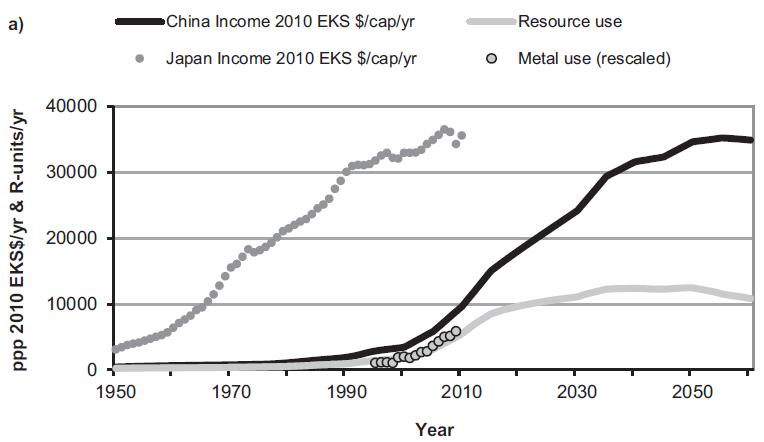
Figure 2a. Simulation of the stylised postindustrial transition, with the historical income growth in China between 1950 and 2010 and its extrapolation to 2060 to the level of Japan in 2010. The graph shows income and resource use; the dots indicate normalised use of the major metals (steel, aluminium, copper, lead and zinc) in China.
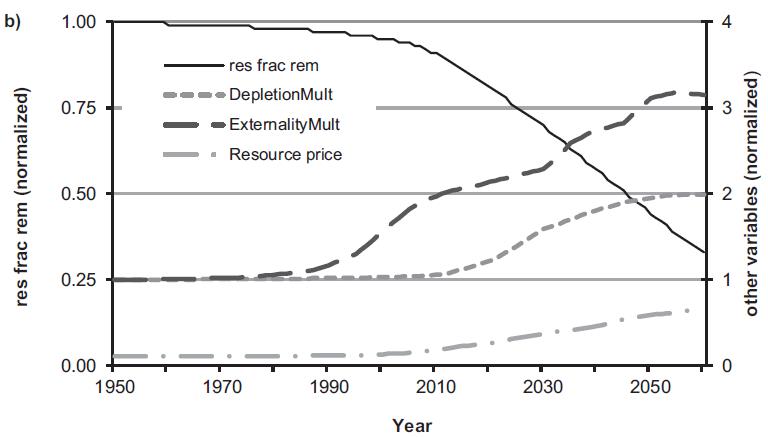
Figure 2b. The depletion and externality multipliers and the resource price for the simulation in Figure 2a.
The stylised transition sketched previously is a widely believed, official outlook on the future. It presumes that countries can maintain economic growth rates and thus, implicitly, can overcome a number of social, resource and environmental constraints. The real-world transition can differ from the simulated one for at least two specific reasons. First, the IU and EKC hypotheses have limited validity. The IU hypothesis presupposes the existence of a substitute, such as plastic from oil for steel, that is itself part of another chain with similar dynamics. The EKC hypothesis may be invalid or too late for indirect and long-term impacts, because citizens do not experience the negative consequences themselves.[3] A second reason is that no country operates on its own. Historically, resource shortages have been countered by military conquest, import of resources and outmigration of people. Nowadays, trade is the preferred choice and mineral ore and fossil fuel are the largest bulk trade flows in the world. Resource-scarce countries will try to exchange manufactured goods and services for resources.[4] Availability on the world market will come under stress and cause political tensions and fluctuating prices. A counterforce is that resource extraction costs, at least temporarily, decrease because of innovations, but this will partly be undone by oligopolistic price setting and safety and environmental regulations (Figure 2c). Real-world resource prices can also be expected to fluctuate significantly, which in combination with mismatches between demand and supply from system delays, feedbacks and noise effect the overall process. History abounds with examples.
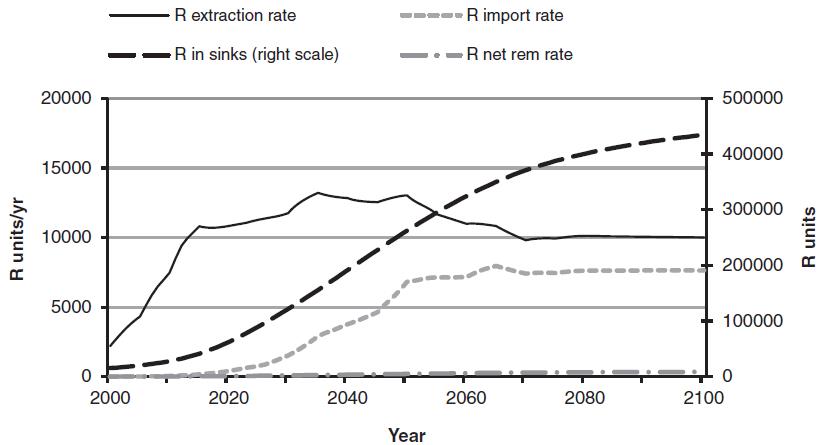
Figure 2c. As in Figure 2a, but extending the simulation beyond 2060 with the assumption of zero income growth after 2060 and the possibility to import resource.
Nevertheless, our simple archetypical model highlights a few points. First, imports are from a global perspective merely displacing the problem. This is seen if we lengthen the time horizon to the year 2100 and open the country for resource imports. Next, we assume that the country starts importing the resource at a price that is initially higher than the price of the indigenous resource. Then, we also suppose that after 2060 the economy does not grow anymore or, if it grows, at zero marginal resource intensity, so resource use remains constant thereafter. With the substitution elasticity assumed in this simulation, imports start around 2010 and make up more than 70 percent of the total flow by 2060. In this longer time resource-trade perspective, the country has successfully postponed depletion of indigenous resources: Even by 2150, still one-third of the initial resource remains (Figure 14.3). But this has been possible at the expense of resource use elsewhere – an example of shifting the burden (§2.4). On the sink side, the situation has aggravated because without a decline in resource use, the stock of pollutants keeps rising towards a dynamic equilibrium of high levels of accumulated pollution with local and global feedbacks. In this long-term perspective, economic growth is dependent on imported, finite resources and creates large and rising environmental impacts. It is, again though differently, unsustainable (Ho and Vermeer 2006). Truly long-term solutions are more intense resource efficiency and recycling and further development of substitutes. They are needed, and without delay, for a path that can be considered a sustainability transition. In some countries, signs of this are visible. In others, only the resistance against it has a voice. In many countries, short-term priorities still overwhelm all long-term concerns and in an A1-worldview the solution comes from exploiting new mineral deposits on the ocean floor or in outer space.
Literature
Charpentier-Poncelet, A., C. Helbig, P. Loubet et al. (2022). Losses and lifetimes of metals in the economy. Nature Sustainability 17 may 2022
Gordon, R., M. Bertram and T. Graedel (2006). Metal stocks and sustainability. PNAS 5(2006)1209–1214
Li, M., Y. Gong, G. Liu et al. (2022). Uncovering spatiotemporal evolution of titanium in China: A dynamic material flow analysis. Resources, Conservation & Recycling 180(2022)106116
Wang, J., M. Guo, M. Liu and X. Wei (2020). Long-term outlook for global rare earth production. Resources Policy 65 (2020) 101569
[1] The third and fourth item have become known as the Intensity-of-Use (IU) and Environmental Kuznets Curve (EKC) hypothesis, respectively. They are discussed further on; see also the blogs www.sustainabilityscience.eu/IU-andEKC-hypotheses.
[2] In other words, in 2060, the average Chinese person will have the same income as the average Japanese person in 2010. Interactions between income and population growth and differences in the composition of production and consumption are not considered.
[3] Negotiations about greenhouse gas emissions and loss of biodiversity and military adventures to safeguard resource imports and waste exports testify that such a response is deeply ingrained.
[4] Land-scarce countries did and do exactly this: importing food as soon as they are able to exchange it for manufactured goods. The UK has done it since the 19th century, and some Asian countries just started doing it. The phenomena of virtual water use and ‘land grabbing’ are in the same category of responses.
Leave A Comment