
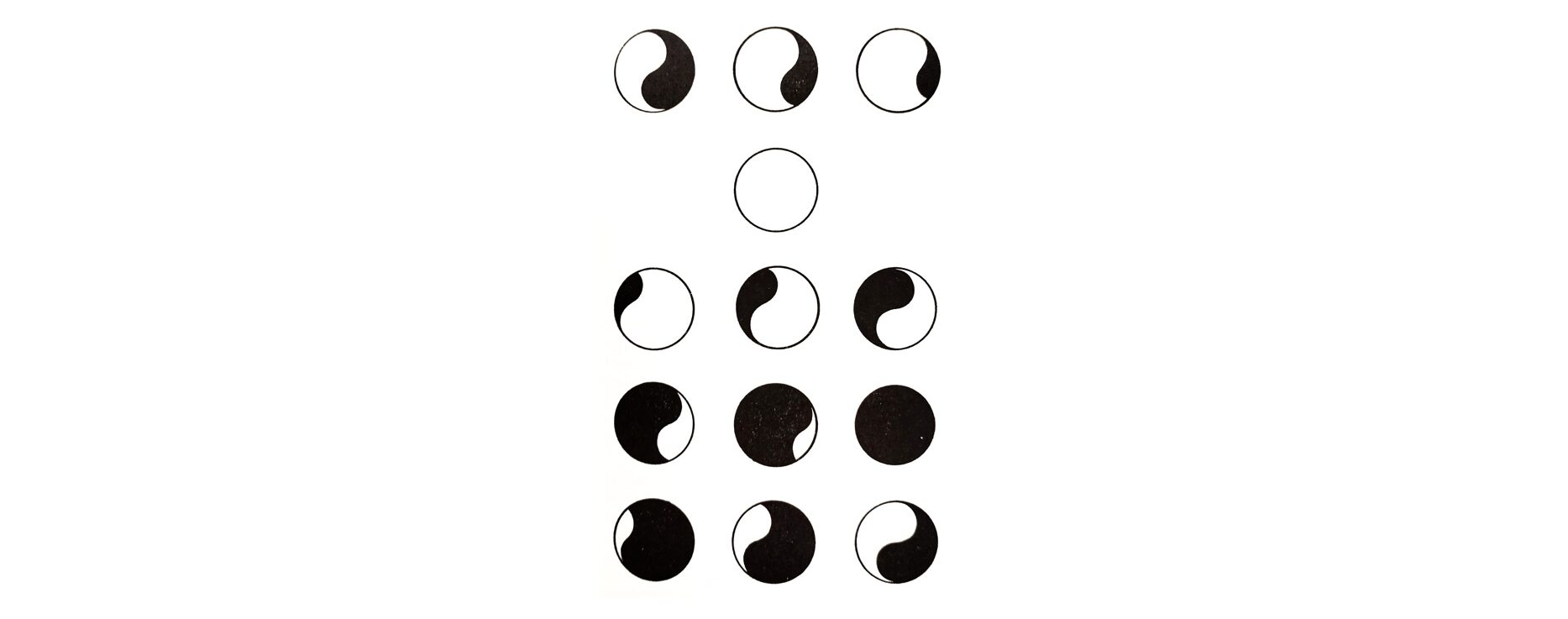
In the book Sustainability Science, I have argued that the location of sustainability is in the center of worldview space, where the balance is found between individual and collective and between material and immaterial (§6.3). The notion of two opposite forces in dynamic equilibrium provides an ingenious description of what is called worldview dynamics in this book.
The idea of balancing between the centrifugal forces towards extremes are found in nearly all cultures in one form or another. Chinese cosmology in particular shows deep insights in the dynamic nature of processes in organisms, human behaviour and societies.Its perennial wisdom is found in Chinese culture, which has given the world a sophisticated cosmology in traditions, teachings and practices of I Ching, T’ai Chi and others.
The idea of a vertical dimension of earth, heaven and human beings in-between is expressed in subtle qualities of yang (light, outer, male, force, cause, authority…) and yin (darkness, inner, female, inertia, impact, servant…). Their combinations are in the I Ching given particular interpretation and meaning, which deeply reflects the insight in and aspiration towards unity of opposites. This integrality shows up, for instance, in the representation of the hexagram 11 T’ai (peace) which puts the yin on top of the yang: the ‘male’ creative and expanding is supporting the ‘female’ following and introspective yin, an order which is considered auspicious (which may seem contradictory when yang and yin are simply seen as heaven and earth).
These ancient philosophies offer important insights about individual and collective human affairs, yet they tend to be associated with the B2-world in the sense of traditional and esoteric. From a 21st century (geo)political perspective, Chinese culture is better understood within the more worldly ideals of Confucianism. Among the many analyses of China’s role in the modern world, I briefly discuss the one offered by Rolland (2020).
In the course of the 21st century, China has become the state with the largest economic activity and, although after India since 2023, the largest population size. This is naturally influencing the international order, if only because Chinese history and culture differ from the Western-style Modernity worldview. Chinese politics seems to advance the ideals of an authoritarian Confucianism “with an emphasis on the sacred “heavenly mandate,” the idea of harmony, the use of rituals to regulate personal desires and interpersonal relationships, and the respect for the educated elite.” (Rolland 2020:26). Ruler and ruled work together for the common good and party members are instructed in traditional values such as benevolence, sincerity, and righteousness. Chinese culture is introduced into socialist ideology: “the blood of the Chinese Communist Party (CCP) is imbued with the fine genes of Chinese traditional culture”, in the words of Chairman Xi Jining in 2017. Some speak of Sino-socialism.
Quite a few non-Chinese commentators are suspicious of the CCP-intentions. The real struggle, they argue, is (still) about ideological dominance: China as counterbalance to the Pax Americana and its American or Western values, the USA-led military alignment and the UN and its institutions. It originates in the CCP’s fear about survival and ambition for power and its impatience with the gap between China’s material power on the one and its authority in and control over international affairs on the other hand.
Yet, it seems that the Chinese regime does not aspire military conquest but a loose and malleable hegemony. The Chinese worldview should be able to compete with the liberal values of human rights, political equality and democracy originating in the West. The CCP understands that the ‘soft’ power of culture may be more important than ‘hard’ military power. “A country’s huayuquan – which can be translated as ‘discourse power’- is essentially a form of power equivalent to military power and economic power, with discourse as its carrier… In a globalized world, the competition between countries not only centers on economic, military power and other hard power fields, but also on soft power field such as social systems, values, ideology, and culture… Discourse power presupposes and is derived from material power.” (Rolland 2020:18).
If China’s discourse power increases, will it define what is right and wrong, true and false, good and evil, beautiful and ugly? Will there be an erosion of fundamental human rights, freedom of thought and expression, and self-government around the world if Chinese power grows? Or is there a significant overlap with European Enlightenment ideals about order, planning and progress and are the totalitarian communist party tendencies not that different from the concentration of power in the hands of a few state-connected corporations? At the moment, the overlap is primarily visible in the organization of state capitalism and the expansion in world trade.
Elements of this are found in ancient Chinese texts, symbols and beliefs, often with reference to Nature. For instance, ‘For the Chinese the bamboo expresses the will to survive, the spirit to endure under adverse circumstances. Great trees in their strength resist the winds and are broken; but the pliant, yielding bamboo, twirled and tossed about madly in the storm, bends and bows unresting, and survives.’ (Diana Kan, Chinese painting 1979:45). Or take the verse of Lao Tzu, the Old Master, in the Tao Te Jing:
The best people are like water.
They benefit all things,
And do not compete with them.
They settle in low places,
One with nature, one with Tao.
As with all ancient religious texts, it is difficult to which extent the original words are reinterpreted to serve novel fashions or ideological pursuits.
Literature
Rolland, N. (2020). China’s Vision for a new World Order. The National Bureau of Asian Research NBR Special Report #83, January 2020
The I Ching or Book of Changes: The Richard Wilhelm Translation (1968). Routledge & K. Paul
Leave A Comment