
CHAPTER 14
Towards a Sustainable Economy?
Summary
Points to remember from this chapter:
Quotes for Reflection
The difficulty lies not with the new ideas, but in escaping the old ones.
— John Maynard Keynes
The important problem of steady state would not be production but distribution. You can no longer avoid the problem of relative distribution by resorting to growth.
— Herman Daly, personal communication
In industrial capitalism, the production of economic goods along with the system of allocating them has conditioned the type of satisfiers that predominate…. [it] leads to an alienated society engaged in a senseless productivity race. Life [is] placed at the service of artifacts, rather than artifacts at the service of life. The question of the quality of life is overshadowed by our obsession to increase productivity.
— Max-Neef, Human Scale Development, 1991
‘…the modern economist has been brought up to consider ‘labour’ or work as little more than a necessary evil… Hence the ideal from the point of view of the employer is to have output without employees, and the ideal from the point of view of the employee is to have income without employment… The Buddhist point of view takes the function of work to be at least threefold: to give a man a chance to utilize and develop his faculties; to enable him to overcome his egocentredness by joining with other people in a common task; and to bring forth the goods and services needed for a becoming existence… the Buddhist sees the essence of civilisation not in a multiplication of wants but in the purification of human character… [which] is primarily formed by a man’s work… While the materialist is mainly interested in goods, the Buddhist is mainly interested in liberation… [and] it is not wealth that stands in the way of liberation but the attachment to wealth; not the enjoyment of pleasurable things but the craving for them’.
— Schumacher, Small is beautiful, 1971
Economic growth is as addictive to the body politic as is heroin to one of us; perhaps we have to keep the craving in check by using a safer substitute, an economist’s methadone.
— Lovelock 2006:150
In the longer term…a technological solution may seem it has the potential to set humanity on a path to the ultimate form of slavery. The more we meddle with the Earth’s composition and try to fix its climate, the more we take on the responsibility for keeping the Earth a fit place for life, until eventually our whole lives may be spent in drudgery doing the tasks that previously Gaia had freely done for over three billion years.
— Lovelock 2006:152
Multimedia
- Watch this video on YouTube for an interesting interview with the economist Partha Dasgupta, with questions about Green Economy, international trade, the inadequacy of GDP (see also Chapter 5) and the role of economists.
Readings
Related websites
Indicators, Models and Games
1. depletion and price feedback: it leads to cost and thus price increases (often delayed by technological progress) that tend to reduce (growth in) demand/use, 2. externality feedback (mixed up possibly with price feedback as environmental policies increase costs (possibly also delayed by technological progress): a societal feedback due to the fact that people, upon becoming more affluent, start to demand more environmental policies to restrain the loss in quality of their environment (EKC), and 3. dematerialisation: with increasing income, the use of energy and materials becomes less per unit of GDP, thus lower material impacts at the margin.
Weak sustainability refers to the assumption that the use of resources and sinks can completely be subsituted for by other non-resource inputs (capital and ingenuity). The strong sustainability view argues that resources and sinks are not completely substitutable..
The basic equation (14.5) indicates that dk/dt = 0 for k^α – c – (m+n) k = 0, or that c = k^α – (m+n) k. If one plots in the phase plane dk/dt as a function of k, it is seen that it is a stable attractor: for given c, any k-level different from k* will tend to move the system back to the equilibrium. For fixed values of m and n, only technological progress in the production function (A in eqn. 14.8a) can bring the system to higher levels of economic output.
Constant returns to scale is indicating that production is assumed to scale proportionately with an increase in all production factors, i.e. for Y=f(K,L) with the two production factors capital K and labour L, f(bK,bL) = bY for any b. In agriculture, an important production factor is land. For land, as a finite resource, one inevitably reaches a point at which less productive soils are to be used and output will be less than proportional. In information services, one may have the opposite: a positive feedback loop due to interactions among different components of the system can cause a more than proportional output.
This is done by connecting energy and/or material inputs (resources) and outputs (pollutants) in physical units to the sectors in the I-O-table. As explained in Appendix 14.C, it is then possible to use the formalism to calculate the use of resources / emission of pollutants throughout the economy for an increase in final demand.
It can be shown that the optimal i.e. cost-minimizing combination of inputs X1 and X2 (e.g. capital K and energy E) occurs when X1/X2 = p2/p1 with pi the price of the input Xi per unit. The implication of an energy price shock (p2 up) is that producers will equilibrate to a new situation in which the ratio X1/X2 increases by investing more capital (X1) to reduce energy input (X2). The rebound effect refers to the phenomenon that measures (e.g. investments) to reduce energy inputs cause lower operational costs (for energy) and therefore more money is available for other activities that cause energy inputs to increase. Usually, the additional energy use thus induced will be less than the amount saved. If a producer responds to higher energy prices by investing in energy efficiency, it will make the price increase of his product less than it would otherwise, but the price will still increase – so demand will still be less than before the energy price increase. But if one considers the wider system, the revenues of higher oil prices in producer countries may contribute to a rebound effect.


1. GDP (or income: GDP/cap) is measuring people’s quality of life inadequately, because many aspects of quality of life cannot be quantified in monetary terms. So if sustainable development is considered to be about people’s quality of life, it is an inadequate measure. 2. GDP does not account for large parts of the economy, notably subsistence activities and informal activities (not part of a country’s statistical accounts, e.g. household and informal labour, criminal activities), and 3. GDP does not account for the long-term dynamic implications of present activities, such as depletion and pollution. Evaluation of the ISEW, the EF and the GPI can be done by looking up the relevant websites. All three indicators are an attempt to include other aspects of quality of life (section 5.5).
Other Content
Related Narratives
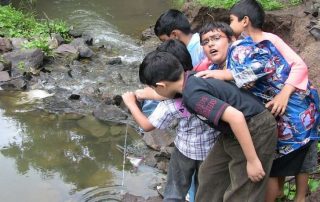
Guest post: Devnadi – the River of God
The firm house lingers, though averse to square
with the new city street it has to wear A number in.
But what about the brook
that held the house as in an elbow-crook?
I ask as one who knew the brook, its strength
and impulse, having dipped a finger length
and made it leap my knuckle, having tossed
a flower to try its currents where they crossed.
The meadow grass could be cemented down
arom growing under pavements of a town;
the apple trees be sent to hearth-stone flame.
Is water wood to serve a brook the same?
How else dispose of an immortal force
no longer needed? Staunch it at its source
with […]
Sao Paulo drought: water shortage and water governance*
 October 2014. Latin America’s biggest metropolis may, again, run out of water. For some of the 20 million residents across Sao Paulo, taps are already running dry. Dilma Pena, chief executive officer of the state-run water utility Cia. de Saneamento Basico do Estado de Sao Paulo (Sabesp), told the city council that supplies are only guaranteed until mid-November unless it can tap the last of the water in its Cantareira reservoir. This four-lake complex that supplies half of Sao Paulo has already been drained of 96 percent of its water capacity […]
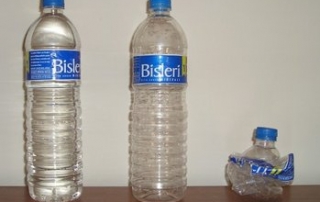
Water as a commodity: ban on bottled water in Australian town*
The market has discovered scarcity as something to be desired. The Stock Fund Utilities department of the dutch bank ING announced in 2007:”…prospects remain good. In the states of California and New York energy shortages threaten and it drives the price up.” Similar advertisement are seen for water. Drinking water used to be a service ‘freely’ offered by nature. With growing populations and hygiene standards, it is in combination with growing agricultural water demand rapidly becoming a scarce commodity in many places – or at least, that is a widespread perception. A process of ‘commodification’ has started. Every scarcity offers […]
Oil and Power*
Natural resources such as metal ores, coal and oil have been throughout history at the centre of power struggles and ideologies. The history of oil has been described by Yergin in his excellent book The Prize (1991). “The rapid rise of Russian production, the towering position of Standard Oil, the struggle for established and new markets at a time of increasing supplies – all were factors in what became known as the Oil Wars. In the 1890s, there was a continuing struggle involving four rivals – Standard, the Rothschilds, the Nobels, and the other Russian producers. At one moment they […]
European Union Fisheries Policy in Senegal *
‘For us, it has no sense or benefit because the industrial fishing boats don’t leave us any chance of survival. They fish right up to the coast without being stopped and the government doesn’t have the means to control their activities. If the government would listen to us, we wouldn’t sign an agreement with people who catch everything, even the small fish,’ says Mario Alberto Da Silva, a West African artisanal fisherman. The fisheries sector is an essential component in Senegal’s development: It provides 75 percent of local protein needs and generates about 100,000 direct jobs for Senegalese nationals, of […]
The Canadian Fish Drama
Northeastern Canadian fisheries – cod, haddock and other species – are in serious crisis since the 1990s. It is “the classic case of the failure of conventional science-based fisheries management: the collapse of the northern cod of Newfoundland and Labrador” (Finlayson and McCay 1998:311). For centuries the extraordinary abundance of cod has been exploited by European settlers. It was done in summer months – storms and ice in winter made it impossible – with relatively simple and inexpensive techniques. Cod fishery was the focal point of the small coastal communities, which tended to have egalitarian social relations.
In the 1960s the […]
Mining in Papua New Guinea
Papua New Guinea is one of the world’s largest island. Called the ‘Last Great Place’, it is home to hundreds of unique species of animals and plants as well as to upward of 820 languages. The Porgera gold mine is situated in the highlands. It produced around 18 tons of gold per year and over $1 billion of profits in 2006, according to Barrick Gold, a Canadian corporation that assumed a majority share of the mine. Barrick operates 26 mines worldwide and boasts of having the industry’s largest reserves.
Porgera, New Guinea’s biggest gold mine, accounts for 72 percent of the […]
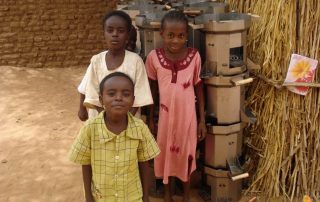
Fuel Efficient Stoves for People in Darfur
In the fall of 2005, Berkeley scientist Ashok Gadgil was asked by the U.S. Government to try to find a solution to a grave problem facing Darfuri families in displacement camps: women had to walk as long as seven hours, three to five times per week to find firewood. In response, he and his colleagues and the women of Darfur designed the Berkeley-Darfur Stove (BDS) V14. The project is a good example of sustainable livelihood improvement, as it solved several problems simultaneously. Because the BDS uses half as much firewood as traditional cooking methods, it limits harmful emissions that contribute […]