
CHAPTER 9
Land and Nature
Summary
Points to remember from this chapter:
Quotes for Reflection
The best people are like water. They benefit all things, And do not compete with them. They settle in low places, One with nature, one with Tao.
— Lao Tzu, Tao Te Jing
Furcht, nämlich – das ist des Menschen Erb- und Grundgefühl; aus der Furcht erklärt sich jegliches, Erbsünde und Erbtugend. Aus der Furcht wuchs auch meine Tugend, die heist: Wissenschaft. Die Furcht nämlich vor wildem Getier – die wurde dem Menschen am längsten angezüchtet, einschliesslich das Tier, das er in sich selber birgt und fürchtet: – Zarathustra heisst es “das innere Vieh”. Solche lange alte Furcht, endlich fein geworden, geistlich, geistig – heute, dünkt mich, heisst sie: Wissenschaft.
Translation: Fear, you see – fear is a basic, inherited feeling of man; original sin and original virtue can be explained from this fear. My virtue grew also out of this fear, that is called: science. That is to say: the fear of wild animals – it was bred in man over a long period of time, including the animal that he hides within himself and of which he is afraid: – Zarathustra calls it “the inner cow”. Such a long and ancient fear, finally become subtle, sacred, intellectual – now, it seems to me, it is called: science.
— Friedrich Nietzsche, Also sprach Zarathustra.
You are the forest you are all the great trees in the forest you are bird and beast playing in and out of all the trees o lord white as jasmine filling and filled b y all why don’t you show me your face?
— Speaking of Siva (Vs. 75). Ed. A.K. Ramanujan. Penguin Classics 1973.
Readings
Related websites
Other Content
Related Narratives
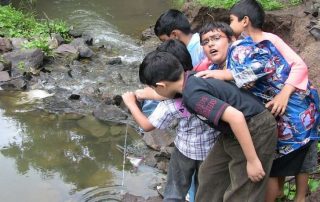
Guest post: Devnadi – the River of God
The firm house lingers, though averse to square
with the new city street it has to wear A number in.
But what about the brook
that held the house as in an elbow-crook?
I ask as one who knew the brook, its strength
and impulse, having dipped a finger length
and made it leap my knuckle, having tossed
a flower to try its currents where they crossed.
The meadow grass could be cemented down
arom growing under pavements of a town;
the apple trees be sent to hearth-stone flame.
Is water wood to serve a brook the same?
How else dispose of an immortal force
no longer needed? Staunch it at its source
with […]
Sao Paulo drought: water shortage and water governance*
 October 2014. Latin America’s biggest metropolis may, again, run out of water. For some of the 20 million residents across Sao Paulo, taps are already running dry. Dilma Pena, chief executive officer of the state-run water utility Cia. de Saneamento Basico do Estado de Sao Paulo (Sabesp), told the city council that supplies are only guaranteed until mid-November unless it can tap the last of the water in its Cantareira reservoir. This four-lake complex that supplies half of Sao Paulo has already been drained of 96 percent of its water capacity […]
Water as a commodity: ban on bottled water in Australian town*
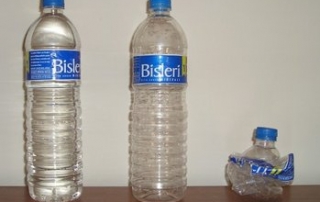
The market has discovered scarcity as something to be desired. The Stock Fund Utilities department of the dutch bank ING announced in 2007:”…prospects remain good. In the states of California and New York energy shortages threaten and it drives the price up.” Similar advertisement are seen for water. Drinking water used to be a service ‘freely’ offered by nature. With growing populations and hygiene standards, it is in combination with growing agricultural water demand rapidly becoming a scarce commodity in many places – or at least, that is a widespread perception. A process of ‘commodification’ has started. Every scarcity offers […]
Oil and Power*
Natural resources such as metal ores, coal and oil have been throughout history at the centre of power struggles and ideologies. The history of oil has been described by Yergin in his excellent book The Prize (1991). “The rapid rise of Russian production, the towering position of Standard Oil, the struggle for established and new markets at a time of increasing supplies – all were factors in what became known as the Oil Wars. In the 1890s, there was a continuing struggle involving four rivals – Standard, the Rothschilds, the Nobels, and the other Russian producers. At one moment they […]
Mining in Papua New Guinea
Papua New Guinea is one of the world’s largest island. Called the ‘Last Great Place’, it is home to hundreds of unique species of animals and plants as well as to upward of 820 languages. The Porgera gold mine is situated in the highlands. It produced around 18 tons of gold per year and over $1 billion of profits in 2006, according to Barrick Gold, a Canadian corporation that assumed a majority share of the mine. Barrick operates 26 mines worldwide and boasts of having the industry’s largest reserves.
Porgera, New Guinea’s biggest gold mine, accounts for 72 percent of the […]
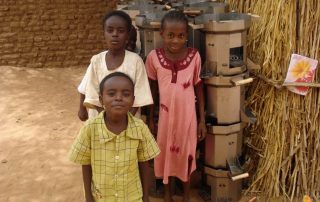
Fuel Efficient Stoves for People in Darfur
In the fall of 2005, Berkeley scientist Ashok Gadgil was asked by the U.S. Government to try to find a solution to a grave problem facing Darfuri families in displacement camps: women had to walk as long as seven hours, three to five times per week to find firewood. In response, he and his colleagues and the women of Darfur designed the Berkeley-Darfur Stove (BDS) V14. The project is a good example of sustainable livelihood improvement, as it solved several problems simultaneously. Because the BDS uses half as much firewood as traditional cooking methods, it limits harmful emissions that contribute […]