
A technology to supply water in relevant amounts is desalinization of seawater. It is at the intersection of water, food and energy issues, because the water for drinking and food is a necessity of life but its production from seawater requires lots of electricity. It competes with other technologies such as extracting water from air. As with other technologies, these may mitigate water shortages in arid and semi-arid regions with enough energy sources (solar energy among them) – but they need materials for their construction (besides ingenuity) and may therefore be faced with new constraints. Nevertheless, within an A1 high-tech oriented world, it will be perceived as an important and necessary development.
Already in the 1950s, desalinization of seawater was seen as a solution. Nowadays already more than half a billion people lives off desilted water, produced in 9000 installations. In Riad, whose population multiplied to over 5 mln in the last half a century, water comes from desalination plants from all over the coast – produced with oil and money from oil. In many other places, desalinization of seawater is introduced, among them Spain.
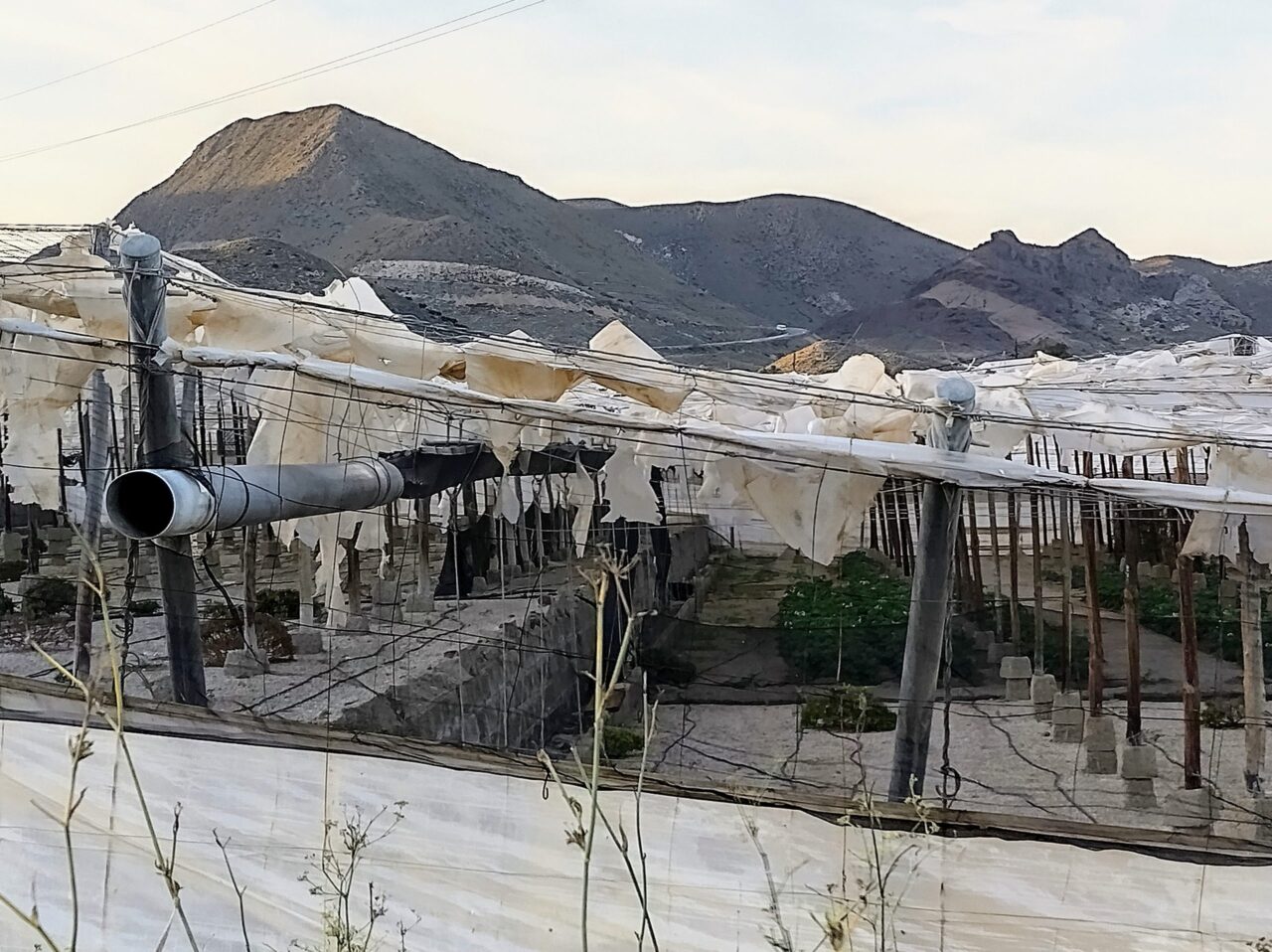
In Spain, there are desalination plants in the Almeria region with annual distribution capacities of 0,42 km3 and 0,21 km3. As the large one was opened in 2002, it was expected that desalinated water would play an important role as a water source used by farmers in the district because of scarce fresh-water resources and groundwater aquifer deterioration. This did not happen: in 2016 the use of desalinated seawater for irrigation was only 0,08 km3/year. One reason was the lower water demand after the 2008-crisis. The plants are capital-intensive and energy-intensive. The second reverse osmosis one installed in 2011 had investment cost of 100 mln € for 60.000 m3/day, irrigating 12.000 ha of high-yielding agricultural land. The remaining salt is pumped into the Mediterranean 1900 m out of the coast at 25 m depth. Electricity use and its price are the other important determinants of final cost, although electric power requirement significantly declined, from 22 kWh/m3 in 1970 to 1,5 to 3 kWh/m3 water (Morote et al. 2017). To deliver 1 km3/yr still requires a power plant in the order of 180 to 350 MWe at full load.
Use of desalinated water in agriculture can become the only option in many regions, perhaps with some advantages. Some Spanish analyses show higher yields with desalinated water. Analyses in 2018 of agronomic and economic productivity of tomato, watermelon, pepper and zucchini for use of well water versus use of desalinated water indicate, according to the researchers, that use desalinated water for irrigation in greenhouses leads to increases in production, improvements in (uniformity in) quality parameters of crops and higher profits. The main problem is the price of 0.53 €/m3, which is far above what is considered reasonable (0.30 €/m3) and is largely due to the energy consumption.
There are also behavioural barriers and disadvantages. A survey among farmers in the Almeria region indicated that they prioritize water from the desalination plant after surface water (1), recycled water (2) and groundwater (3), even though the groundwater has to be desalted. Besides the high price, the low nutrient content is seen as a disadvantage: ‘desalinated water is dead water’ and farmers have to apply additional fertilizer and management. The one advantage is high availability. It also turns out that in particular small farmers, with low education and working in family enterprises with much experience in traditional practices, have low acceptance levels. The researchers ascribe this to little knowledge of the real effects and “that is why policies devoted to information campaigns among farmers on the quality and benefits of the use of desalinated seawater for irrigation are crucial.” Use of desalinated water is promoted with subsidies, price and volume discounts and tax reductions – a common practice once such capital-intensive venture operates below capacity.
High-tech supply options can lead to a lock-in which deflect attention to modernization with computers and block critical analysis that reveals how to reduce over-consumption and the like, crowding out people and money for more intuitive and low-tech experiments which increase availability by slowing water in the landscape, increasing percolation and other ‘nature-based’ options. Choices for the short-run may thus prevent pathways to long-run sustainability.
Literature
Morote, A.-F., A. Rico and E. Moltó (2017). Critical review of desalination in Spain: a resource for the future? Geographical Research doi:10.1111/1745-5871.12232 (retrieved in january 2023 at https://rua.ua.es/dspace/bitstream/10045/73272/5/2017_Morote_etal_GeoRes_rev.pdf ).
Leave A Comment