
Identifying and measuring beliefs: two case-studies
An analysis of the outcomes of the World Value Survey (§4.2) over the period 1989-2004 has been used to identify popular support for the transition to a market economy in India and China (Migheli 2010). It is based on a set of questions about the role of competition, government intervention, income inequality, hard work and fairness for economic performance. The [...]
Analogs and metaphors
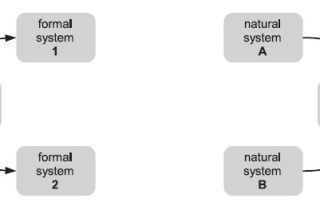
In an abstract scientific sense, modelling is a coding process and creates a relation between a ‘natural’ and a ‘formal’ system (Figure 1a; Rosen 1985). As scientists refine existing and construct new theories, there may (temporarily) be two different formal systems to describe the same natural system. An example of such complementarity is the wave and the particle description of [...]
Catastropic change in (eco)systems: case-studies
There are some empirical, illustrative case-studies in which catastrophic did happen. The first classical example is the interactive dynamics between the spruce budworm, its predators and the boreal forest in North America (Holling 1986; Meadows 2008). When the budworm became a ‘pest’ and northern forests were sprayed with the insecticide known as DDT to control it, success in killing the [...]

Resource scarcity: the Crustal Abundance Geostatistical (CAG) model
In the context of sustainable development, the emphasis is usually on depletion and a key question is: How big is the resource or, in expert jargon, what is the geological resource base? First, I look at mineral ores. Solid evidence on resource ore quantity and quality is limited by its very nature to those regions that have been explored. However, [...]
Social dynamics in Cultural Theory
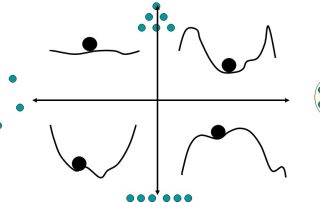
Cultural Theory interprets social-cultural change as a continuous, dynamic interplay between the adherents of the four perspectives (Thompson 1992, 1997; Vries 2023). Individuals alter their perspective when it is no longer reconcilable with their experience. Collective, institutional change happens whenever larger groups of people start to doubt the correctness and adequateness of the dominant perspective (Janssen and De Vries 1998). [...]

Fish, gold and pollution: homo economicus vs. homo psychologicus
Can we understand the role of human behaviour in renewable resource exploitation? To explore this question, we constructed an imaginary island called Lakeland, with a local population catching fish for its livelihood, having the possibility to exploit a goldmine and the option to permit large, foreign trawlers to fish in their waters. Based on an underlying system dynamics model (see [...]