
CHAPTER 17
Energy: to a carbon-free supply
Energy was and is an essential precondition for industrialization and Modernity. The metabolic profile of the industrial regime is dominated by fossil fuels and a small number of materials for construction, nutrition, transport and energy supply.
- The exploitation of non-renewable energy carriers has increased exponentially since 1800, in a transition from local and diffuse land-based sources (food-wood-water-wind) to concentrated and globally traded fossil fuel–based energy carriers. Per capita energy and material use rose three- to five-fold. Energy productivity, in use per unit of economic output, rose also significantly. It occurred first in Europe and offshoots; since mid-20th century also in other regions;
- Energy use in a country depends on location, economic structure and other factors. Most energy use is for manufacturing, heating and cooling in the built environment and transport. In 2020, humanity burned the equivalent of about 11 bln tons of oil (about 85% of primary energy use) for these purposes.
- Yet, hundreds of million of people have still no or limited access to secure and affordable energy for basic needs. There is a gradual shift towards ‘comfort’ carriers electricity and (natural) gas, which is known as the energy ladder in the context of poor households. It reduces and displaces local and in-house environmental and health damages.
- Since early industrialization, the exploitation of fossil fuels, notably the black gold oil, is a core determinant of economic growth and connected to military power and conflicts. There have been concerns about depletion of fossil fuels (coal, oil, gas), but new discoveries and technology by globally operating corporations have permitted continuous growth in output, albeit with political crises and price volatility.
- Burning these large amounts of fossil fuels causes a variety of environmental and health damages. At the local-regional level, these are at least partly mitigated in the wealthy countries by regulatory policies; poor countries may follow as impacts increase.
- Fossil fuel combustion is also for over two third responsible for the emission of greenhouse gases (ghg) which influence the radiative balance on earth. The resulting climate change has initiated, after decades of denial and confusion, an energy transition towards more energy efficiency and non-carbon energy sources. Part of it is an increase in the share of electricity, because it facilitates an increase in energy efficiency and in the use of non-carbon (hydro, wind, solar, nuclear) sources. It requires massive investments and stirs a discussion on the role and form of public utilities and local cooperatives.
Test your understanding of this chapter by reviewing the study questions below.
Answer:
- Energy stocks and flows are measured in a single ‘natural’ unit: the Joule. (Fossil-fuel and non-fossil-fuel based) energy carriers are utilized for their energy content in conversion (in Joule).
- Metal-containing minerals are also part of large and varied cascades of semi- and finished products. Within these cascades, most materials can (at least partly) be recycled, at various stages.
- Materials (from mineral ore but also plastics and other chemicals from fossil fuels and biomass) have a large potential for substitutes and novelty.
Answer:
A refrigerator offers the service to bring a certain system (substance, item) at a temperature below ambient temperature. A chainsaw provides mechanical power, in the form of straight or circular moving saw, to process wood and other materials.
Answer:
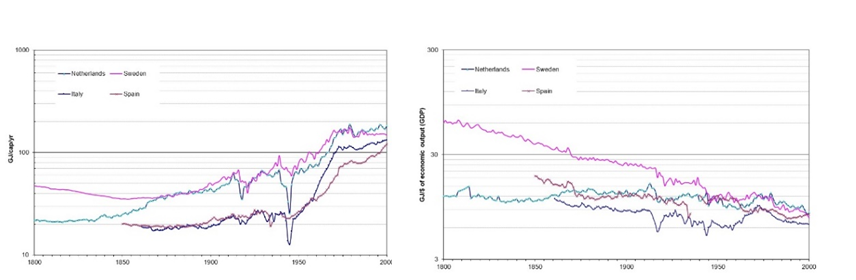
In the industrial transition, biomass-based energy stocks and flows (wood, animals, wind and others) were gradually replaced by fossil fuels. Their much higher energy density required less space, their conversion was generally simpler and their use became more efficient. The cost of useful energy declined and the number of applications increased. As a result:
- Energy use per person grew exponentially (left graph), with the growth in extent and nature of applications, and
- Energy use per unit of economic activity declined exponentially, at least until de mid-20th century, as the result of continuous improvements in use efficiency.
Answer:
The energy ladder postulates that household energy use shows a transition from traditional biomass fuels (wood, dung, and crop residues) via the direct use of liquid and solid fossil fuels (coal and kerosene) to relatively clean, efficient and easy-to-use ‘comfort carriers’ (gas and electricity). It tends to coincide with and at least partly be driven by a rise in appliance ownership (fans, heating equipment, refrigerators, washing machines, televisions, computers…) and with lower appliance costs and less specific energy use.
Answer:
The supply cost curve (SCC) orders the options to increase energy efficiency and reduce energy losses along the cost of energy unit (joule) saved. Following this order would be ‘optimal’ cost-minimizing behaviour. In practice, there are barriers to do this:
- transactions costs: it takes time and money to operate in the actual application, which is often not included in the cost estimate;
- this gets worse if there incomplete and uncertain information on prices and available techniques; for instance, volatile interest rates can make users hesitant to invest;
- it also gets worse when energy costs are only a minor fraction of over-all (operating) costs and if saving on other costs is easier;
- relatedly, the user has to overcome habits, procurement and other rules; protectionism and secrecy may play a role too;
- there can also be organizational and cultural values, although these can work both ways; for instance, installing novel efficient equipment can provide status;
- also the existence of positive and/or negative externalities, co-benefits and rebound effects can play a role.
Answer:
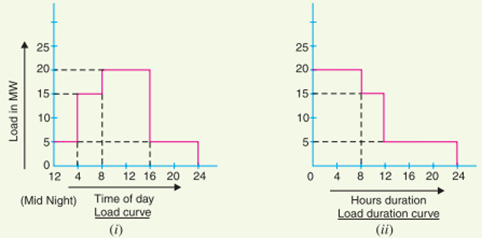
Electric power demand fluctuates during the day and the year, because many applications are dependent on fluctuating variables such as daylight, outside temperature, working hours, cooking time etc. For a given system, such a load curve is represented with a (daily, monthly, yearly) load curve (in MWe)(left in figure). If one repositions the points of a load curve in order of size, one gets a load duration curve (LDC)(right in figure)(figure from rcet.org.in). .
With fossil-fuel fired power plants, it is possible to follow the load by regulating the power generation. When there are wind turbines and/or solar panels in the system, these are intermittent and not under control. Hence, when they generate power Pren(t) when the load demand is Ldem(t), then one needs storage whenever Pren(t) > Ldem(t). How often and to what extent this occurs, and thus how much storage capacity is needed, can be estimated from the LDC and the installed intermittent power generation capacity (but when it occurs is more difficult to estimate).
Answer:
Fossil fuels are non-renewable because they come from stocks which are exhaustible or finite at the human time-scale because their natural rate of formation happens at a geological timescale of thousands or millions of years. Also, burning them causes material flows into the environment (‘pollution’) and the disposed material is not or only slowly and partly broken down or immobilize.
Answer:
The notion of resource curse was coined to describe the observation that, in quite a few countries, the wealth from oil and other minerals obstructs (the path towards) democracy in a country. Supposedly this happens because the state officials are rich enough to reduce or suppress the desire for democracy (for instance, via low taxes) and/or to spend massively on the military and the police in order to suppress such a desire or offer ‘modernization without emancipation’. The resource curse hypothesis cannot really be ‘proven’, stemming from correlations between proxy variables.
Answer:
Common indicators at a country level are:
- Greenhouse gas (GHG) emissions per person (kg CO2-eq/cap/yr) and GHG-emission per unit of GDP (kg CO2-eq/$/yr), often seen as a proxy of energy-efficiency.
- (an assessment of the) GHG-emission reduction potential, proposed as an indication of how much or little effort is needed in emission reduction (or mitigation).
- historical cumulative GHG-emissions of a country, for instance since the start of the industrial era, as a proxy indicator of the historical contribution to global warming.
The first one measures the role of a country in present annual GHG-emissions and how ‘productive’ they are. Ethical issues are distribution across income groups and causes of (under)development. The second one tells which countries should be first in GHG-emission reduction from a techno-economic perspective. Ethical issues are technology transfer and financial obligations on behalf of the rich countries. The third one puts GHG-emissions in the broader context of global industrialization, arguing that past emissions should be incorporated in ‘just’ future quota.
Answer:
The two extreme CO2-emission pathways are roughly in line with the SSP1 and SSP3 storylines. A crude estimate from Figure 17.8 shows that the cumulative emissions for the period 2020-2050 in SSP1 are about 1200 Gt CO2 and in SSP3 in the order of 1600 Gt CO2. The near-linear relationship between cumulative CO2-emissions and anticipated rise in global surface temperature suggests that by 2050, temperature will have risen with 1,5-2 oC in SSP1 and 1,7-2.5 oC. This is in agreement with the curves in Figure 13.8, but it also shows the level of uncertainties on both source and sink side.
All Materials Relevant to this Chapter
From private to public transport: lock-in dynamics
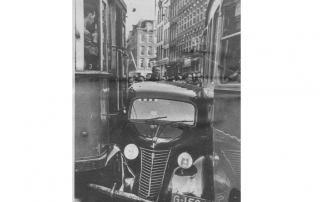
The car as a lock-in The car has gained a dominant position in present-day mobility and transport, not in the least because the costs of pollution, noise, accidents, congestion and use of space are not [...]

The lure of flying – and the flyprint
Living on a plane. "Ana-Maria P. is the president of Powerstorm, a US company working on sustainable telecom solutions focused on reducing CO2 emissions in emerging markets. How often do you travel? I basically live [...]

Top-down or bottom-up, that is the question?
Every now and then I meet friends who have given up on changing the world: “It is too complex, too violent, too far away, and I feel powerless in the face of it. So I [...]
Oil and Power*
Natural resources such as metal ores, coal and oil have been throughout history at the centre of power struggles and ideologies. The history of oil has been described by Yergin in his excellent book The [...]
The South Nyírség Bioenergy Project – with updates
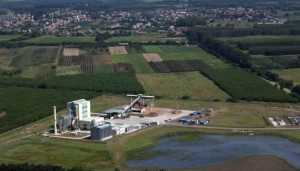
The South Nyírség region in the North-Eastern part of Hungary was traditionally an agricultural area, renowned for its tobacco and apple production. Since the transition in 1990, local agriculture has gradually lost its importance. Apple [...]

Fuel Efficient Stoves for People in Darfur
In the fall of 2005, Berkeley scientist Ashok Gadgil was asked by the U.S. Government to try to find a solution to a grave problem facing Darfuri families in displacement camps: women had to walk [...]