
CHAPTER 5
Sustainability – Concerns and Definitions
Summary
Points to remember from this chapter:
- Since the 1950s, there have been warnings about resource supply limitations to development. In the 1970s, pollution of the environmental sinks became another concern. In the 1980s, development and environment came together in the UN report Our Common Future in the term sustainable development.
- In the course of the 1990s, the ambiguity and plurality of the concept became clear in divergent emphases on nature versus culture and on efficiency versus equity. A common denominator is to have a balance between the three P’s: people, planet, profit.
- Many sustainability issues derive from the collective (public) character of resources and the interaction between resource users. This has been formalized in the notions of excludability and rivalry, and associated categories of public goods (PG) and common pool resources (CPR) (see Section 5.4).
- To implement actions to reach a goal one needs indicators. Sustainable Development Indicators (SDI) are constructed on different scales and at different aggregation levels. Some aggregate SDIs are the Human Development Index (HDI), the Genuine Savings Rate, the Index of Sustainable Economic Welfare (ISEW) and the Ecological Footprint (EF).
Quotes for Reflection
The optimist believes we live in the best of all worlds.
The pessimist fears she’s right.
Listen, O Lord of the meeting rivers,
things standing shall fall,
but the moving ever shall stay.
— Basavanna, Speaking of Shiva
The idea that humans are yet intelligent enough to serve as stewards of the Earth is among the most hubristic ever.
— Lovelock 2006:152
Readings
Related websites
Organisations
Reports and Conventions
Global Change Statistics and Sustainable Development Indicators
Other Content
Related Narratives
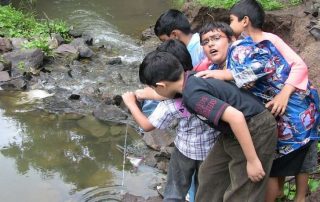
Guest post: Devnadi – the River of God
The firm house lingers, though averse to square
with the new city street it has to wear A number in.
But what about the brook
that held the house as in an elbow-crook?
I ask as one who knew the brook, its strength
and impulse, having dipped a finger length
and made it leap my knuckle, having tossed
a flower to try its currents where they crossed.
The meadow grass could be cemented down
arom growing under pavements of a town;
the apple trees be sent to hearth-stone flame.
Is water wood to serve a brook the same?
How else dispose of an immortal force
no longer needed? Staunch it at its source
with cinder loads dumped down? The brook was thrown
deep in a sewer dungeon under stone
in fetid darkness still to live and run –
and all for nothing it had ever done
except forget to go in fear perhaps.
No one would know except for ancient maps
that such a brook ran water. But I wonder
if from its being kept forever under
the thoughts may not have risen that so keep
this new-built city from both work and sleep.— Robert Frost
परोपकाराय फलन्ति वृक्षाः परोपकाराय वहन्ति नद्यः|
परोपकाराय दुहन्ति गावः परोपकारार्थमिदं शरीरम् ||
Translation: It is for the benefit of others that the trees bear fruit. Rivers flow for the benefit of others. Cows yield milk for the benefit of others. Similarly, our human body is meant to serve others.— Ancient eastern wisdom
Dev means god. Nadi is river. Literally Devnadi is the river of god.
There is no mention of the Devnadi in the records of the Pune Municipal Corporation in whose jurisdiction it flows. Nor is it mentioned in the records of the Survey of India who survey, document and map the territory.
The new smart city of Baner has grown over it. In parts the Devnadi is put deep in a sewer dungeon. In parts it is bound in cemented walls that take away its 60 meter width and fit it into 2. In parts it has been replaced by 9 or 12 storey buildings built on the debris dumped to claim the Devnadi. In parts it has lost the trees to fire furnaces or make furniture. Perhaps Robert Frost travelled time an described the Devnadi in his poem on the Brook in the City. Perhaps his poem narrates the story of every brook across the world.
In any case the Devnadi was not always like this. This is the story of the Devnadi. Perhaps the story of the people who want to save every brook in every city so that it may resemble Tennyson’s Brook, not Frost’s Brook in the City.
The Devnadi was perhaps the reason I moved into my apartment in Baner village on the outskirts of Pune, in 2008. My apartment’s balcony overlooked a 60 meter wide green with a brook within. The green was littered with construction debris left behind by the company that built and sold my apartment and those that built the neighbouring ones. Instead of seeing the dump, I saw it for what it could be – a small urban forest with a waterbody.
The garden superintendent of the Pune Municipal Corporation thought my dream was absurd. He said urban brooks are small – barely 2 meters wide and with mostly sewage flowing through. When he came over, at my insistence, he was amazed. He could see himself convert the brook into a Japanese garden, from its origin to the point it met the river Mula – a distance of approximately 5 kilometres. I talked with my neighbours in my my apartment and the neighbouring ones. The excitement grew. Some saw jogging tracks, others envisioned children parks. Few saw an urban forest. We found a common purpose of protecting the land of the brook. We began by clearing the debris. The children were excited to see mongoose, occasional snakes and rabbits. Dozens of species of birds. A year later we finally got the new garden superintendent of the Pune Municipal Corporation, who had replaced the one wanting to make a Japanese garden, to help us to plant 100 trees in the space behind my apartment.
Dr. Rajendrasingh, Magsaysay Award winner and India’s waterman, heard of our initiative. When we heard he was coming to see what we had done, enthusiasm doubled. Rajendrasingh pointed out that our little brook could actually flow throughout the year. He told us how we could build check dams to slow the water and allow it to percolate. He explained that the brook helps the earth to fill itself with water. Once full, the earth releases the excess water to allow the brook to flow.
After 2 hours every Sunday for a few weeks, our first check dam was built. The monsoon brought water and the stream flowed for more than 9 months. Rajendrasingh declared that the Devnadi was reborn. The sound of the flowing brook playing with the rocks, the kingfisher announcing its dives, the coots announcing their territory, the warblers their arguments, filled the Devnadi. Our wells were full to the brim even after the Devnadi ran out of flow. Devnadi was true to its name, the river of God.
We realised the brooks recharge our groundwater. They keep the perennial flow of the rivers that they join. They are the lifeline of rivers, groundwater and of all the biodiversity in our city. We released the brooks magically bring joy, serenity and peace.
Then one day in August 2010 JCBs, the earthmoving machines of mass destruction, turned up to move the banks, change the shape and channelise the Devnadi in cement. We convened the local residents into a body of residents, the Baner Area Sabha. The engineers of the Pune Municipal Corporation explained that the brook was a storm water drain and had to be channelised under the Jawaharlal Nehru National Urban Renewal Mission, a World Bank funded project. When dialogue and discussion failed, and we saw concrete being poured over the fresh water springs at the origin of Devnadi we decided to approach the courts.
A Public Interest Litigation was filed with the prayer to prohibit concreting or altering any urban stream in the state. Neither the Constitution of India nor any of the laws framed by the State and Federal Government protect rivers, much less a brook. The court referred the matter to the Ministry of Environment. Many Expert Committees later the Ministry’s recommendations to prohibit concrete, protect the natural course and width, free from encroachments, free from sewers, and afforest 10 meters on either side were ordered by the Mumbai High Court in April 2012.
Only if the rule of law prevailed! In June we were already back to the court highlighting contempt of the court’s orders by ignoring the directions and continuing to destroy the brooks across the State. Judging by the fact that the court is yet to rule on the contempt petitions filed in 2012, the court’s ability to rule on contempt petition seems restricted.
The Constitution of India and the Laws of the Union of India or its States has little protection for rivers. It became obvious that the mechanical process of courts in following laws would yield limited protection to the brooks that bring magic into our lives.
We realised that we need a legislation to protect our brooks and rivers. We began work to create a draft legislation for the restoration and conservation of rivers. Working with river activists, environmentalists, government officials, citizen groups across India and many workshops and drafts later, in January 2014 we had the first draft of the legislation. Rajendrasingh and I handed over copies of the draft to dozens of Members of Parliament and Chief Ministers of several states. The legislation recognises the important role of the river in the water-cycle. It has three parts: The first part requires the identification, notification and protection of rivers. The second lists permitted and prohibited activities. The third part creates a governance structure that ensures those with a skin in the protection of rivers can govern.
Almost 5 years on and dozens of workshops, meetings and campaigns later we wait for the legislative process to overtake the destruction of the brooks across India. Maybe you will enact it through your legislators to lead the way. That would be truly awesome. Devnadi would have changed the way we look at our brook. In the meantime the Devnadi waits to be freed from its concrete prison, the deep dungeons with sewers and of buildings that have been encroaching its land.
That would be the day the river of God would bring magic back into our life.
Additional references:
Sao Paulo drought: water shortage and water governance*
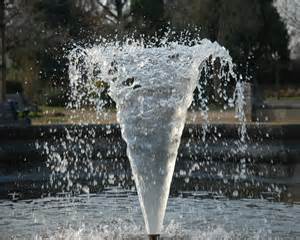 October 2014. Latin America’s biggest metropolis may, again, run out of water. For some of the 20 million residents across Sao Paulo, taps are already running dry. Dilma Pena, chief executive officer of the state-run water utility Cia. de Saneamento Basico do Estado de Sao Paulo (Sabesp), told the city council that supplies are only guaranteed until mid-November unless it can tap the last of the water in its Cantareira reservoir. This four-lake complex that supplies half of Sao Paulo has already been drained of 96 percent of its water capacity amid Brazil’s worst drought in eight decades. Meanwhile, Sao Paulo recorded heat of 36.7 degrees Celsius, the highest since 1933, and an increasing need for water is expected.
The combination of high consumption and limits on withdrawn causes serious governance conflicts. Regulators of the National Water Agency (ANA) have so far refused to allow Sabesp to use the rest as they fear mismanagement of supplies. Sabesp said it would as part of a contingency plan it delivered to ANA. ANA wanted to see Sabesp’s contingency plan to reduce withdrawals of water from Cantareira before agreeing to grant permission to tap the last of the sediment-filled pools in the center of the reservoir (the so-called “dead reserves”). To help Cantareira recover would take twice the historical average rainfall, according to Climatempo meteorologist Bianca Lobo.
There is a financial and economic aspect to the water stories around the world – and in Sao Paulo. The United Nations estimates that by 2050 more than 2 billion people in 48 countries will be short of water. The water industry generates as much as $450 billion in revenue each year, trailing only electricity and oil. According to a 2006 report to various investors, the lack of usable water worldwide has made it more valuable than oil. The Bloomberg World Water Index (BWWI) of 11 utilities returned 35%/year since 2003. The world’s biggest investors are choosing water as the commodity that may appreciate the most in the next several decades. “There is only one direction for water prices at the moment, and that’s up,” said Hans Peter Portner, who manages a $2.9 billion Water Fund. Water is becoming big, and profitable, business.
But can and should water be supplied by private commercial companies? Historically, most water supplies are owned by governments and the cost of water is usually set by government agencies and local regulators. But there is a growing need for capital: investment in water infrastructure (supply, transport, distribution, purification) in developing countries such as China and India will require an estimated 180 billion $/year, double the amount that’s being spent now (http://www.worldwatercouncil.org). Who else can provide it but the international capital markets? Water thus becomes linked to the global financial system, which indebts countries in order to arrange the loans for the multinational corporations – such as General Electric and Veolia – who will make the investments. The proponents argue that only in this way water systems will get the capital and technology that is needed and be disciplined by the market. Sabesp, Latin America’s biggest publicly traded water utility, feels this logic already, as its stock value has plunged 26% this year according to the BWWI. The opponents think it utterly undesirable that the provision of water, a basic commodity and common pool resource, comes in the hands of profit-oriented business. They see water as a basic right (see e.g. Jean Robert, Water is a commons. Habitat International Coalition 1994; www.hic-al.org).
Everything is linked to everything else… On the source side, there is some evidence that the erratic water supply is at least partly caused by Amazonian deforestation. On the use side, the water scarcity has serious consequences for electricity generation, as Brazil gets its electricity for three-quarters from hydropower. On the sink side, the low water levels aggravate the impact of pollutants, as has already been experiences in the Californian drought.
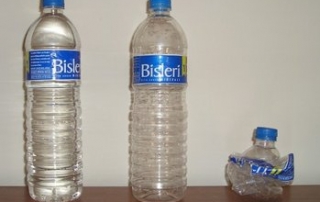
Water as a commodity: ban on bottled water in Australian town*
The market has discovered scarcity as something to be desired. The Stock Fund Utilities department of the dutch bank ING announced in 2007:”…prospects remain good. In the states of California and New York energy shortages threaten and it drives the price up.” Similar advertisement are seen for water. Drinking water used to be a service ‘freely’ offered by nature. With growing populations and hygiene standards, it is in combination with growing agricultural water demand rapidly becoming a scarce commodity in many places – or at least, that is a widespread perception. A process of ‘commodification’ has started. Every scarcity offers an opportunity for value added: profit and employment – and its exploitation tends therefore to be supported by business people and politicians.
In the first decade of the 21st century, an estimated 200 billion water bottles are annually consumed and bottled water has become worldwide a 60-billion dollar industry. Total bottled water consumption amounted to some 35 billion liters, largely in high-income regions. In 2007 a USA citizen drank on average 125 liter of bottled water per year, up from 7 liter per year in 1976. Massive marketing efforts have led to this change. Selling one liter of water at a price many times the production cost (and many times the price of the equivalent from the public water system) is undoubtedly a marketing success. The bottled water market is expanding at the expense of the sodadrinks, as these are increasingly seen as a cause of obesity. “drinking water instead of three sugary drinks per week for a year will spare you seven pounds of fat.” says one of the Nestlé ads. In essence, it is a costly way of going ‘back to the 1950s’.
The industry worries that increased activism on the alleged environmental impact of bottled water can affect sales negatively. The billions of mostly plastic bottles, also from soft drinks, are now causing waste problems from local to global scale. This is pushed aside by the International Bottled Water Association (IBWA): “…there’s little if any measurable evidence that activists have had an impact upon bottled water sales. Bottled water is well-established and popular with consumers who rely on its convenience, healthfulness and refreshing taste…
But not everyone is getting in line. In Bungadoo, a 2000-inhabitant town 120 km south of Sydney, the community council decided to put a ban on plastic bottled water. The decision was taken in response to a project of a large company to pump water in Bungadoo and then bottle and sell it. Permission for the project has been refused, but the decision is reconsidered in the Land and Environment Court. “We are a small community in favour of environmental sustainability” says a local shopkeeper. ‘Bundy on tap’ has become the slogan, now that the community council has decided to install tapwater systems. Australians pay more than 2 A$/liter for bottled water, whereas tapwater is almost free. The industry fights the idea with the arguments of unemployment and obesity…
Oil and Power*
Natural resources such as metal ores, coal and oil have been throughout history at the centre of power struggles and ideologies. The history of oil has been described by Yergin in his excellent book The Prize (1991). “The rapid rise of Russian production, the towering position of Standard Oil, the struggle for established and new markets at a time of increasing supplies – all were factors in what became known as the Oil Wars. In the 1890s, there was a continuing struggle involving four rivals – Standard, the Rothschilds, the Nobels, and the other Russian producers. At one moment they would be battling fiercely for markets, cutting prices, trying to undersell one another; at the next they would be courting each other, trying to make an arrangement to apportion the world’s markets among themselves; at still the next, they would be exploring mergers and acquisitions. On many occasions they would be doing al three at the same time, in an atmosphere of great suspicion and mistrust…” (Yergin 1991:71). This was in 1892-93. Since the early 20th century, oil exploitation, processing and marketing has become ever more global, deeply intertwined with imperial power and wars and increasingly an affair of corporations as well as governments – with massive geopolitical implications. The most recent manifestation has been the impact of the Russian-Ukrainian was on European energy markets.
Let us look at one story in a bit more detail. In march 2001, US oil majors were the leading foreign investors in Kazakhstan’s hydrocarbon riches. Six months before ’9/11‘, US ambassador to Kazakhstan Jones said the United States wanted ”Kazakhstan to develop its energy resources… and have better access to world (oil) markets.” “…a stable central Asia – and Kazakhstan in particular – would allow stable exports of Caspian oil to international markets… the US government backed the export pipeline from Kazakhstan to Russia’s Black Sea port of Novorossirsk… Washington also supported two other planned pipelines, which will eventually link the Caspian region… on the Mediterranean. But… Washington would continue to oppose plans to export Caspian oil to neighbouring Iran, which it accuses of sponsoring international terrorism… the US Congress was likely to extend sanctions against Iran after they expire in August.“
Summer 2010. It has long been known that Afghanistan had significant deposits of gemstones, copper and other minerals, but United States officials say they have discovered and documented major, previously unknown deposits, including copper, iron, gold and industrial metals like lithium. A Pentagon team, working with geologists and other experts, has shared its data with the Afghan government. It is working with the Afghan Ministry of Mines to prepare information for potential investors. On Thursday, Afghan officials said they believed that the American estimates of the value of the mineral deposits — nearly $1 trillion — were too conservative. They could be worth as much as $3 trillion. The Ministry of Mines also announced that it would take the first steps toward opening the country’s reserves to international investors. Two hundred investors from around the world have been invited to offer suggestions for how to develop the iron ore deposits at the Hajigak area of Bamian Province, according to the principal mining specialist for Afghanistan for the World Bank.
Literature Maddow, R. (2019). Blowout – Corrupted Democracy, Rogue State Russia, and the Richest, Most Destructive Industry on Earth. Penguin Random House. Yergin, D. (1991). Prize – The epic quest for oil, money and power. Simon & Schutsre, London
Mining in Papua New Guinea
Papua New Guinea is one of the world’s largest island. Called the ‘Last Great Place’, it is home to hundreds of unique species of animals and plants as well as to upward of 820 languages. The Porgera gold mine is situated in the highlands. It produced around 18 tons of gold per year and over $1 billion of profits in 2006, according to Barrick Gold, a Canadian corporation that assumed a majority share of the mine. Barrick operates 26 mines worldwide and boasts of having the industry’s largest reserves.
Porgera, New Guinea’s biggest gold mine, accounts for 72 percent of the country’s export earnings. It utilizes the most advanced extraction technologies and helicopters fly people and gold in and out on a daily basis. Its extraction process creates cyanide-laced waste-water that the company discharges directly into the local river system. One millionth of a gram of cyanide in a liter of water is enough to kill the fish. Because Porgera is literally at the top of the country, the streams into which the toxins are dumped flow into many other tributaries before they reach the sea. After 14 years, the mine waste has slowly torn the hills from under the local inhabitants and turned the small valley below into a choked river of dirt creeping toward the Gulf of Papua two hundred miles away. The large rainforests and its inhabitants are also under threat: it is estimated that half of the forests has disappeared by 2020 if present deforestation rates continue. The causes of deforestation are exploitation for timber and clearing by small farmers.
In the Indonesian part of New Guinea, the province Irian Jaya, the American mining company Freeport exploits since the 1970s some of the world’s largest reserves of copper and gold. Here, too, huge profits are made while ecosystems are destroyed. Massive deforestation for infrastructure took place. Almost all processed material is released and fills up several square kilometers at the mouth of the nearby river. These mines are part of what the United Nations Industrial Development Organizations (UNIDO) calls a ‘gold rush in the Third World’ that began in the 1980s and spread to Tanzania, Surinam and many other countries. Mining for gold is one of the world’s most grotesque industries, consuming vast resources and producing mountains of waste to produce a small amount of soft, pliable metal with few practical uses. To make one gold wedding band, at least 20 tons of earth must be excavated..
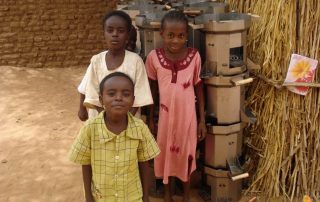
Fuel Efficient Stoves for People in Darfur
In the fall of 2005, Berkeley scientist Ashok Gadgil was asked by the U.S. Government to try to find a solution to a grave problem facing Darfuri families in displacement camps: women had to walk as long as seven hours, three to five times per week to find firewood. In response, he and his colleagues and the women of Darfur designed the Berkeley-Darfur Stove (BDS) V14. The project is a good example of sustainable livelihood improvement, as it solved several problems simultaneously. Because the BDS uses half as much firewood as traditional cooking methods, it limits harmful emissions that contribute to global warming. Users save $300 per year in fuel costs. Over the five-year life span of the stove, this savings is approximately $1,500. Reduced excursions for firewood collection translate into rest and relief for the exhausted women in the displacement camps and time that could be spent with family or on income generating activities. As to safety, the stove reduces the need for women to leave the camps in search of firewood and it thereby reduces their exposure to sexual assault and violence. It also contributes to health because it limits toxic pollutants released that cause respiratory diseases such as pneumonia.
The BDS was developed by scientists and engineers at the Lawrence Berkeley National Lab, with evaluation and feedback from women in Darfur. They brought together the world’s best minds in engineering to develop a simple, locally appropriate technology and to provide ongoing technical support to the field partners. The BDS is well-adapted to the local situation. It is specifically tailored to the windy climate, the sandy terrain, the pot sizes and the cooking style of families living in the displacement camps in Darfur. The local participation of the women in Darfurprovided feedback at every step of the process, ensuring the stove design fits their needs. The local employment and low cost due to its manufacturing process are also beneficial. The BDS starts out as sheet metal pieces stamped out in India. These ‘flat-kits’ are shipped to Sudan where they are assembled by the Sustainable Action Group, a Sudanese NGO affiliated with the project partner Oxfam America. The total cost to fabricate, ship and assemble each stove is $20.
The Darfur Stoves Project and its partners produced over 15,000 stoves by the end of 2010. Each year they are in the field, these 15,000 stoves save Darfuri women as much as $2 million in fuel expenses and offset more than 20,000 tons of greenhouse gases, which is equivalent to taking > 4,000 average-sized cars off the road in the United States. An estimated 300,000 families are in need of a fuel-efficient stove and the goal is to distribute a BDS to each family. This project teaches at least two lessons for a project to succeed: you have to ‘walk with the people’, and there are always winners and losers and you have to identify them. (Photo courtesy Ashok Gadgil).