
About
The Worldview Monitor is an online survey for eliciting one’s worldview based on a set of questions.
Background
The solution to the sustainability issue lies only to a limited extent in the use of new technologies. At least as important are the values that people hold. Together, these values form the view of man and the world, from which we look not only at human and social values and objectives, but also at problems and solutions. The limited progress in the sustainability debate can largely be explained by differences in worldviews.
The purpose of this Monitor is to map out one’s own view of man and the world, and thus that of others, literally and figuratively. Only when it becomes clear from which different directions one looks at objectives, problems and solutions, can the sustainability problem be tackled in a more substantial way. The Monitor consists of 3 prioritization exercises of 18 values, 18 problems and 18 solutions in the pages below.
The method used here is primarily based on values research as conducted by Schwartz, Rokeach, and TNS/NIPO/RIVM by means of social surveys. Secondly, the results of the survey have been translated into a view of man and the world as expressed in the philosophy, culture and history of many centuries. On the basis of philosophical and historical considerations and socio-cultural surveys, two axes have been postulated to this end:
- Individual – collective: this dimension reflects (the tension between) the needs and experiences of the individual on the one hand and the structures and demands of the collective on the other; and
- Material – immaterial: this dimension represents (the tension between) the material and physical on the one hand and immaterial and spiritual on the other.
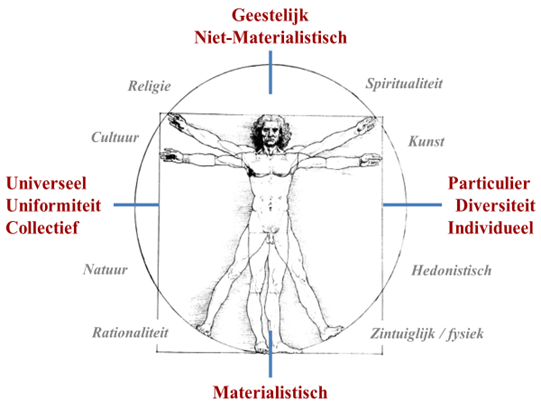
Together, these two axes span a space with four quadrants, which can be named on the basis of the pairs of subjectivism-objectivism and materialism-idealism, following the example of the German philosopher Hegel.
The hypothesis is that people develop by participating in the economic, social and cultural life from the bodily-subjective point of view (left side: A1-B1) and developing themselves emotionally, mentally and spiritually (right side: A2-B2). The ‘identity’ thus acquired can be questioned on the basis of the predominant values and ideas. That is what happens in this survey with regard to values and (social) problems and possible solutions.
Since the four worldviews in the quadrants can be characterized by certain values and ideas (beliefs, beliefs, beliefs), the result of such a survey can be displayed in the ‘worldview space’ of the figure below.
Learn More
- N D van Egmond (2019). Homo Universalis: moral compass for a new European renaissance; de Geus – Amsterdam.
- B J M de Vries (2013). Sustainability Science. Cambridge University Press.
- www.sustainabilityscience.eu
- www.klaasvanegmond.nl